Memes About Cats and Dogs That We Think You’ll Love

Nothing makes me quite as content as seeing adorable dogs and cats having a good time and causing trouble.

It just warms my heart, what can I say?!?!

I have a feeling you’re in the same boat as me, because here we are!

No more delaying! Here are THE MEMES!

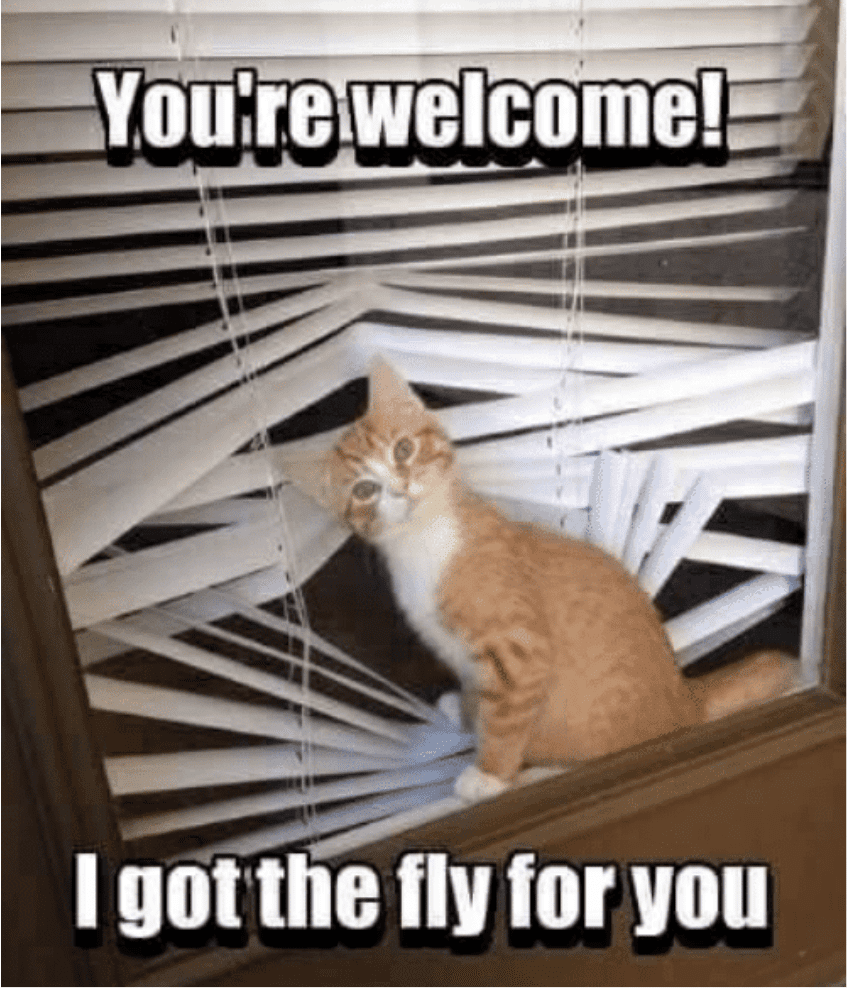
1. Little helper.

Photo Credit: someecards

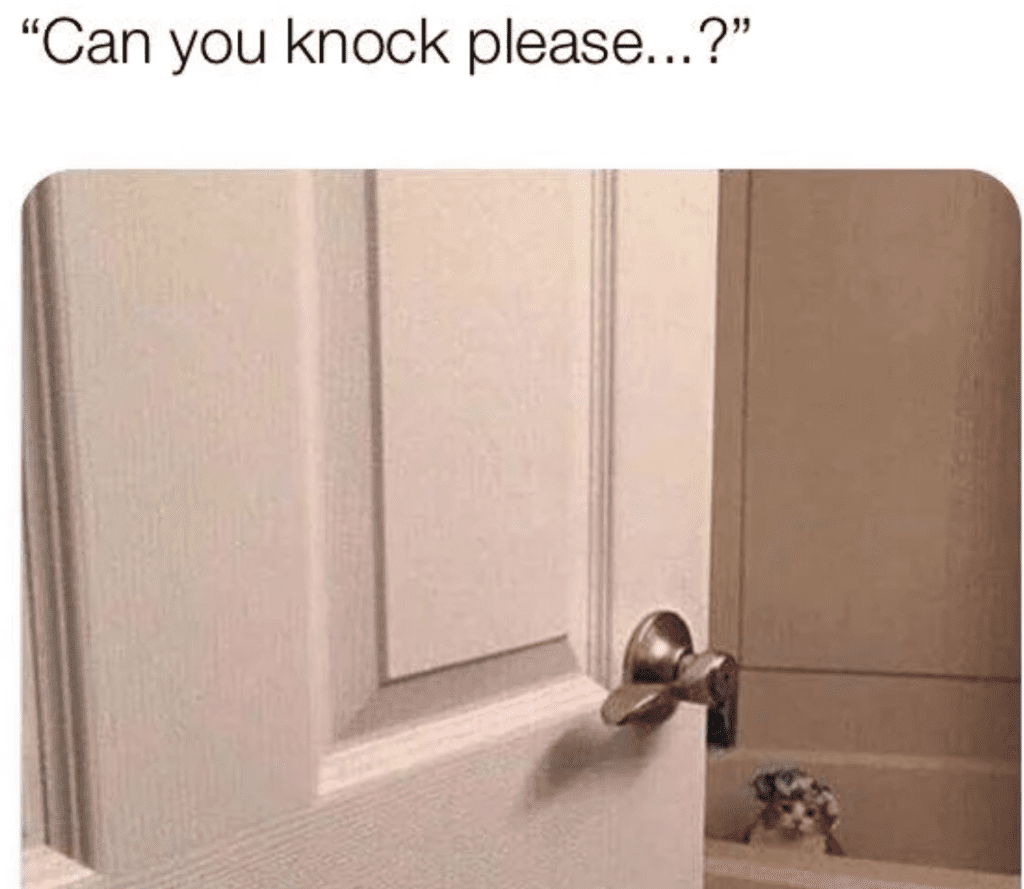
2. Big shot.

Photo Credit: someecards

3. That’s not how the game works.

Photo Credit: someecards

4. I already have my child.

Photo Credit: someecards

5. I’m busy in here!

Photo Credit: someecards

6. An interesting turn of events.

Photo Credit: someecards

7. I’d like to know the answer to this, too.

8. Not bored anymore.

9. Why can’t you do more of this?

10. Awwww. Look at that.

Photo Credit: someecards

11. My spirit animal.

Photo Credit: someecards

Oh, you darn doggos and kitties out there!

They’re always up to something!

Hey, we want to hear from you in the comments.

Share a pic of your dog, cat, hamster, snake, ferret, etc. in the comments and introduce us to them!

The post Memes About Cats and Dogs That We Think You’ll Love appeared first on UberFacts.

If Certain Noises Make You Mad, You’re Not Alone and You’re Not Crazy

If you’re anything like me, there are certain noises and sounds that drive you absolutely bonkers. And not like, they annoy you. Like, they cause a full-blown rage spiral, and if the person making them is living in your house, they’d better look out.

For me these sounds include, but are not limited to, chewing, eating ice, smacking candy, cars without mufflers.

If you have sounds that make you rage (there are plenty of us!), you might have a brain hardwired to produce an excessive emotional response to particular noises.

The condition is called misophonia, and it’s more than just being annoyed, like I said – those “trigger” sounds can create so much instant stress that it can activate a person’s fight or flight response.

For the first time, researchers have conducted brain scans on people who suffer from misophonia and found that their brains have physical differences from “average” brains.

During the study, scientists played a range of sounds – some neutral, some pleasant, some unpleasant, and then a person’s trigger sound – and found that the region of the brain that links our senses with our emotions was sent into overdrive when the subject heard those “trigger” sounds. They responses ranged from annoyance, to hatred, feelings of being threatened, panic, and extreme stress.

One of the subjects, Olana Tansley, spoke with BBC News.

“I feel there’s a treat and get the urge to lash out – it’s the fight or flight response.

It’s not a general annoyance, it’s an immediate ‘Oh myGod, what is that sound?’ I need to get away from it or stop it.”

Like I said, if you’re someone I know well enough to scream at and you’re making that noise, watch out.

View this post on Instagram

Sometimes your #misophonia is beyond you? ? Are you totally losing control? ? Is the anger filling your body? ? Know that I am preparing a free training that will give you lots of advice to manage and take control of your #misophonia! ?? (you will even have access to some exclusive practical exercises!) I hope to help a maximum of #misophone with this gift. ?? Personalized support will also soon be available with online training and coaching sessions by video conference. ? We have been collecting all the information available on misophonia, in English and French, from the four corners of the world for several months now! ?? Tell me in the comments if you would like to be notified of the release of our free training! ???✍✍✍ —– Parfois, votre #misophonie vous dépasse? ? Vous perdez totalement le contrôle? ? La colère emplit-elle votre corps? ? Sachez que je prépare une formation gratuite qui vous donnera de nombreux conseils pour gérer et prendre le contrôle de votre #misophonie! ?? (vous aurez même accès à des exercices pratiques exclusifs!) J'espère aider un maximum de #misophone avec ce cadeau. ?? Un support personnalisé sera également prochainement disponible avec des sessions de formation et de coaching en ligne par vidéoconférence. ? Nous collectons depuis plusieurs mois toutes les informations disponibles sur la misophonie, en anglais et en français, aux quatre coins du monde! ?? Dites-moi dans les commentaires si vous souhaitez être informé de la sortie de notre formation gratuite! ???✍✍✍ #misophoniaawareness #misophoniaproblems #misophoniasupport #misophonie #misophone #misophonietherapie #misophonieparadise #misophoniesolution #misophonia

A post shared by Ben Feel (@benfeel.misophone) on

Other subjects said that they feel shame and embarrassment after an intense reaction, even though they can’t control it, and to that I say, bah. Stop it.

Explains Dr. Sukhbinder Kumar, who co-authored the study,

“They are going into overdrive when they hear these sounds, but the activity was specific to the trigger sounds not the other two sounds.

The reaction is anger mostly, it’s not disgust, the dominating emotion is the anger – it looks like a normal response, but then it is going into overdrive.”

Those of us who live with the condition have figured out ways around the response, like leaving the room, using earplugs, or threatening murder, but the study doesn’t leave scientists with any real ideas on how to treat it.

Fingers crossed for marriages everywhere that’s the next step!

The post If Certain Noises Make You Mad, You’re Not Alone and You’re Not Crazy appeared first on UberFacts.

Why Haven’t Americans Embraced Bidets Yet?

There are some questions that never seem to really crop up until something (like a crisis of toilet paper) forces them to rise to the top of the public consciousness.

One of those, at least for me, was why haven’t Americans really embraced the idea of the bidet? I mean. Everyone likes to feel clean and fresh down there. Wiping involves a certain amount of risk to your hands. You have to continuously buy toilet paper, and half the time a child or a dog unrolls it down the hallway.

I mean, really? A bidet, which washes your booty for you without you needing to use your hands, is a pretty genius invention…so why haven’t Americans been installing them in their homes for all of these years?

Is it because we think they’re too fancy? Too French? We don’t really know how to pronounce it? We didn’t think of it first? Let’s take a look!

You probably know that in other places in the world, it’s difficult to find a bathroom that doesn’t contain a bidet. Asia, Europe, and South America all embraced the technology decades ago and haven’t looked back.

The very first bidet was said to have been constructed in the early 1700s in France. It gets its name from the French word for a “cob horse,” which should bring to mind how you’re supposed to “ride” the contraption (for lack of a better word; I’m sure the French have one).

One of the earliest models was installed in the room of a French royal soon after its inception, and soon began to spread not only through France, but through Europe and beyond, too. Bidets are estimated to proliferate in around 80% of the bathrooms in France, Italy, Portugal, Argentina, Venezuela, many Middle Eastern countries and throughout East Asia.

In 2007, NYU professor Harvey Molotch wrote a piece for the New York Times, in which he mused on why Americans never caught the wave. One theory was (aha!) because it was French, and therefore snubbed by the English, and Americans followed suit. Another is that many Americans first glimpsed bidets during the World Wars, often in brothers, and somehow connected them in their minds.

Americans, as we know, love nothing more than wrinkling our noses at immortality that we’re definitely participating in behind closed doors.

His third thought was that U.S. bathrooms were historically often small and built to contain only the necessities – but that, of course, has changed in the last decade or two.

Interestingly, one of the most successful bidet models in the world was invented in the 1960s by an American, Arnold Cohen. When he began marketing it at home, though, 99% of customers had never seen or even heard of a bidet, and he ended up having much bigger success abroad, especially in Japan.

View this post on Instagram

Toilet paper shortage? No problem! Wash your butt with a bidet ? . Using a bidet is more hygienic alternative than using toilet paper, and much cleaner! Also, it is softer on your skin. . On top of this, you will save tons of paper being tossed away. Remember that the production of toilet paper includes cutting down trees, adding toxic chemicals to make it white and soft, plastic packaging and transportation emissions. . Instead, why not try the bidet? There are different types available, choose the one that suits you best ? . Of course, this still creates water consumption, so it’s important to be mindful. . If you want to stick with toilet paper, make sure you choose recycled toilet paper, and if possible with no plastic packaging to save on waste. . For more saving tips in the bathroom, have a look at the smart toilet option, where you can reuse the water from the sink to flush! . For more ideas on how to be more eco-friendly, visit our profile and find hundreds of easy eco tips @easyecotips ? . . . #easyecotips #recycled #tips #ecofriendly #ecotips #greentips #ecology #savetheplanet #zerowaste #zerowasteliving #zerowastelifestyle #zerowastelife #greenliving #sustainableliving #climatechange #globalwarming #reuse #reducereuserecycle #zerowastetips #savetheplanet #biodegradable #organic #bidet #toiletpaper #toiletpapershortage #toilet #bathroom #bathroomdesign #savewater
A post shared by Easy Eco Tips (@easyecotips) on

While bidet proponents cite cleanliness comfort, and environmental sustainability as reasons to jump on the bandwagon, we all know what Americans are like when they dig in their heels on a thing.

That said, companies like Kohler are looking to invest in ideas that incorporate appliances that clean your under-bits into existing toilet designs, hoping to tempt high-end buyers and people who spend way too much money remodeling their bathrooms.

So you know, in fifty years or so, the rest of us schleps might be able to afford one.

Until then, good luck finding toilet paper. May the odds be ever in your favor.

The post Why Haven’t Americans Embraced Bidets Yet? appeared first on UberFacts.

Scientists Discovered a Key Relationship Between Brain Wiring and Autism

Scientists have gotten one step closer to figuring out how autism spectrum disorder relates to the brain’s information paths. And after conducting studies on both mouse and human brains, this new information could go a long way in discovering how the disorder operates.

According to a report in Nature Neuroscience, researchers found that an abnormality in cells produces a substance called myelin. This substance is critical in providing insulation in brain wiring, but a shortage or excess of myelin can result in a variety of neurological problems.

According to Brady Maher, a lead investigator at the Lieber Institute for Brain Development, “Myelination could be a problem that ties all of these autism spectrum disorders together.”

Photo Credit: Pixabay

The associate professor from Johns Hopkins School of Medicine added that we may be able to change the developmental trajectory for children if we treat it soon enough.

Though autism research is still ongoing, this new discovery could also help explain the brain size discrepancy for people with autism spectrum disorders. Ironically, the myelination revelation happened on accident.

While studying brain cells in mice with a specific gene mutation, Maher said, “We saw a signature that suggested there might be something wrong with myelination. So that was pretty surprising to us.”

Photo Credit: Pixabay

Biostatistics expert Andrew Jaffe assisted by looking at a genetic analysis of brain tissue from people with autism who had passed away. Interestingly, the myelination problem reared its ugly head in those cases, too. However, scientists maintain that the only way to get a full grasp of the problem is to study developing brain tissue.

This obviously poses a challenge, but it is possible through the use of brain organoids—human brain cells that can be grown in a petri dish.

If scientists can continue forging forward and learn more about autism spectrum disorder, there is the possibility that the myelination problem could be corrected in children earlier in life.

The post Scientists Discovered a Key Relationship Between Brain Wiring and Autism appeared first on UberFacts.

DNA Was Found In A 75-Million-Year-Old Baby Duck Bill That Had Been Preserved

In a case of Hollywood predicting the future, it appears the theory behind Jurassic Park might be possible.

At least, that’s the case according to a new paper published in National Science Review. The scientists who wrote it suggest that DNA may actually be able to persist for dozens of millions of years – a finding that’s sure to spark as much debate as excitement in the scientific community. If it’s true, new avenues for studying the biology of prehistoric organisms could surely be available (though no one is saying we could or should resurrect dinosaurs anytime soon).

The claims made in the paper are definitely controversial; previous research indicated that DNA only remains stable for around a million years. The discovery of DNA inside a 75-million-year-old baby duck-billed dinosaur called a Hypacrosaurus, though, could upend everything we previously “knew” about ancient DNA.

The specimen, housed at the Museum of the Rockies, revealed some remarkably preserved cells within a section of fossilized cartilage tissue during a routine examination. Researchers isolated the cells, the applied two DNA strains, which bind to fragments of DNA and highlight areas where genetic materials are present.

In the Hypacrosaurus tissue, both of the DNA strains interacted in a pattern consistent with modern cells. That indicates that at least some of the dinosaur’s DNA was preserved, says study author Alida Bailleul,

“I couldn’t believe it, my heart almost stopped beating.

These new exciting results add to the growing evidence that cells and some of their biomolecules can persist in deep-time.

They suggest DNA can preserve for tens of millions of years.”

View this post on Instagram

#NetMassimo #paleontology #dinosaurs #hadrosaurs #fossils #Cretaceous #Hypacrosaurus #HypacrosaurusStebingeri An article published in the journal "National Science Review" reports evidence of the identification of proteins, chromosomes and DNA markers in the fossil cartilage of a Hypacrosaurus stebingeri nestling, a dinosaur belonging to the hadrosaur family dating back to around 75 million years ago, in the Cretaceous period. A team of researchers led by Alida Bailleul of the Institute of Vertebrate Paleontology and Paleoanthropology, China, used chemicals that bind to DNA in living cells on fossil bone fragments resulting in a fluorescence indicating that they bonded to the original molecules and not to external contaminants. Read the details at https://english.netmassimo.com/2020/03/04/traces-of-dna-found-in-the-fossil-of-a-duck-billed-dinosaur

A post shared by Massimo Luciani (@netmassimo) on


Of course, only certain conditions will lend themselves to preserving DNA for longer periods of time.

The bones in this particular sample had all become disconnected from each other, suggesting that the organism didn’t end up buried until after it had started to decompose – a set of circumstances the researchers say probably led to the DNA’s preservation.

The report also posits that ancient genetic material is only expected to be found in well-preserved cartilage cells, not bones. Cartilage is less porous than bone, so it lets in less water  and microbes that break down material.

View this post on Instagram

Paleo News #135 • Evidence of possible proteins, chromossomes and DNA markers on cartilage cells (condrocytes) from Hypacrosaurus, a #Dinosaur from the #Cretaceous were described !! What is even more amazing is these "cells" were positively marked for DNA using DAPI!? What a discovery! Quoting from the abstract: "A histological ground-section from a duck-billed dinosaur nestling (Hypacrosaurus stebingeri) revealed microstructures morphologically consistent with nuclei and chromosomes in cells within calcified cartilage. We hypothesized that this exceptional cellular preservation extended to the molecular level and had molecular features in common with extant avian cartilage. Histochemical and immunological evidence supports in situ preservation of extracellular matrix components found in extant cartilage, including glycosaminoglycans and collagen type II. Furthermore, isolated Hypacrosaurus chondrocytes react positively with two DNA intercalating stains. Specific DNA staining is only observed inside the isolated cells, suggesting endogenous nuclear material survived fossilization. Our data support the hypothesis that calcified cartilage is preserved at the molecular level in this Mesozoic material, and suggest that remnants of once-living chondrocytes, including their DNA, may preserve for millions of years." #paleontology #paleonews #science #evolution #dna #fossils #jurassicpark #dapi #mesozoic #dinosaurs #duckbills #hadrosaurs #hypacrosaurus

A post shared by Glimpses of Prehistory (@glimpses_of_prehistory) on

Among the arguments sure to follow is a new, continued discussion about how long genetic material can actual persist, and what sort of conditions would make searching for it worth people’s time.

We’ll just have to sit back, wait, and see how long it takes for someone (looking at you John Hammond) to do something stupid with it.

Because you know it will happen eventually.

We’re humans. We can’t help it.

The post DNA Was Found In A 75-Million-Year-Old Baby Duck Bill That Had Been Preserved appeared first on UberFacts.

Forget About Following These 4 Grammar “Rules”

I love language and proper grammas as much as the next person, but here the thing – it’s always changing.

What was right and proper when you were taught, or the last time you checked, might have been updated in this brave new world of ours (double-spacing after a period and the Oxford comma are two great examples!), so it never hurts to double check.

Image Credit: Pixabay

Here are 4 more “rules” that it’s now more than acceptable for you to go ahead and break.

4. They is a singular pronoun.

Officially, ‘they’ is a plural pronoun and must have a plural antecedent, but here’s the rub: if you don’t know whether your subject identifies as a he or she, what should you do instead?

While a generic ‘he’ would have been chosen in the 19th century, and later the cumbersome ‘he or she’ was favored, the fact is that ‘they’ is just easier (and more politically correct).

Authors as far back as Shakespeare and Jane Austen have used ‘they’ in conjunction with singular antecedents, and really, no one even notices because it just sounds right. So go ahead and join them.

3. Go ahead and split those infinitives.

The rule says that nothing should go between the word “to” and its verb – you shouldn’t say “to boldly go,” for example – but there’s no real reason why it was ever frowned upon.

In fact, famous authors have been eschewing this rule for centuries and honestly, we’re all okay.

2. Start your sentences with “hopefully…”

Hopefully is supposed to be used to mean “in a hopeful manner, so saying something like “Hopefully, the bus will be here soon” doesn’t work, because buses can’t do things in a hopeful manner. The correct wording is “It is hoped that the bus will get here soon.

The thing is, there are plenty of other adverbs that can modify entire sentences without causing a stir (Unbelievably, sadly, clearly), so what’s the deal?

People still quibble about it, but the AP stylebook threw in the towel on this one awhile back.

1. Put prepositions at the ends of your sentences.

This one will drive my mother batty, but listen – sometimes there’s no way to move your preposition to the middle of the sentence without sounding totally stilted and pretentious.

The “rule” originally cropped up in the 17th century when people were still trying to copy the linguistic “purity” of Latin. English and Latin are more dissimilar than they are alike, though, and while the rule had purpose in Latin, in English it’s completely arbitrary.

I, for one, feel liberated.

I’m never giving up the Oxford comma, though, and if you’d like I can email you my PowerPoint presentation that explains why.

The post Forget About Following These 4 Grammar “Rules” appeared first on UberFacts.

This Is How Airplanes Are Cleaned

As someone who has a peanut allergy, I can tell you one thing for sure – your plane doesn’t get cleaned at all during the day, between flights. I know this because, regardless of how close I came to peanuts on my own flight, I would inevitably turn into a red, sneezing, coughing, sniffling mess within 10 minutes of boarding.

Sometimes as soon as they opened the jetway and the air hit me in the face.

Really.

But amid the worldwide concerns about COVID-19, how we’re going to ensure everyone’s health and safety, and how we can hang onto some semblance of normalcy in the world gone mad, everyone you’ve ever given your email address to is informing you how they’re going to be cleaning their shizz the way they should have been all along.

How and when do they clean airplanes, though? Who does it, and how often? Is it safe to travel? If you’re curious, we’ve got answers to those questions (and maybe more!) below.

First off, infectious disease expert Sanjaya Senanayake says that,

“The risk of getting a communicable disease on a plane is quite low … not zero, but very low.

The reason it is so hard to get infected by a sick passenger on a plane has to mostly do with the plane’s circulation system and advanced filters in many parts of the world and they are good enough to filter virus.”

In addition to these built-in features, most companies use a special anti-microbial spray that they apply to walls, seats, television screens, arm rests, and tray tables once a plane is done for the night.


According to Sarah Adam, General Manager of Product and Customer Experience for Virgin Australia, says the product they use also protects against many viruses.

“The product is called DuroPax.

The beauty of the product, is it allows us to protect our guests and customers from many strains of viruses including influenza.

It is environmentally safe and non-toxic so everyone can rest assured when they jump on board they are safe.”

The product has been tested, with germ readings before and after applications, and the results are more than acceptable – cleaner than your cell phone would be right now if someone swabbed it, probably.

That said, the cleaning procedures are only applied at the end of each day, so if you’re flying anything other that the first flight of the day, you’ll want to take your own extra precautions – wash your hands with soap and water, use hand sanitizer between washings, take Clorox wipes to wipe down your own tray table, television, arm rests, et al.

I know personally what a pain this can be, but take it from someone who could have died immediately from touching or inhaling peanut dust left behind – you’re far better off being safe than sorry.

Even if it does cramp your devil-may-care style, just for a while.

The post This Is How Airplanes Are Cleaned appeared first on UberFacts.

The Very Tiny Cat Museum in Poland is a Must See

Just to be clear, we’re talking about a very tiny museum, not a regular museum full of tiny (not real) cats.

Which is just as awesome as any other way you slice this thing, guys, and some of the cats are smol and stuff.

Check this out!

There are, of course, plenty of museums around the world that celebrate our collective lover for cats, but the Cat Museum in Krakow, Poland, has to be one of (if not the) the smallest.

There are around 1000 cat collectables in around 161-square-feet of space, which include figurines, cat-shaped soap dispensers, snow globes, and pretty much anything else cat-shaped or cat-inspired that you can think of…and I know you can think of a lot, y’all.

Like, what in the world could not be made better by also being an homage to cats?

The museum is owned and operated by a Ukrainian couple, and even though the museum opened in 2019, they’ve been amassing their collection for over a decade.

Check out this story about the best place ON EARTH!

It all began 15 years ago, when co-owner Nataliya Koshivaya received a cat figurine as a gift from a friend. She and her husband never stopped collecting cat-shaped and related merchandise from around the world.

More gifts were received, as well, and finally they knew they had to share their treasure trove with the world.

You definitely want to visit, if only because Nataliya says her gray cat Geisha is the “real owner” of the museum, and can be found prowling her domain any hour of the day or night.

And if you want to love these people more, consider this: they’re planning to open a second location with more room to house homeless cats looking for families (real ones).

I know where I’m headed the next time I find myself in Poland. How could you miss this?

The post The Very Tiny Cat Museum in Poland is a Must See appeared first on UberFacts.

A Homeless Woman Talks About Why You Shouldn’t Donate to the Salvation ARMY

Many people don’t spend a whole lot of time thinking about the people who ring the bells and ask for spare change around the holidays, or the people we call to haul away our unwanted clothes and other items after we’ve Marie Kondo-ed our lives.

View this post on Instagram

This Christmas season the Salvation Army has been under attack for its supposed mistreatment of those of the LGBTQ+ community. But it's time to set a few facts straight. The Salvation Army NEVER turns away an individual who needs help. This would be against their belief in their calling to love their neighbor, as it should be for all Christians. What the Salvation Army does do is uphold certain rules they have always had for the safety of the most vulnerable among us. Primarily, they have separate sleeping quarters for people with male genitalia and female genitalia. This is not discrimination, this is protection. There is simply no way of knowing the intentions of those requesting exceptions. The individual who died on the street outside of one of their centers did not die because he was denied shelter, but because he denied the shelter offered him. Let us pray for our brothers and sisters who are working so hard this winter season to care for those in need, and may we be the first in line to support them. #thesalvationarmy #salvationarmy #salvationarmyusa #salvationarmyus #salvationarmybellringer #salvationarmybellringers #salvationarmyfamilyservices

A post shared by Resurrection Free Lutheran (@resurrectionflc) on

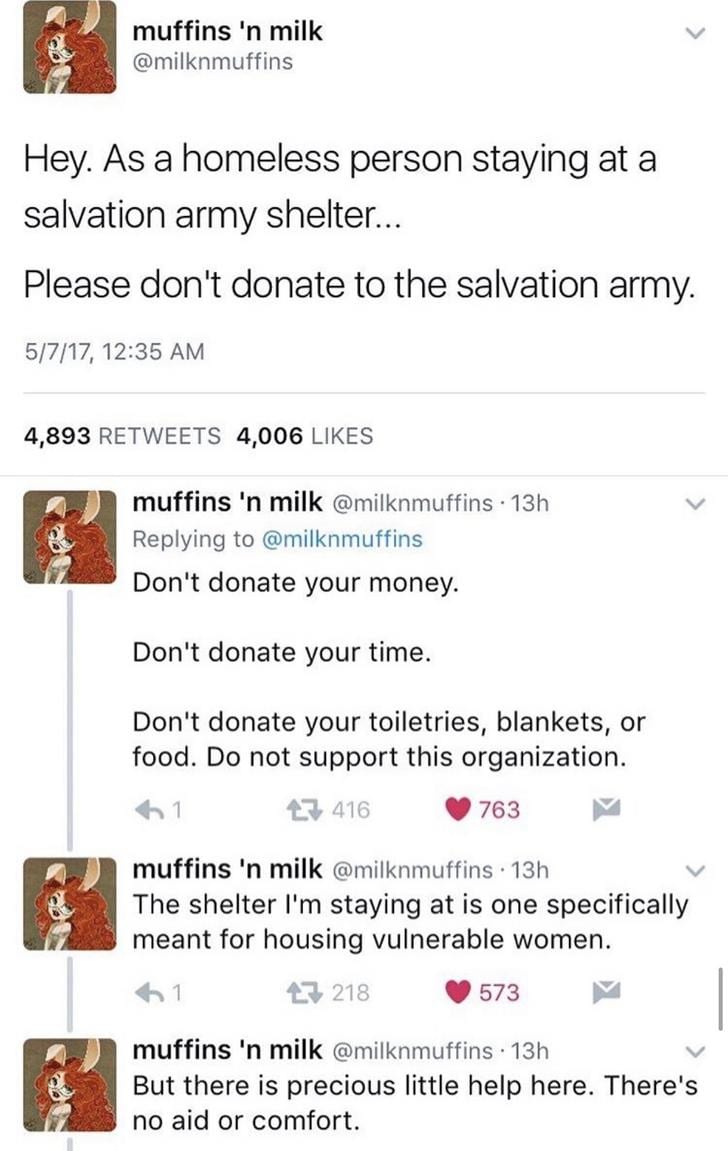
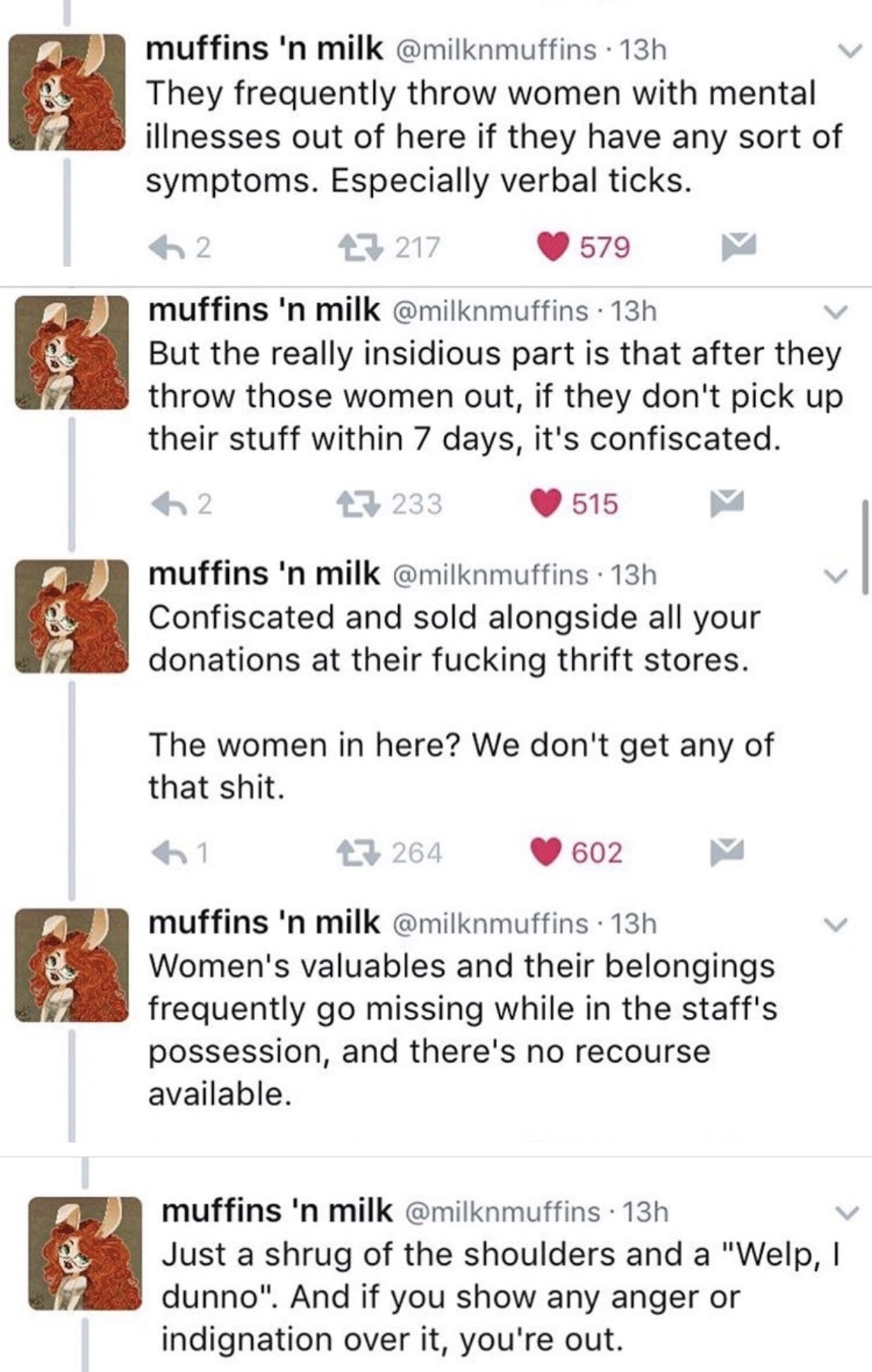
For people who depend on the help offered by organizations like the Salvation Army, though, who gets your well-intentioned gifts of charity matters – and according to one woman who knows, you should be passing over the Salvation Army for someone else.

Image Credit: Imgur

A woman who has been in need of shelter on occasion, and who has stayed in a women’s shelter owned by the Salvation Army, details a litany of complaints on Twitter.

Image Credit: Imgur

She states that the donations aren’t passed along to residents, but sold instead for cash in their stores.

Image Credit: Imgur

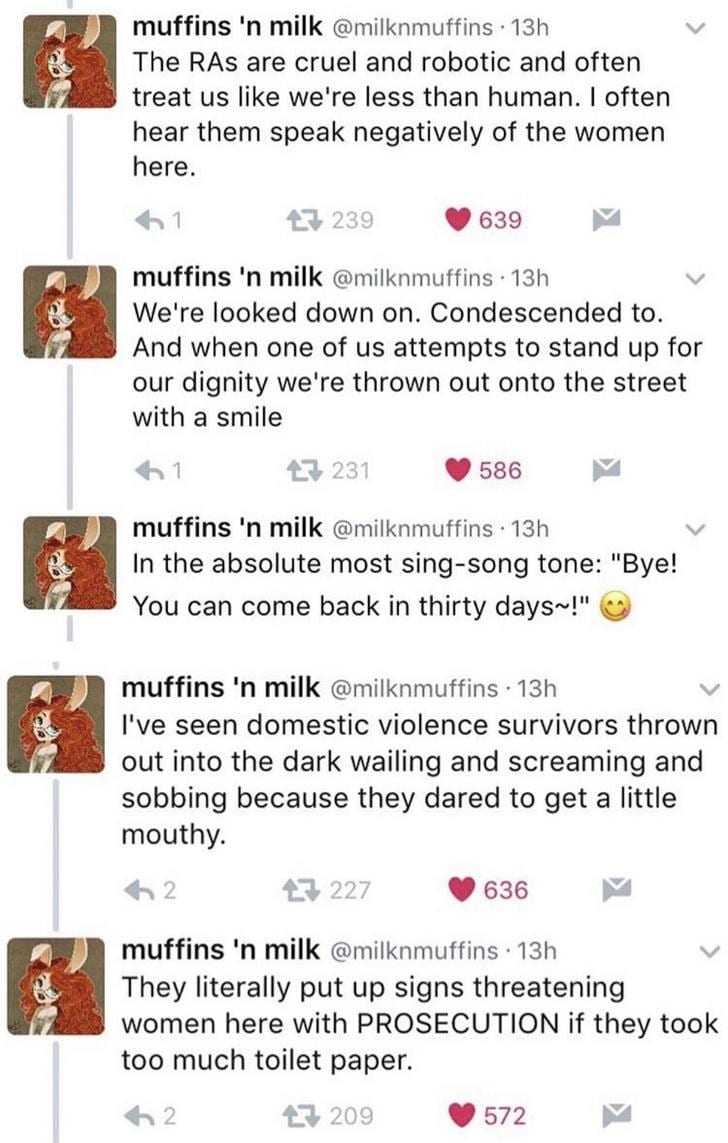
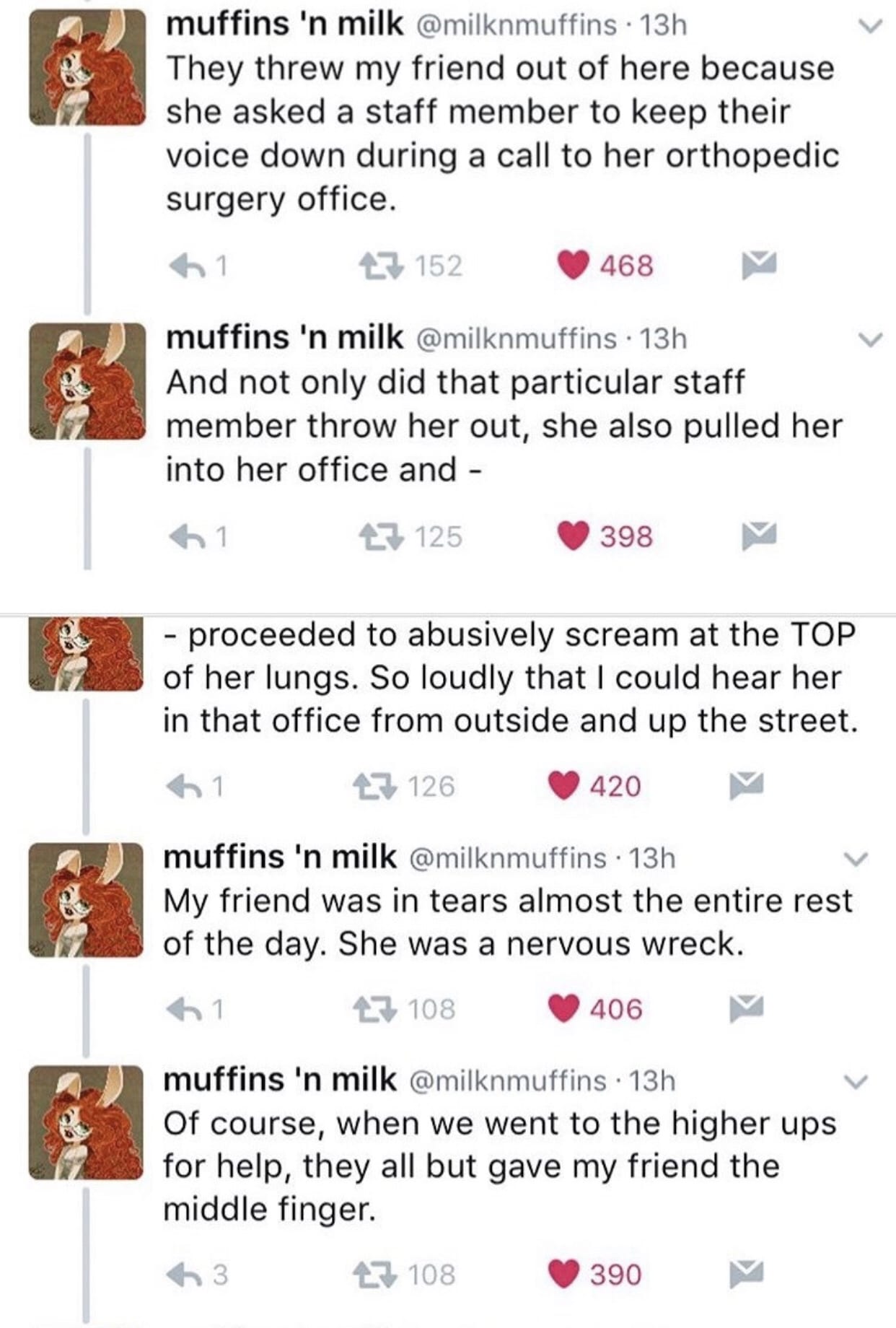
The people in charge are cold, unfeeling, and mean, especially to the most vulnerable residents, like women with mental illness and women who have escaped domestic violence.

Image Credit: Imgur

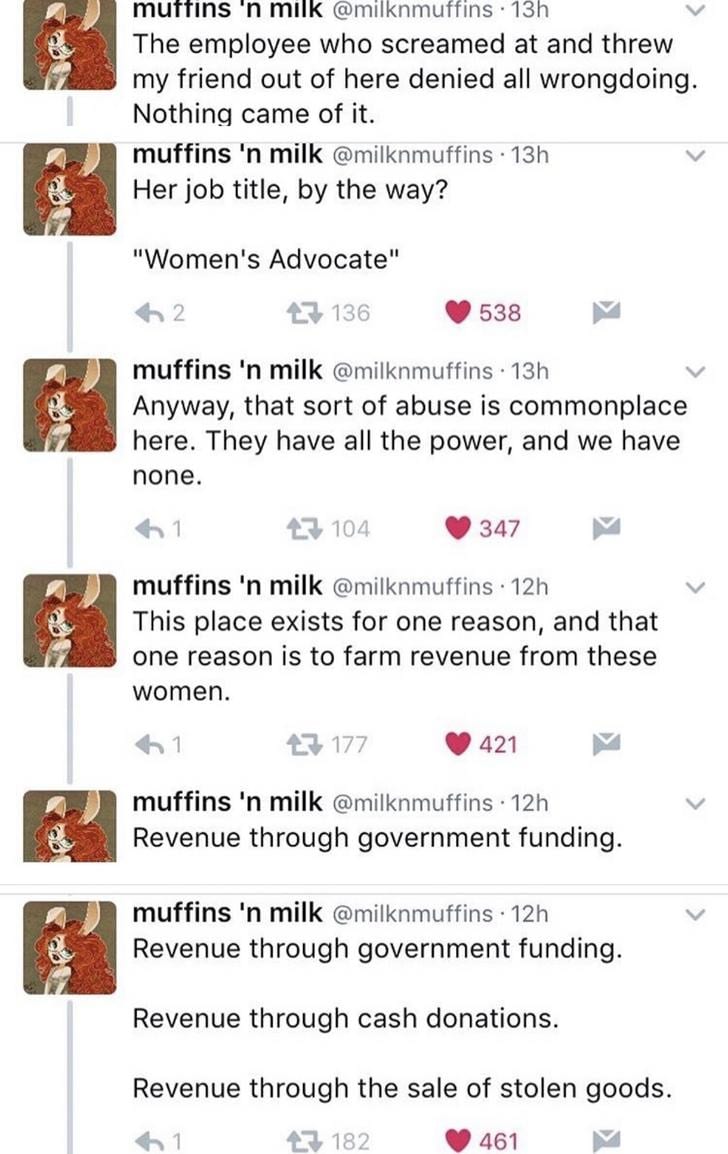
Not only that, but the leadership is vindictive and just plain awful in many cases.

Image Credit: Imgur

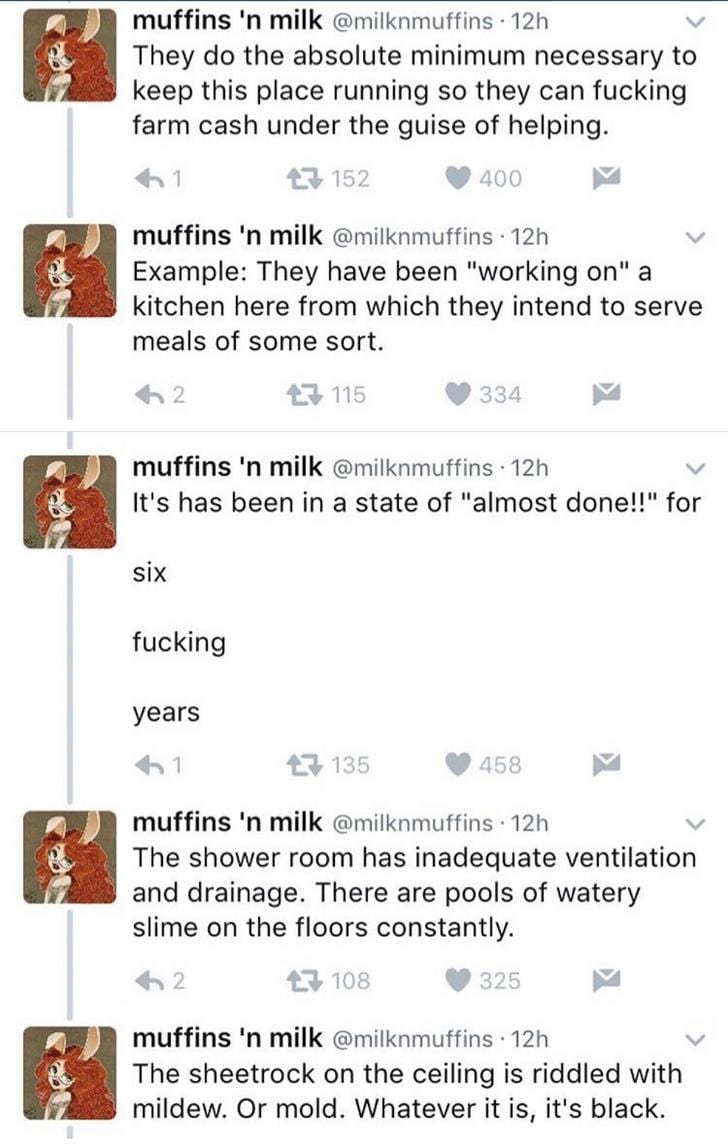
The shelters aren’t clean or well-kept, leading to more suspicions that donations aren’t funneled to the people who really need them.

Image Credit: Imgur

Another user chimed in with her own terrible story about children who didn’t receive their Christmas donations.

Image Credit: Imgur

If you believe these ladies (and all of the other stories you can find if you Google), make sure your old things and your cash go to an organization that actually does good for people in need.

Let us know in the comments if you’ve worked with a charitable organization that puts its money where its month is; I’m sure we all would like to give when we can.

The post A Homeless Woman Talks About Why You Shouldn’t Donate to the Salvation ARMY appeared first on UberFacts.

This is How Gyms Trick You Into Buying Memberships You’ll Never Use

There’s so much conflicting information out there about exercise.

Cardio in the morning or in the evening? Intermittent Fasting or lots of mini-meals throughout the day? Machines vs. free weights vs. calisthenics?

What’s really the right move?

Photo Credit: Tallahassee Blogs

The one thing that popular wisdom does seem to agree on, however, is that if you want to get in shape, the best place to start is by getting a gym membership.

Gyms offer classes, trainers, and a whole slew of equipment to help you reach your body’s highest potential.

Photo Credit: Pixabay

That’s all well and good… if you actually go, that is.

I’d be willing to bet that you can name at least one person in your life (possibly yourself) who got a gym membership and didn’t use it. Sure, you probably started out by going several days in a row, but then work got super busy and you had to skip. Then you get sick and skip a few more times. Before you know it, months go by and you’ve skipped way more often than you’ve gone.

Sadly, during that whole time where your waistline is staying the same, your bank account is steadily getting thinner from all the monthly fees.

Photo Credit: Pixabay

Picture a restaurant or a department store that’s almost completely empty of customers. It’s any business owner’s nightmare – unless you own a gym.

It’s pretty much the only business in the world where it’s a good day when hardly anyone shows up.

For instance, the manager of a Planet Fitness location in Manhattan reported that it has a maximum capacity of around 300 people… but roughly 6,000 members!

Photo Credit: Pixabay

This is a huge part of the reason that gyms like Planet Fitness can offer the cheap membership fees (sometimes as low as $10).

If all those members were to actually show up diligently, the gym’s costs would jump through the roof between having to rent more space and wear and tear on the equipment.

Gyms need people not to show up in order to turn a profit.

Photo Credit: Pixabay

Still, they do have to find a way to get you in the door and sign you up. That’s where they use clever consumer psychology tricks.

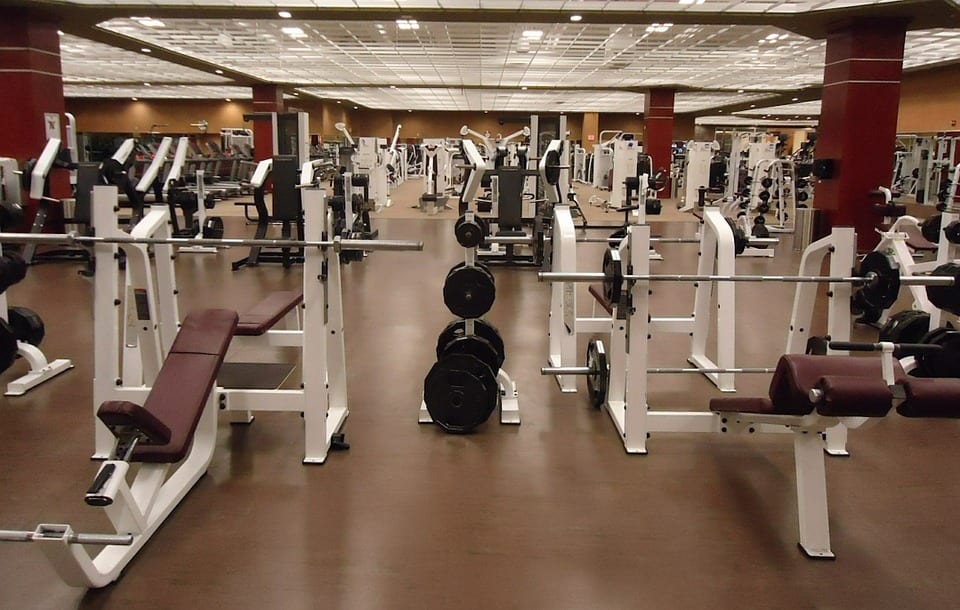
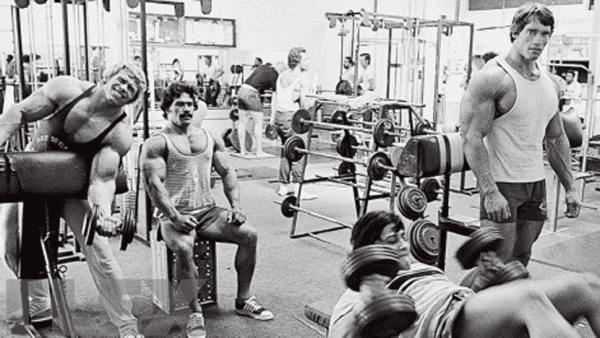
One of these tricks is by creating a very inviting design. Compared to the classic, warehouse-style gyms of old where we first saw guys like Arnold Schwarzenegger getting swole, modern gyms are more like hotels or bars.

Photo Credit: White Mountain Films

They’ve got chic, comfortable lounges (often more than one), juice bars, snack shops, gift shops, and all kinds of other amenities that have absolutely nothing to do with exercising.

All of this helps attract the casual fitness enthusiast, the type of customer who thinks they’ll be there every day, but almost certainly won’t.

Photo Credit: Flickr

Once they’ve got that customer in the door, it’s time for the moneymaker: the annual contract.

While people tend to hate being locked into something (like cell phone contracts), gym memberships are an example of what behavioral economists refer to as “pre-commitment.” We actually tend to prefer being locked into a gym membership, because we start imagining the newer, fitter version of ourselves a few months down the line. We also think the money will be a financial incentive that’ll force us to stay regular with our routines.

Sadly, that rarely ever plays out and the gym keeps your money because those contracts are easy to get into but insanely hard to get out of.

Photo Credit: Pixabay

The contracts do end at some point, though, and so gyms have one last trick to keep you coming back: more amenities.

Planet Fitness, for instance, has rows of massage chairs and also holds various social events and mixers for members. They also have weekly Pizza Nights and Bagel Breakfasts, which are – hilariously – the busiest days for the gym.

The idea is that people will have fond memories of these events and sign up for another year (possibly thinking “THIS year, I’ll actually work out!”).

Photo Credit: Yelp

On the other end of the spectrum are the gyms that are actually meant for serious athletes and fitness freaks.

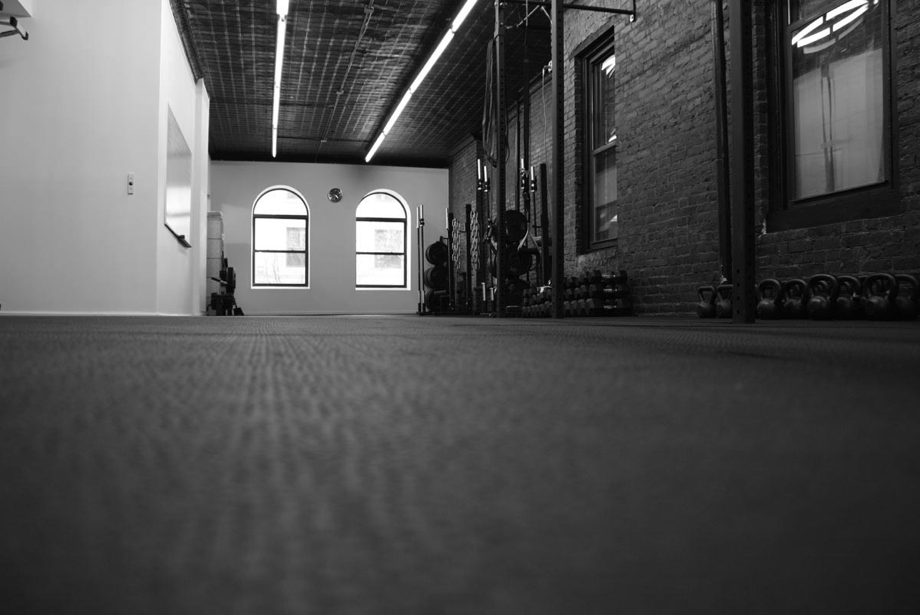
Precision Athlete is another Manhattan gym not far from the Planet Fitness location we discussed earlier. It’s only got about 150 members, but all of them show up. You can even get kicked out for not coming often enough, or have your membership application rejected if you don’t seem committed enough.

There are no fancy amenities, no music, no mirrors. This is not a place where your membership is subsidized by slackers who paid and never came. So what’s the real cost of a gym that everyone actually exercises in? At Precision Athlete, it started at around $500/month (and that was in 2014).

Photo Credit: Yelp

Now, we’re not saying that going to the gym is for suckers or that gyms are evil scammers out for your money. There are plenty of people who go to gyms like Planet Fitness and have no trouble being regular and getting great results.

It just requires a level of discipline that – according to the number of dropouts and no-shows at most gyms – most people just don’t have.

Photo Credit: Pixabay

You’re better off saving your money and investing it into some basic home fitness equipment like a few free weights, workout mat, pull-up bar, and possibly a cardio machine (if you have room).

You can probably get most of those things for less than a year’s fees at a gym (especially if you’re savvy on Craigslist).

Alternatively, you can also just go for walks/runs or join a local recreational sports league to get your cardio in and do your strength training with bodyweight calisthenics.

Photo Credit: Pixabay

Working out at home also has the advantage of saving you travel time, which can often get in the way of your motivation to get to the gym.

Plus, you get to wear whatever you want with no judgment. Wanna work up a sweat by jamming to your favorite playlist in your undies at midnight?

Get down with yo’ bad self!

Photo Credit: chinaSMACK

Finally, if your biggest concern about not going to a gym is the lack of structure provided by a trainer, you couldn’t have been born at a better time in history.

Between YouTube, Instagram, and Facebook, there are countless free workouts you can follow along with.

You can also join online fitness communities so you have other likeminded people to help encourage you along the way.

The post This is How Gyms Trick You Into Buying Memberships You’ll Never Use appeared first on UberFacts.