Wow! Astronomers Watched a Star Skip the Supernova Stage and Go Straight to Black Hole.

When people say “go out with a bang”, they usually don’t mean literally. But when it comes to dying stars, typically astronomers expect them to go out with enormous bangs: supernovae. However, recently a group of Ohio University scientists observed a star that didn’t have quite the same life path in mind.

Instead of exploding and then collapsing in on itself, the star turned directly into a black hole. That shocked the group of scientists who had been studying the star, named N6946-BH1 to be exact, which was located in the Fireworks Galaxy, 22 million light-years away. At first they didn’t think it was possible, yet in 2015, after six years of watching the star weaken, scientists concluded that the star had bizarrely skipped the supernova stage.

They chalked it up as a “massive fail.” That’s a technical term, referring to the star’s mass.

“The typical view is that a star can form a black hole only after it goes supernova,” said Ohio State astronomy professor and study researcher Christopher Kochanek. “If a star can fall short of a supernova and still make a black hole, that would help explain why we don’t see supernovae from the most massive stars.”
Photo Credit: Pexels

This atypical event still requires more analysis, but scientist Scott Adams estimates that massive fails occur in about 10 to 30 percent of massive stars. Ultimately, this discovery could lead to more answers about how super-massive black holes come to exist, since supernovae tend to blow away a lot of a star’s mass.

Without a supernova, more of a star’s mass would stick around to collapse in on itself and become a vortex that bends time and space and eats light for supper.

The post Wow! Astronomers Watched a Star Skip the Supernova Stage and Go Straight to Black Hole. appeared first on UberFacts.


This is Officially the Hottest Place on Earth

The past ten years were the hottest in recorded history, and it has seen record-breaking average yearly temperatures and single-day temperatures in places across the globe. This is largely due to global climate change, and it’s a dangerous trend.

However…

According to the World Meteorological Organization, the hottest temperature ever recorded was a sweltering 134 degrees Fahrenheit at Furnace Creek in Death Valley, California, way back in July 10, 1913.

Up until 2012, the record on file – 136.4 degrees Fahrenheit – occurred in El Azizia, Libya, and was recorded in 1922. But it was disqualified 90 years later because, according to the Guiness Book of World Records, the temperature could have been off by up to seven degrees due to the type of surface on which the measurement was taken.

Dallol, Ethiopia, is considered the hottest regularly inhabited place.

Photo Credit: Pixabay

Back to Death Valley. Air temperatures there typically reach 120 degrees due to its geographic location and boiling desert environment. The area receives less than three inches of average annual rainfall, and the sun beats down on the ground – 190 feet below sea level and enclosed by mountains.

So, in Death Valley, hot air rises and gets trapped by the surrounding mountain ranges. Then it cools and falls back into the valley. As it falls, where it’s heated again by then sun and the high air pressure down on the valley floor. That’s how the area holds the record for highest recorded air temperature.

Death Valley, though, is not the only hot spot around.

Photo Credit: Billy Hathorn

In Yellowstone National Park, the geothermal pools often reach 250 degrees Fahrenheit and above. According to National Geographic, vents on the ocean floor release liquids at 750 degrees Fahrenheit and higher. The Earth’s core is estimated to have a temperature of a super scorching 11,000-degrees. In our solar system, scientists say the hottest place is the sun’s core which is about 15 million Kelvin, or roughly 26 million degrees Fahrenheit.

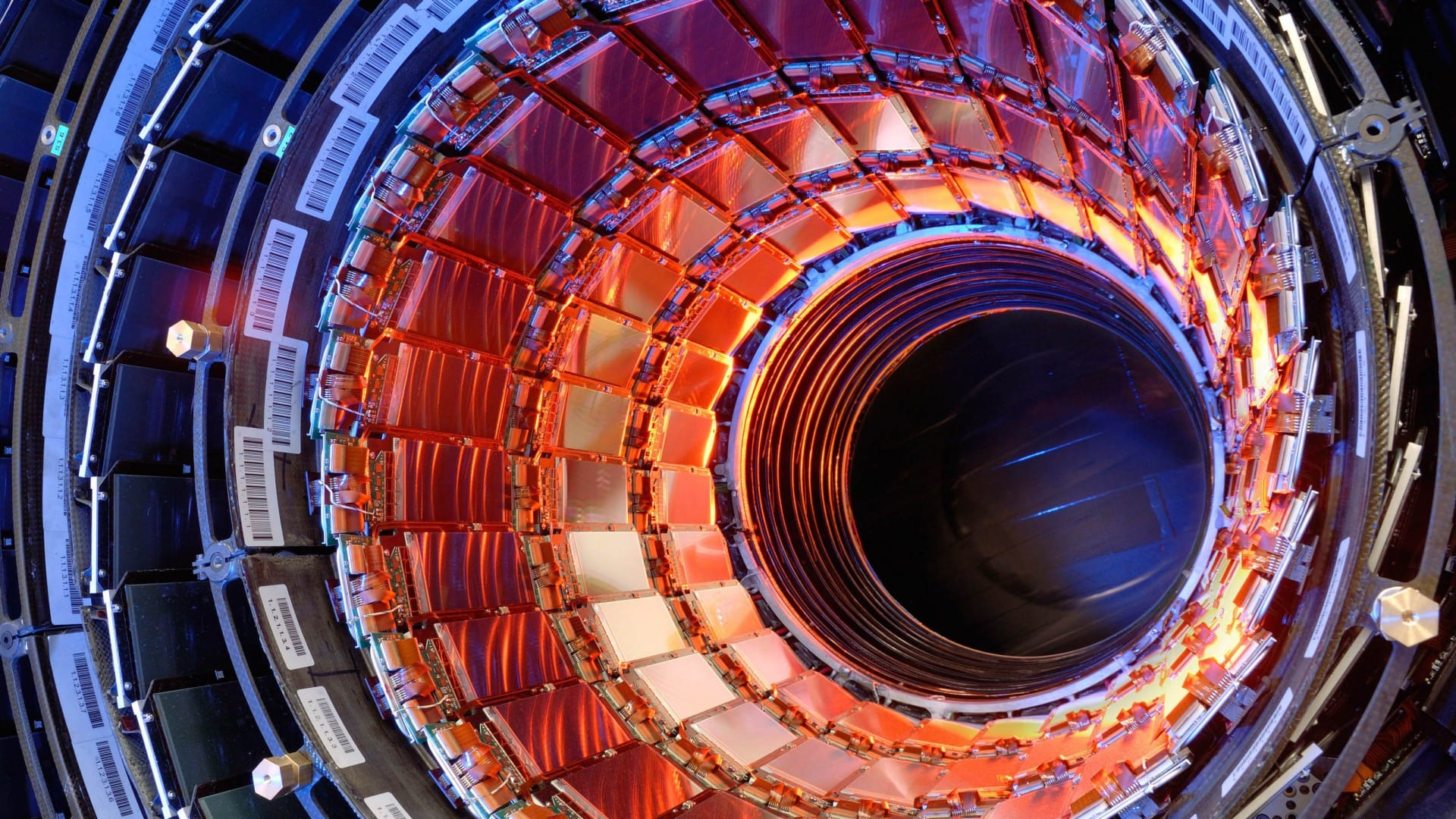
If you’re looking for the hottest location in the universe, that seems to be, surprisingly, just outside of Geneva, Switzerland. At the Large Hadron Collider, scientists and engineers smash atoms in their experiments.

Photo Credit: Flickr

According to Inside Science News Service, the temperature inside the equipment reaches an incredible 7.2 trillion degrees Fahrenheit (if just for short bursts).

That’s a valid excuse for sweating.

The post This is Officially the Hottest Place on Earth appeared first on UberFacts.

A Teenager Discovered a Planet on the Third Day of His NASA Internship

These kids today…are pretty great, as it turns out!

At least, some of them are.

On only the third day into his internship at NASA, a 17-year-old named Wolf Cukier (awesome name) discovered a new planet that is being called “TOI 1338 b”. The planet is 6.9 times larger than Earth, and the folks at NASA believe the planet will be in a stable orbit for at least the next 10 million years. It is located roughly 1,300 light-years away from Earth.


View this post on Instagram


A post shared by MM News (@mmnewsdottv) on

The teenager discovered the planet while looking at “variations in star brightness” in images captured by NASA’s Transiting Exoplanet Survey Satellite (TESS).

Cukier is from Scarsdale, New York, and he completed a two-month internship last summer with NASA at their Goddard Space Flight Center in Maryland.

Cukier said, “I was looking through the data for everything the volunteers had flagged as an eclipsing binary, a system where two stars circle around each other and from our view eclipse each other every orbit. About three days into my internship, I saw a signal from a system called TOI 1338. At first I thought it was a stellar eclipse, but the timing was wrong. It turned out to be a planet.”

NASA just recently confirmed Cukier’s findings, and they submitted a paper co-written by the teenager about the discovery of the new planet.

Let’s get to meet this whiz kid, shall we?

Cukier also confirmed that he is indeed now looking for other new planets. Keep up the great work!

As the saying goes, the kids are alright.

The post A Teenager Discovered a Planet on the Third Day of His NASA Internship appeared first on UberFacts.

People Think up the Scariest Messages That Aliens Could Possibly Send Us

If we ever make contact with aliens, it’d be arguably the most major event in our entire species’ history so far. But depending on how that first meeting goes, it could either be a revelation or a terror.

On AskReddit, a user asked what the “scariest” message would be to hear from aliens from outer space. Here are 14 of the spookiest ideas.

1. A cry for help.

“A species more advanced than us screaming for help would imply something much worse is already after them…”

“A cry for help originating from millions of light-years away. By the time the message reaches us, its been floating through space for millions of years. We’ll never know if we just heard the last words of an alien civilization or if it was saved by another civilization. Regardless, it would be a harrowing message.”

2. Earth is a video game.

“Sorry guys; dinner’s ready and mum says I should turn you off.”

3. Earth is a simulation.

“Experiment’s goals accomplished. Simulation scheduled for termination on January 1st.”

4. Just “hello.”

“A random hello would scare the fuck out of everyone at NASA let me say that.”

5. A warning to run.

“RUN.”

“There’s something just so viscerally terrifying about receiving just that one-word command: run. It doesn’t say what’s coming. It doesn’t say when. It doesn’t say where to go. All you know is that you cannot stay where you are and that whoever sent the warning was only able to get out a single word to communicate the impending threat to the rest of the universe.”

6. A warning not to run.

“Do not leave your star system. Trust us.”

7. A countdown.

“…14…13…12…11…10…”

8. Deja vu.

“Hm. Your race was just like this last time too.”

“Don’t try this again… after the 5th time we’re tired of sending your planet back to the stone age…”

9. They’re among us.

“We’re coming to pick up the 2 billion members of our species living on your planet.”

10. Pyramids.

“Radio…? Why aren’t you using the Pyramids?”

11. God didn’t make them.

“God created you, he didn’t create us.”

12. We’ll be harvested.

“CHOOSE HALF OF YOUR HUMANS FOR HARVESTING. IF YOU DO NOT CHOOSE WE WILL.”

13. Taxes.

“You now have to pay galactic taxes.”

“Can’t wait for the Boston tea party 2.”

14. Literally anything.

“I honestly think any communication with extraterrestrial life with freak us out, even if it was totally benevolent or even benign, like we accidentally picked up a communication (don’t tell me this can’t happen. A LOT of accomplishments and discoveries were made entirely by accident).”

The post People Think up the Scariest Messages That Aliens Could Possibly Send Us appeared first on UberFacts.

Look at These Awe-Inspiring Photos of the Final Solar Eclipse of the Decade

On December 26, people from Saudi Arabia to Guam scrambled to take pictures of the final solar eclipse to grace the Earth this decade.

Unlike in some eclipses, you’ll notice that the moon didn’t totally black out the sun. Instead, it covered the majority of the sun, leaving a visible “ring.” This type of event is called a “ring of fire,” or annular, eclipse.

The NOAA provided more information about the moon’s path on the 26th.

Images of the eclipse are stunning, especially against the backdrop of beautiful landscapes such as these sand dunes.

A photographer in Guam was able to capture the moon’s movements against the ocean tide.

View this post on Instagram

Solar Eclipse 2019 in Guam. I still can’t believe I got to witness this eclipse. Before anything, I want to thank @natgeotraveler_korea for believing in my crazy idea. @Saerom.h will be writing a story about our experience for the magazine and can’t wait to share it with you all. It’s been a long 6 months to prep, but it was all worth it. Two years ago, I missed the solar eclipse that was passing by the US, but I finally got my opportunity, and the day couldn’t have gone any better… And a big thank you to Guam and it’s people for making my time here even more memorable. ⠀⠀⠀⠀⠀⠀⠀⠀⠀⠀⠀⠀⠀⠀⠀⠀⠀⠀⠀⠀⠀⠀⠀⠀⠀⠀⠀⠀⠀⠀⠀⠀⠀⠀⠀⠀ ⠀⠀⠀⠀⠀⠀⠀⠀⠀⠀⠀⠀⠀⠀⠀⠀⠀⠀⠀⠀⠀⠀⠀⠀⠀⠀⠀⠀⠀⠀⠀⠀⠀⠀⠀⠀ Eclipse Solar 2019 en Guam. Todavía no puedo creer que haya presenciado este eclipse. Antes que nada, quiero agradecer a @natgeotraveler_korea por creer en mi loca idea. @Saerom.h escribirá una historia sobre nuestra experiencia para la revista y no puedo esperar para compartirla con todos ustedes. Han sido largos 6 meses para preparar, pero valió la pena. Hace dos años, perdí la oportunidad de ver el eclipse solar que pasaba por los Estados Unidos, pero finalmente tuve mi oportunidad y el día no pudo haber sido mejor… Y también, muchas gracias a Guam y gente por haber hecho mi estadía mucho más memorable.

A post shared by PABLO 오세민 (@pablooh) on

This picture gives us a different point of view from India.

Some lucky travelers were able to fly right past the eclipse as well!

Residents of India, Pakistan, parts of Africa, and China will get to see the first solar eclipse of the new decade, which will pass by them in June 2020.

These images are out of this world!

Did you catch the eclipse? Share your thoughts with us below.

The post Look at These Awe-Inspiring Photos of the Final Solar Eclipse of the Decade appeared first on UberFacts.

Stars Are Disappearing and Scientists Aren’t Ruling out Aliens as a Cause

There have been a few stories lately when scientists and other suit-and-tie types have been unwilling to say aliens aren’t behind one thing or another – which I guess is the safest course, because no one likes to be proven wrong.

I mean, if a situation actually arose in which aliens were discovered, I doubt people would be running around pointing fingers at all of the folks who said aliens were a fantasy. But what do I know.

…But back to the story at hand, and the hundred-plus stars that have disappeared from the map.

View this post on Instagram

なんとか見れる形に現像できただろうか? その2 . . .•*¨*•.¸¸☆*・゚•*¨*•.¸¸☆*・゚ やっぱり星空撮っている時間好きだなぁと改めて思う. . . •*¨*•.¸¸☆*・゚•*¨*•.¸¸☆*・゚ なんかとんでもなく忙しい… 明日無事に仕事が納められるるのか… とりあえず…あと10分寝よう? . . . #岡山県 #井原市 #美星町 #美星天文台 #岡山へ行こう #星活 #星空撮影 #星景ら部 #天の川 #milkyway #nightphotography #nightsky #night_gram #night_shots #japan_night_view #best_moments_night #stars #setouchigram92 #colore_de_saison #瀬戸内カメラ部 #star_hunter_jp #team_jp_西 #Lovers_Nippon #photo_shorttrip #eosm3 #サムヤン12mmf2 #キリトリセカイ #その瞬間に物語を #ダレカニミセタイソラ

A post shared by どむどむ (@ddom_cat) on

Yes, it turns out that the night sky, which has remained static enough to guide seamen and pirates and explorers for eons, is changing.

The Vanishing and Appearing Sources during a Century of Observations Project (VASCO) compares 70-year-old surveys with recent images of the night sky to document what has changed, and after years of painstaking work (there are a lot of stars, after all), they’ve published their results in the Astronomical Journal.

The 100-odd stars that were documented to have disappeared could represent short-lived flashes in the night, or they could be actual stars that disappeared.

The researchers hope their results, and results to come, will be relevant to astronomy and the search for extraterrestrial intelligence (SETI).

“VASCO is a project that is both a SETI project and a conventional astrophysics project,” explained Beatriz Villarroel, a researcher at the Nordic Institute for Theoretical Physics and one of the report’s coauthor. “Even if we do SETI and have SETI questions, we are also interested in publishing other results that we find along the way.”

The disappeared pinpricks of light are curious because when stars die, their last burst of glory is usually hard to miss – people saw and wrote about them long before there were telescopes – so if they can also just wink out without fanfare, well, we want to know why.

And to that end, some of the researchers don’t think we should rule out something like another advanced civilization blocking stars with their solar panels to gather energy.

For her part, Villarroel is on board.

“If we should look for aliens, maybe we should actually look for something that would be truly absurd to find.”

The research is being conducted by a team of 20 astronomers and astrophysicists who have compared 70 years worth of sky images taken by the US Naval Observatory and the Panoramic Survey Telescope and Rapid Response System.

They used software to analyze 600 million light sources that should have appeared in the earliest and most recent sets of data. At first,  the number of potential missing stars numbered around 150,000, but was winnowed down to 24,000 after some additional cross-referencing.

In the end, Villarroel is confident the 100 stars they presented are, indeed, missing.

“We have done the best work to remove anything that resembles any artifacts.”

If they are – or were – brief flashes that just happened to show up on the old US Navy surveys, they were likely red dwarf flares, variable stars that dimmed, or the afterglow of a gamma ray burst.

If they really were enduring light sources that disappeared without fanfare, Villarroel – and others – would be much more excited. SETI enthusiasts have speculated about how alien civilizations with advanced engineering power could shield a star from view.”You would have to exclude all-natural things, and then there might also be new natural phenomena that we don’t know about can be more exciting.”

If this is totally blowing your skirt up, the scientists at VASCO plan to implement a citizen science project that lets civilians help search through the rest of the 150,000 candidates.

You know you want to be the one who discovers the spot where technologically advanced aliens are hiding….

The post Stars Are Disappearing and Scientists Aren’t Ruling out Aliens as a Cause appeared first on UberFacts.

This Is How to Tell the Difference Between Stars and Planets Just by Looking

This seems like it would be difficult – until, that is, you remember that classic lullaby that put us all to sleep.

Remember “Twinkle, twinkle little star”?

Yep. Stars twinkle, and planets don’t.

With the exception of our solar system’s sun, stars are all so far away that astronomers talk about their distance from Earth in terms of lightyears, or the distance light can go in one Earth year.

Considering light moves at about 186,000 miles per second, a lightyear is pretty freaking far.

The closest star to our sun is called the Alpha Centauri, and it’s 4 lightyears away from our planet. Because it takes a star’s light several lightyears to get to Earth, we see it as a small point in space.

But before we can see it from the surface of Earth, starlight is refracted. This refraction is influenced by every change in density and temperature in every media that the light passes through.

Photo Credit: Wikipedia

Planets are much closer to us than stars. A planet’s light (which is really sunlight reflected back to us) gets refracted to a much lesser degree because it travel a much shorter distance. Planets usually appear bigger (because they’re closer), and their light twinkles significantly less.

Actually, planetary light looks basically steady.

Of course, if you catch a planet a bit lower in the sky – maybe so you’re looking at it through the horizon – you’ll have a harder time telling it apart from a star. If light is traveling through the horizon, that means it’s going through a lot more atmosphere before it reaches your eyes than if it were directly overhead. That causes more light refraction, and, thus, more twinkling.

Photo Credit: Wikipedia

It’s easier to tell stars and planets apart later because there’s less light refraction when you’re looking directly up.

If this trick gives you trouble at the beginning, keep practicing and tou’ll be able to tell the planets and stars apart in no time.

Are you going to try this simple trick? Share your results with us in the comment area, if you’d like.

The post This Is How to Tell the Difference Between Stars and Planets Just by Looking appeared first on UberFacts.

Magnetars: A Magnet so Strong, They Could Tear Your Body Apart

This is kinda crazy…

Some magnets are so weak they can barely keep a photo on the refrigerator. Meanwhile, there are magnetars: the strongest known magnets in the universe. Sadly, you can’t buy these at your local grocery store.

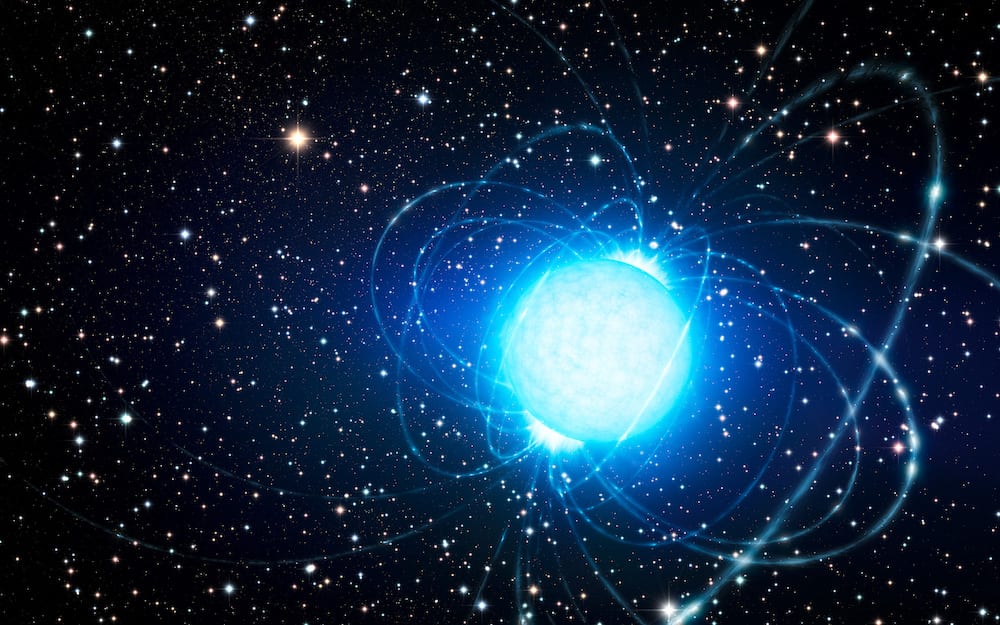
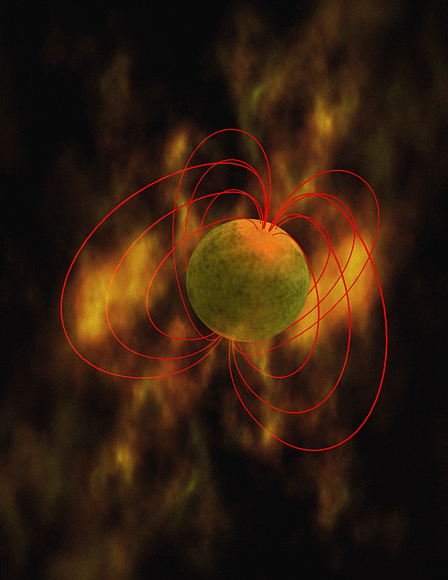
A magnetar is a type of neutron star with an unbelievably powerful magnetic field. Though they have the strongest magnetic pull of any known object in the universe, they are surprisingly small. They’re also very mysterious.

So, where do magnetars come from? Curiosity explains: When a star dies, it explodes into a supernova, collapsing in on itself in a giant extravagant display of light before fading away. If the star was large enough, it will then create a neutron star in its place. A neutron star is so small that it’s often just the size of a small city (for a star, that’s tiny!). However, it’s also incredibly dense. Just one teaspoon weighs at least one billion tons. All this matter spins around hundreds of times per second, creating a magnetic field that is a trillion times stronger than the Earth’s own.

And then there are magnetars. Magnetars are an especially magnetic type of neutron star. Nobody really knows why they’re so magnetic, but they are. They’re roughly 1000 trillion times more magnetic than Earth.

Photo Credit: Wikimedia Commons

This magnetic field is so strong that just coming within 600 miles of it would destroy your nervous system and even change your molecular structure. If you came closer, the gravitational force would destroy you at the atomic level. These stars can also wreak havoc on planets like the Earth.

Thankfully, the closest magnetar to us is much too far to do such damage, and they’re also incredibly rare. Scientists have been on the lookout for magnetars since 1979, but while they’ve found over 2000 neutron stars, fewer than 25 have been confirmed as magnetars.

Photo Credit: Wikimedia Commons

Still, it’s fascinating to know that they’re out there somewhere!

The post Magnetars: A Magnet so Strong, They Could Tear Your Body Apart appeared first on UberFacts.

The Curiosity Rover Found Oxygen Behavior on Mars That Is Baffling Scientists

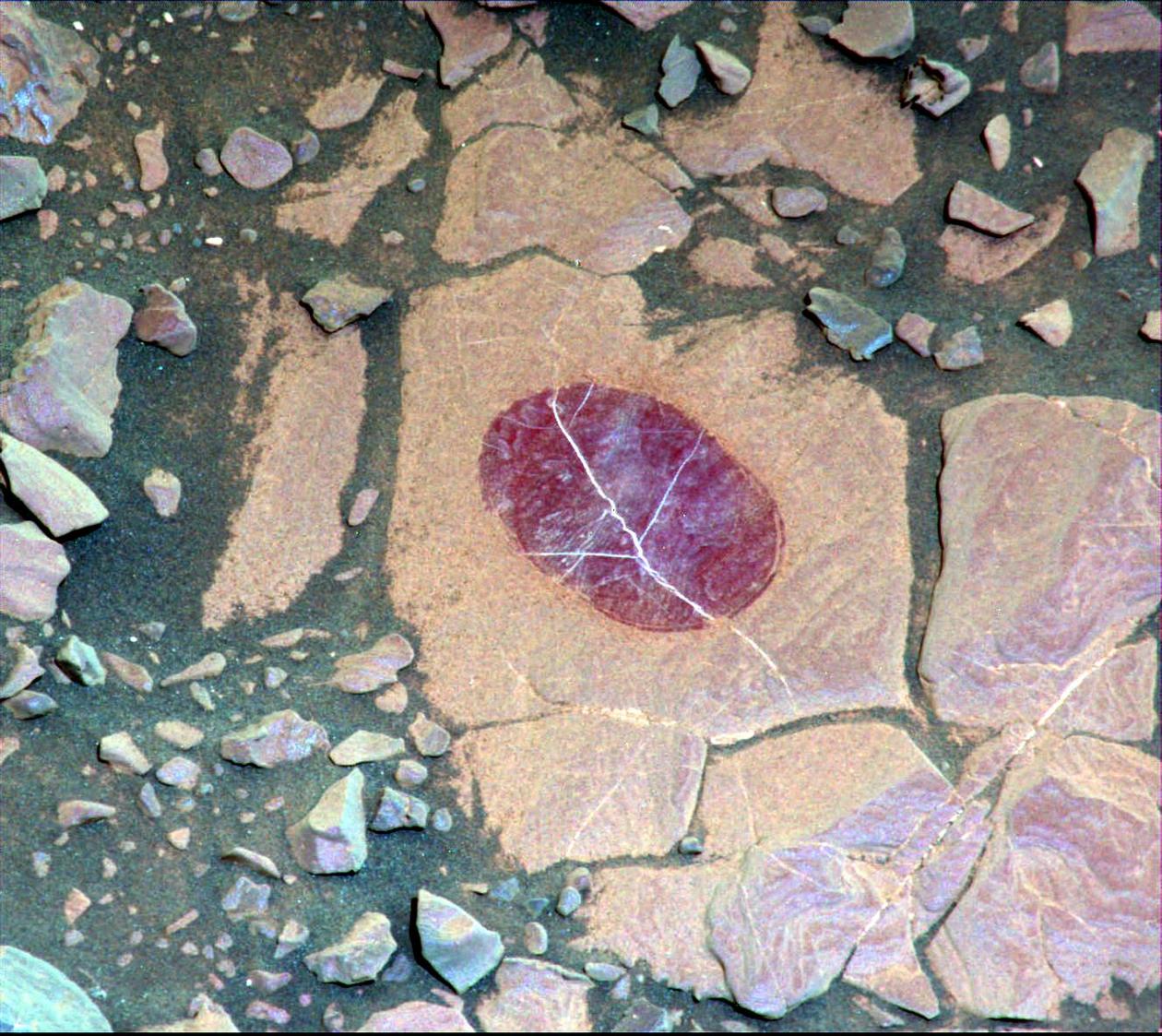
The Curiosity rover has been in Mars’ Gale Crater in 2012, and since then, has been studying all things Martian, so we can know more about the planet’s past.

Well, what we now know, more than anything, is how much we don’t understand about what’s happening out there.

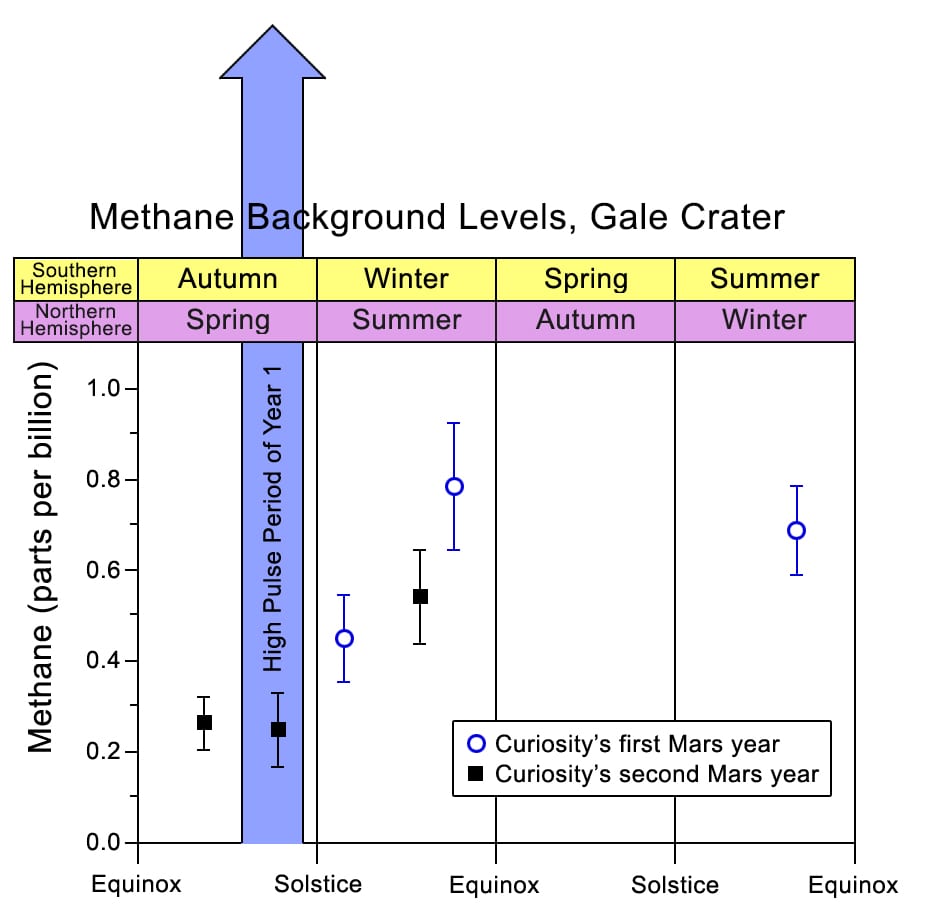
Case in point: the rover’s tunable laser spectrometer (or Sample Analysis at Mars, SAM) recently found a huge amount of methane–the largest since landing there.

Photo Credit: NASA

Followed closely by the discovery that oxygen is behaving in a way scientists don’t quite understand.

In the past six years, SAM has determined the following about the atmosphere of Mars: 95 percent is carbon dioxide, 2.6 percent molecular nitrogen, 1.9 percent argon, 0.16 percent oxygen and 0.06 percent carbon monoxide.

Mars has seasons sort of like Earth, but they happen because the air pressure changes when carbon dioxide gas freezes at the poles during winter. This event causes the air pressure to lower. When the carbon dioxide eventually evaporates and is redistributed into the atmosphere, the air pressure rises for a Mars spring and summer.

Photo Credit: NASA

Nitrogen and argon followed a similar pattern.

Oxygen, however, didn’t.

It actually rose and peaked at 30 percent during spring and summer, then lowered to normal levels in fall.

Photo Credit: NASA

This pattern has repeated itself since Curiosity started monitoring. The only difference was that the levels of oxygen rising and falling varied.

Is the oxygen being created by something? What’s causing it to fall?

According to CNN, one of the authors of a new paper covering the seasonal variations, Sushil Atreya, said the data was “mind boggling.”

Photo Credit: NASA

The scientists involved in the study were so puzzled they even had the rover checked out for operational issues. But Curiosity was working as usual.

Melissa Trainer, study author and planetary scientist at NASA’s Goddard Space Flight Center, said:

We’re struggling to explain this. The fact that the oxygen behavior isn’t perfectly repeatable every season makes us think that it’s not an issue that has to do with atmospheric dynamics. It has to be some chemical source and sink (of elements into the soil) that we can’t yet account for.

So, what about the huge amount of methane?

The Tunable Laser Spectrometer on NASA’s Curiosity Mars Rover
Photo Credit: NASA

On Earth, most of our methane is created by living things, but also by rocks and water. Mars has plenty of rocks and water.

Principal Investigator Paul Mahaffy of NASA’s Goddard Spaceflight Center in Greenbelt, Maryland, noted that current measurement systems cannot determine the exact source of methane. What they do know, however, is that the methane fluctuates with the seasons as widely as oxygen.

Could the strange behavior of the two gases be related somehow?

Atreya believes so, although no one can figure out how.

In the meantime, the team invites any and all Martian experts to chime in.

The post The Curiosity Rover Found Oxygen Behavior on Mars That Is Baffling Scientists appeared first on UberFacts.