
This Is How Far You Can Actually Drive After Your Gas Tank Reads Empty

There are two types of people in this world: people who get gas when the gauge drops below half a tank, and people who wait for their gas light to come on, drive a while longer, and then stop to fill up at the last minute.

As someone who falls into the latter category, I’ve long argued that the light is just a warning, and if you’ve got 20 or 30 miles left after it lights up, why hurry?

https://www.instagram.com/p/B4msShGjG–/

But am I right? I don’t know about you, but I’m dying to find out.

Well, lucky for me (and everyone else who likes to push the needle all the way past E, auto repair service YourMechanic has put together a handy chart that will let you know – based on the make and model of your car – how far you can go after your light comes on.
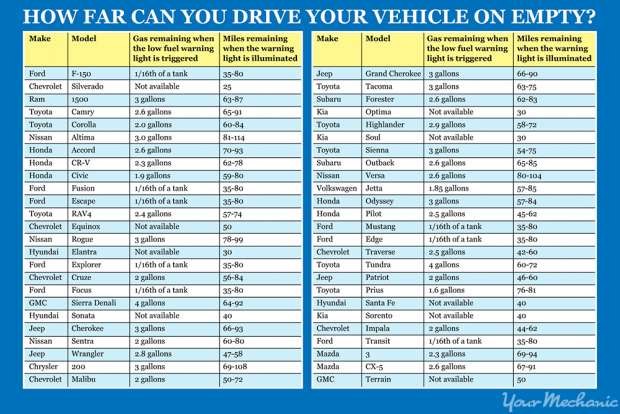
Image Credit: YourMechanic

You’ll definitely want to check, too, because it ranges from over 100 miles (the Chrysler 200) to less than 30 in a Chevy Silverado.

My Honda can go another 60, so you’d better believe I’ll be wagging my finger at my overly cautious fella the next time he says we definitely need to stop!

That said, there are like, sensible reasons to not push it so hard. Your car’s fuel pump burns hotter near empty than it does on a full tank, so if you do it all the time, you’ll burn your pump out faster.

So, YourMechanic recommends you use their chart for emergency situations only.

The post This Is How Far You Can Actually Drive After Your Gas Tank Reads Empty appeared first on UberFacts.

A Teenage Girl Invented a Simple and Innovative Way to Get Rid of Your Car’s Blind Spots

The creative spirit and innovation of young people is so refreshing! Sometimes, they have the best ideas because they’re thinking forward while a lot of us older folks are set in our ways. In other words, when a young person has an idea about something, listen up, because it might turn out to be a game-changer.

That’s what happened with a 14-year-old named Alaina Gassler, who came up with a project called “Improving Automobile Safety by Removing Blind Spots” for the Broadcom MASTERS competition, which features science and engineering projects from middle schoolers.

Gassler built the system with a webcam, a projector, and other 3D-printed materials, and together it all works to fill in the space that a car’s frame blocks from drivers’ view.

Gassler hails from West Grove, Pennsylvania, and she took first place in the competition and won the $25,000 Samueli Foundation Prize. Her invention works like this: she mounted a webcam outside the passenger side of the car, which steams a live video onto the inside pillar of the passenger side from a projector attached to the sunroof above the driver’s seat.

Gassler also resurfaced the interior frame with a retro reflective fabric to make the projection clear. She said the material “only reflects light back to the light source, which is the projector in this case. Since the driver’s eyes are next to the projector, the driver can see a crisp, clear image, and the passengers only see a black piece of fabric.”

Take a look at the video below to see it in action.

This is quite impressive, I must say. Great work, Ms. Gassler, and we’ll be looking for more work from you in the future.

These kids today, I’ll tell ya…

The post A Teenage Girl Invented a Simple and Innovative Way to Get Rid of Your Car’s Blind Spots appeared first on UberFacts.

Google Maps Is Adding Alerts for Speed Traps and Other Road Incidents

Are you one of the drivers out there who sticks to Waze for navigation purposes because it lets you know other useful info, such as where police cars are hiding in wait to give you a speeding ticket? Well, you can soon switch to Google Maps and enjoy the same perks.

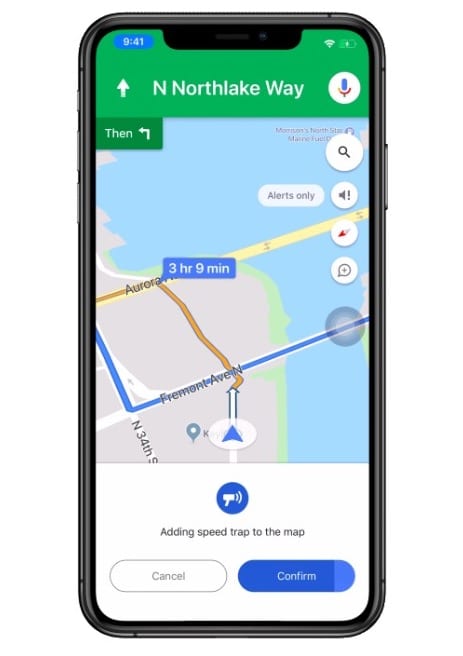
Google Maps is finally adding this feature to its own navigation system. Users will be able to report speed traps, crashes, road closures, construction, slowdowns, disabled vehicles and objects on the road. Some of those updates are already available on Android devices, but they’re now being rolled out globally to Apple users as well.

Photo Credit: iStock

“This feature has been one of our most popular on Android, and we’re excited to expand it to iOS,” Google Product Manager Sandra Tseng wrote in a recent blog post.

“Google Maps has always helped people get from point A to B in the easiest way possible. Today, we’re adding more tools that reflect real-time contributions from the community so you can stay even more informed when you’re behind the wheel.”

Photo Credit: Google

Submitting a report through Google Maps is simple and streamlined. You simply tap on the + sign and then click “Add a report.”

Unlike on Waze, there’s no option to add comments or photos to your report, so there’s less detail available — but also less clutter.

This is exactly the sort of thing I like in an update. It’s easy, it’s useful, and it makes me actually want to bother to go through with downloading new software.

The post Google Maps Is Adding Alerts for Speed Traps and Other Road Incidents appeared first on UberFacts.

The miniskirt is named after…

The miniskirt is named after the Mini Cooper and not the skirt’s size. The designer, Mary Quant loved Mini Cooper cars and named the garment after them, saying that car and skirt were both “optimistic, exuberant, young, flirty,” and complemented each other.

Tailgating the Car Ahead of You Through Endless Lights Won’t Help You at All

Gridlock is the worst, isn’t it? You’ve already sat though one light cycle, and with this long line of cars also waiting to get through, it looks like you may be sitting through another one. But although it’s tempting to ride the guy’s bumper in front of you through the light, science says that won’t help you at all.

Photo Credit: Flickr

Tailgating is never a good idea. But when you’re desperate to make it through a red light, doesn’t it make sense to minimize the space between you and the next car?

With all the collisions that happen at intersections, researchers from Duke University and Virginia Tech wanted to put the desire to squeeze through a traffic light on someone else’s tail to the test. Their study, which wound up showing some surprising results, was published in the Journal of Physics in November of 2017.

For the test, researchers had volunteers sit in 10 Chevrolet Impalas lined up at a red traffic light on a test road. The cars were at varying distances from each other. When the light turned green, drivers were told to accelerate at a “normal and comfortable fashion.” Meanwhile, a drone recorded their speeds.

Photo Credit: Needpix

When researchers analyzed the film, they found the tailgating cars took as long to get through the light as the cars stopped up to 25 feet behind the car in front. How does that work?

To explain, the researchers compared the findings to melting ice. The extra energy, or “latent heat,” it takes to get ice to begin melting is like the amount of time it takes a car to accelerate from a full stop. Cars close to the bumper of the car in front of them have to wait until the entire line of cars begins to melt to accelerate safely.

In the words of the researchers, “the ‘temperature’ (kinetic energy) of the vehicles cannot increase until the traffic ‘melts’ into the liquid phase.”

Photo Credit: Flickr

Which means that it takes more time for a tailgater to accelerate, while a driver who stops further back can accelerate faster – and they both wind up moving at the same pace.

Who knew? So stop tailgating and enjoy the ride. We’ll all get to where we’re going eventually.

The post Tailgating the Car Ahead of You Through Endless Lights Won’t Help You at All appeared first on UberFacts.

A Person Using Google Earth Spotted a Car in a Florida Pond and Solved a Dark 22-Year-Old Mystery

This is a tragic story with an sad ending, but at least the family members involved can now have some closure after 22 whole years.

No one had heard from William Earl Moldt, a 40-year-old man from Lake Worth, Florida, since November 7, 1997, when he called his girlfriend to tell her he was leaving a nightclub and would be arriving home shortly.

North America: United States The mystery of a missing Florida man has been solved 22 years on, thanks to Google…

Posted by TSC International News Channel on Friday, September 13, 2019

Then, Moldt disappeared.

On August 28 of this year, a Lake Worth man was looking at Google Earth images of his neighborhood when he noticed something unusual in a pond. Upon closer inspection, the man noticed that the object was a sunken vehicle that was not visible from ground level.

Authorities were alerted and the car turned out to be a 1994 Saturn SL with skeletal remains inside and they were later identified as belonging to Moldt. In a statement, the Palm Beach County Sheriff’s office said, “The vehicle’s exterior was heavily calcified and was obviously in the water for a significant amount of time.”

The pond where Moldt’s car ended up was under construction when he disappeared in 1997, and it’s unclear how his car ended up in the water.

Although the story sounds outrageous, it is a fairly common occurrence for cars to end up in waterways. In Florida alone, there were 168 water-related deaths from car accidents between 2011 and 2016. According to the missing-persons website NAMUS, Moldt “was not a frequent drinker but did have several drinks at the bar” the night he disappeared.

The post A Person Using Google Earth Spotted a Car in a Florida Pond and Solved a Dark 22-Year-Old Mystery appeared first on UberFacts.

When Toyota introduced its first…

When Toyota introduced its first model in the USA, the Crown, in 1957, they attempted a common American advertising stunt – an endurance run from Los Angeles to New York. However, the car barely managed to reach Las Vegas.

This Is How Much These Iconic Movie Cars Cost in Real Life

Think about some of the iconic movies featuring cars: Back to the Future, Bullitt, heck, how about Herbie the Love Bug? A lot of times, cars play as big of a role in movies as actors do.

But how much do those bad boys cost in real life? The wait is now over! We have the answers!

Here’s how much 5 iconic movie cars would cost to buy today.

1. 1970 Dodge Charger – The Fast and the Furious

This baby costs a cool $85,000. The Fast and Furious franchise has really catapulted these muscle cars to the forefront. When they came out in 1970, they were only valued at $3,711. My, how times change…

2. 1966 Ford Thunderbird – Thelma & Louise

The actual car from the film sold for $71,500 in 2008. She sure is a beauty, ain’t she?

Just don’t drive it over a cliff, okay?

3. 1981 DeLorean DMC-12 – Back to the Future

Yes! One of the most iconic cars in cinematic history! The DeLorean driven by Marty McFly actually cost $25,000 when it was produced ($69,000 in today’s currency), and today the model is only valued at $32,378, according to recent sales. Kind of surprising, huh?

4. 1968 Ford Mustang GT 390 Fastback – Bullitt

The streets and hills of San Francisco have never looked cooler than they did in 1968’s Bullitt with Steve McQueen. The film is famous for its car chase scenes throughout the extremely hilly city.

These models originally sold for $3,500 and now can fetch $80,000. Timeless and TOUGH.

5. 1977 Pontiac Trans Am Special Edition – Smokey and the Bandit

Burt Reynolds’ finest hour? Perhaps…though he was also pretty amazing in Deliverance, you must admit. But many people remember Reynolds for Smokey and the Bandit. And why not – just look at that Firebird!

The car originally cost $5,456, and they go for around $22,000 today. Not bad, not bad at all!

The post This Is How Much These Iconic Movie Cars Cost in Real Life appeared first on UberFacts.

The 10 Car Brands That Cost the Least to Repair

Some of us don’t think about how much potential repairs cost when we’re shopping for a new car because that’s usually the last thing on our mind. But you have to face the facts: at some point, your vehicle is going to have problems – it might even break down and need major repairs.

So if you’re looking for a new ride, you might want to take this list into serious consideration. It could save you some money down the road.

This data is based on crunching the numbers from 5.6 million vehicles that had their check engine lights go on in 2018. Take a look.

1. Mazda

This Japanese producer had the lowest repair rate for check engine problems, costing an average of $285.70. The 2013 Mazda MX-5 Miata was the least expensive Mazda to fix.

2. KIA

From South Korea, KIA’s average repair cost was $319.97. The 2016 KIA Soul was the least expensive model to repair.

3. Dodge

View this post on Instagram

#durango #2017durango #2017dodgedurango #callhersnow

A post shared by ShelbyLeigh86 (@shelbyleigh86) on

The first American car company on the list, Dodge’s average cost was $326.41 with the 2017 Dodge Durango as their most cost-efficient model.

4. Hyundai

Hyundai, from South Korea, averaged $328.32 for check engine light repairs in 2018. Their least expensive model to fix was the 2017 Hyundai Tucson.

5. Chrysler

Chrysler came in at fifth place on the list with an average of $329.43. The 2017 Chrysler 200 was the carmaker’s cheapest car to repair.

6. Jeep

A check engine light cost Jeep owners an average of $338.57. The cheapest model was the 2017 Wrangler.

7. Chevrolet

Chevy owners paid an average of $341.19 to get their rides fixed up. The 2016 Chevrolet Traverse was the most economical model.

8. Volkswagen

The automaker from Germany cost drivers an average of $357.92. The 2017 VW Tiguan cost VW drivers the least amount of cash in the repair shop.

9. Honda

Since I see sooooooooo many Hondas on the street, I’m surprised that the Japanese company was not higher up on the list. The average repair cost was $426.86 and the most economical model was the 2016 Honda CR-V.

10. Toyota

Finally, another Japanese carmaker rounds out the top 10. For Toyota drivers, the 2014 Prius C is your best bet if you want to save money on repairs.

There you have it! Good luck on your car search!

The post The 10 Car Brands That Cost the Least to Repair appeared first on UberFacts.