WWI Centennial: U.S. Breaks Off Relations With Germany

filed under: war, world-war-i, ww1
Image credit: 

Erik Sass is covering the events of the war exactly 100 years after they happened. This is the 265th installment in the series.  

February 3, 1917: U.S. Breaks Off Relations With Germany

Germany’s fateful decision to resume unrestricted submarine warfare on February 1, 1917, allowing U-boat commanders to sink unarmed neutral vessels without warning, sent shockwaves around the world after it was publicly announced on the last day of January. Coming close on the heels of President Wilson’s offer to host peace talks, the new U-boat campaign was a slap in the face to the United States, which had twice threatened to break off diplomatic relations with Germany over this precise issue; there was now no way to avoid an open breach, setting the stage for America’s entry into the war. 

This wasn’t for lack of effort by Johann Heinrich von Bernstorff, the German ambassador to America, who frantically tried to persuade Berlin to delay the U-boat campaign, dispatching a flurry of secret telegrams up to the very last moment. On January 26, 1917 he sent a message marked “Most urgent,” asking to be allowed time to consider Wilson’s proposals, or at least give the appearance of doing so: 

After having had very important conference request most urgently postponement till my next two messages received… To begin U-boat war without previous negotiations regarding above proposals would among other things put us seriously in the wrong, and owing to Wilson’s personal sensitiveness, would make prevention of rupture quite impossible. 

The following day, January 27, Bernstorff again warned Berlin: 

If the U-boat campaign is opened now with any further ado, the President will regard this as a smack in the face, and war with the United States will be inevitable. The war party here will gain the upper hand, and the end of the war will be quite out of sight, as, whatever people may say to the contrary, the resources of the United States are enormous… At present, therefore, it is only a matter of postponing the declaration for a little while so that we may improve our diplomatic position. 

On January 29, however, Chancellor Bethmann-Hollweg brushed off Bernstorff’s warnings with the breezy assertion that Wilson’s proposal for peace negotiations came too late:

If his offer had only reached us a few days earlier, we should have been able to postpone opening of the new U-boat war. Now, however, in spite of the best will in the world, it is, owing to technical reasons, unfortunately too late, as far-reaching military preparations have already been made which cannot be undone, and U-boats have already sailed with new instructions… [I]n view of the life and death struggle which has once again been proclaimed against us, we cannot any longer delay the use of those means which appear to us best calculated to end the war quickly… 

In short, the die was cast. 

“Enemy Of Mankind” 

The American reaction was exactly as Bernstorff predicted. Although Wilson and Secretary of State Robert Lansing had heard rumors that Germany was preparing to resume unrestricted U-boat warfare through diplomatic and intelligence channels, they may have been surprised by the lack of warning in the latest declaration, which opened the campaign immediately. In any event both men were outraged, and Lansing, who had long been sympathetic to the Allies, advocated an immediate declaration of war. 

On February 2, Lansing sent Wilson a lengthy memorandum about “Germany’s broken promise and the crime of submarine warfare,” laying out several possible responses before making his own recommendation. First of all, he wrote, “I am firmly convinced that we must without taking any preliminary step break off diplomatic relations by sending Bernstorff and his suite home and by recalling [U.S. ambassador] Gerard and closing our Embassy at Berlin.

After this step, Lansing continued, the White House could attempt to minimize American casualties by advising U.S. citizens and merchant vessels to avoid traveling on the high seas – but he quickly pointed out that this would essentially mean the U.S. was submitting to Germany’s demands by severing its connections with Britain. In addition to undermining the Allied war effort and possibly handing Germany victory, tolerating the actions of an “outlaw” nation would be an obvious affront to American prestige (although Lansing didn’t feel the need to state this explicitly). 

Thus Lansing recommended the second, more extreme course of action: 

To follow up the severance of relations by announcing to Congress this action with a statement that Germany has forfeited every consideration by reason of her breach of faith, that the full criminality of her previous acts is revived and that no honorable course remains but for this country to employ every resource which it possesses to punish the guilty nation and to make it impotent to commit in the future crimes against humanity. 

In other words, Lansing was pushing Wilson to declare war on Germany, and marshaled a number of arguments in favor of the second course of action, appealing to Wilson’s fervent belief in democracy (which Lansing shared): “It amounts to a frank declaration that an outlaw Government is an enemy of mankind, and will show that the present military oligarchy must be eliminated for the sake of civilization and the future peace of the world… It will give tremendous moral weight to the cause of human liberty and the suppression of Absolutism.” 

On February 3, 1917 Wilson announced that the United States was breaking off diplomatic relations with Germany to a special session of Congress (top), by expelling the German ambassador and recalling the American ambassador to Berlin. For the time being diplomatic relations would continue with the other members of the Central Powers (in fact the U.S. didn’t declare war on Austria-Hungary until December 1917, long after it went to war with Germany, and never declared war on the Ottoman Empire). 

The New York Times 

Everyone understood that breaking off relations with Germany was the final step before a declaration of war, but Wilson remained understandably reluctant to embroil his country in the bloodiest conflict in human history; for one thing, in an age before opinion polls it was unclear where the American people stood, and he needed time to read the national mood. He may also have decided to wait for the first German U-boat attacks on American shipping in order to be able to present a firm case to Congress.

Unbeknownst to Wilson, British intelligence was about to make the task of convincing America to go to war much easier, with the disclosure of the Zimmermann Telegram.  

See the previous installment or all entries.


February 3, 2017 – 11:00pm

20 Super Facts About the New England Patriots

Image credit: 
Billie Weiss/Getty Images

Love ‘em or hate ‘em, there’s no denying that the New England Patriots have established a dynasty of truly historic proportions. This team just clinched its record-breaking ninth Super Bowl berth and its seventh in the past 15 years. Here’s some fun trivia worth memorizing before they take on the Atlanta Falcons.

1. THEY WEREN’T THE FIRST PRO FOOTBALL TEAM TO REPRESENT BOSTON.

Massachusetts began flirting with pro football long before the New England Patriots came along. The Boston Bulldogs were created and dismantled in 1929. The Boston Redskins (originally the Braves) came next in 1932, but, after five years, they relocated to Washington, D.C.

2. THEY WERE FOUNDED AS THE “BOSTON PATRIOTS.”

The Patriots organization began as the “Boston Patriots,” and they were founded as part of the American Football League on November 16, 1959.

3. THEY WON THE AFL’S VERY FIRST PRE-SEASON GAME.

On July 30, 1960, the Patriots won the upstart American Football League’s very first pre-season game by toppling the Buffalo Bills 28-7.

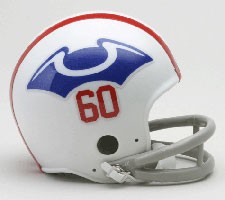
4. A TRI-CORNER HAT USED TO ADORN THEIR HELMETS.

Modern Patriots may wear that star-spangled “Flying Elvis” logo, but their forebears spent the 1960 season rocking a much simpler helmet design—one which consisted of a tri-corner hat sitting atop each player’s number.

5. THEY MOVED A LOT DURING THE 1960S.

Between 1960 and 1971, the Patriots changed venues four times. Nickerson Field, Fenway Park, Harvard Stadium, and Boston College’s Alumni Stadium all took turns hosting the team during that stretch.

6. IN 1970, A FIRE BROKE OUT IN THE STANDS.

In 1970, the Patriots’ final game at Alumni Stadium was rudely interrupted when a popcorn machine beneath the bleachers caught fire, scattering a large section of the crowd. “Fortunately, nobody was hurt,” said radio announcer Gil Santos, “and it wasn’t a huge section of seats that were burned. After the fire was out, everybody found a seat, and the game continued. Popcorn sales, of course, went down.”

7. THEY WERE GOING TO BE CALLED THE BAY STATE PATRIOTS, BUT THERE WAS A SLIGHT PROBLEM.

Upon leaving for Foxborough, Massachusetts in 1971, they were re-christened as “The Bay State Patriots.” The name was rejected when people pointed out the abbreviation would be “The B.S. Patriots.”

8. IN THE EARLY YEARS, THEIR STADIUM HAD SOME TOILET PROBLEMS.

Schaefer Stadium (a.k.a. Foxboro Stadium) wasn’t exactly Buckingham Palace. In 1971, the Pats’ longtime residence just barely passed a mandatory “flush-off” test—wherein health inspectors flushed every single on-property toilet simultaneously. The test was ordered after hasty repairs were made when it was discovered that the plumbing was insufficiently prepared.

9. A SNOW PLOW OPERATOR BECAME A SPORTS HERO IN 1982. 

On a harsh, wintry day in 1982, snowplow operator Mark Henderson became a New England folk hero when he cleared a patch of field for Patriots kicker John Smith, whose late field goal slew the visiting Miami Dolphins. Incidentally, at the time, Henderson was there on work release from prison.

10. THE 1990S DID NOT GET OFF TO A GREAT START FOR THE TEAM.

The year 1990 was unkind to New England football fans. Not only did the Patriots amass a franchise-worst 1-15 record, but in 11 of those losses, they never even led once.

11. THEY ALMOST MOVED TO ST. LOUIS.

When Missouri native James Orthwein bought the Pats in 1992, he had a single goal in mind: shipping them off to St. Louis. However, at the time, Foxboro Stadium was owned by Robert Kraft, who effectively nixed the idea and purchased Orthwein’s franchise two years later.

12. THEY ALMOST GOT SHIPPED OFF TO CONNECTICUT, TOO.

New England escaped relocation again in 1998. Businessmen from Hartford, Connecticut, attempted to lure Kraft’s Pats out of Massachusetts by offering a brand-new, publicly financed stadium. This blockbuster deal fell through when Kraft managed to secure $72 million from the Bay State, with which he eventually constructed Gillette Stadium—the squad’s current home.

13. TOM BRADY’S COLLEGE CAREER DIDN’T PORTEND HIS SUPERSTAR STATUS.

Getty Images

He may be a future Hall of Famer, but during his collegiate days, nobody would’ve mistaken Patriots QB Tom Brady for a big-shot. At one point, Brady was the seventh quarterback on the University of Michigan’s depth chart.

14. BRADY COULD HAVE PLAYED PRO BASEBALL INSTEAD.

Speaking of Brady: the Montreal Expos drafted him as a catcher in 1995. (He didn’t play.)

15. THE TEAM’S SUPER BOWL VICTORIES HAVE BEEN CLOSE.

Each of New England’s four Super Bowl victories was decided by four points or fewer.

16. THEY’VE GOT THE LONGEST WINNING STREAK IN PRO FOOTBALL HISTORY.

The franchise claimed 21-straight regular and postseason wins from 2003-2004, an NFL record.

17. IT TOOK NEARLY 30 MINUTES FOR EITHER TEAM TO SCORE IN SUPER BOWL XXXVIII.

Though the Pats eventually prevailed over Carolina in Super Bowl XXXVIII, viewers had to wait 26 minutes and 55 seconds before either team scored. However, the teams scored 37 combined points in the fourth quarter, the most ever in a single quarter of a Super Bowl.

18. VLADIMIR PUTIN MIGHT HAVE ONE OF ROBERT KRAFT’S CHAMPIONSHIP RINGS.

Getty Images

Vladimir Putin: jewelry thief? Kraft claims that, while visiting Russia, he had to bid one of his championship rings “dasvidanya.” Allegedly, President Putin had asked to hold it, remarking “I could kill someone with this ring.” Kraft complied, at which point the statesman pocketed the keepsake and left. Kraft later said it was a gift. Putin curiously said he has no memory of the event. “You know, I do not remember either Mr. Kraft or the ring,” he told AFP. “They handed out some sorts of souvenirs.”

19. GAME OF THRONES AUTHOR GEORGE R.R. MARTIN HAS LIKENED THE TEAM TO THE LANNISTERS.

Game of Thrones creator and Giants/Jets fan George R.R. Martin has said that, in his mind, the Patriots are the NFL’s Lannisters.

20. BILL BELICHICK RENAMED HIS BOAT AFTER THE 2015 SUPER BOWL.

Getty Images

Head coach Bill Belichick—who won two Super Bowl titles as a defensive coordinator with the Giants and four as head coach of the Pats—owns a boat he calls VI Rings. Up until 2015, it had been known asV Rings, but he renamed it in 2015, after the Patriots won Super Bowl XLIX. Who knows? After this Sunday, he just may have to re-christen it VII Rings. (We’re betting he wouldn’t mind the touch-up.)

Additional Sources:
Then Belichick Said to Brady…: The Greatest New England Patriots Stories Ever Told, by Jim Donaldson
The Patriot Way: The History of the New England Patriots
Patriots.com


February 3, 2017 – 8:00pm

‘Heat’ and ‘The Dark Knight’ Are Surprisingly Similar Movies

filed under: Movies, video
Image credit: 
Paul Kane/Getty Images

You may not have been thinking about Heat as you watched The Dark Knight in 2008, but Michael Mann’s 1995 heist classic had a major influence on Christopher Nolan’s Batman flick. Glass Distortion, the film analysis series, just took a look at the distinct echoes of Heat and other Mann movies that appear in The Dark Knight, as Gizmodo spotted.

In an interview, Nolan directly cited Mann as an inspiration on the film, telling Variety in 2009 that he screened Heat for his department heads before they started filming.

“I always felt Heat to be a remarkable demonstration of how you can create a vast universe within one city and balance a very large number of characters and their emotional journeys in an effective manner,” Nolan said. See how that inspiration made its way into his blockbuster:

[h/t Gizmodo]


February 3, 2017 – 6:30pm

17 Super Facts About the Atlanta Falcons

Image credit: 
Kevin C. Cox/Getty Images

For the second time in franchise history, the Atlanta Falcons are headed to the Super Bowl. Will they rise up and claim Atlanta’s first major pro sports championship since 1995? Super fan Samuel L. Jackson has definitely got his fingers crossed. From adventurous mascots to touchdown dance crazes, here’s a quick primer on everything you should know about the “Dirty Birds.”

1. ATLANTA’S TEAM WAS ALMOST THE CARDINALS.

Before the Falcons came along, the Arizona Cardinals (as we now know them) considered migrating to Atlanta. From 1960 to 1987, this storied football team played in St. Louis, where they were briefly holed up in an outdated stadium called Sportsman’s Park. Owners Bill and Charles Bidwill didn’t think much of this home field and the replacement was suffering constant delays, so between 1963 and 1964, they met with Atlanta mayor Ivan Allen Jr. to talk about the possibility of bringing their Cards to Georgia’s capital city. Faced with the threat of losing its NFL team, the city of St. Louis appeased the Bidwills by building Busch Memorial Stadium, a $24 million sports venue. It opened in 1966.

2. THEY WERE BORN IN 1965.

The Atlanta Falcons were born in 1965 as an NFL expansion team, which the league awarded to Atlanta-based insurance executive Rankin Smith for $8.5 million. At the time, this was the highest sum that had ever been paid for a professional sports franchise. (By comparison, in 2008 the Miami Dolphins were purchased for $1 billion. How times have changed.)

3. THE TEAM’S FIRST-EVER DRAFT PICK GOT SOME ADVICE FROM AN ASTRONAUT, AND IGNORED IT.

Linebacker Tommy “Mr. Falcon” Nobis has the distinction of being the franchise’s first-ever draft pick. He’s also one of the few athletes who’s ever gotten career advice from an astronaut. In college, Nobis averaged almost 20 tackles per game and led his Texas Longhorns to a national title in 1963. His skills caught the attention of two rival football leagues: the established National Football League and the upstart American Football League. (On June 8, 1966, the two leagues announced that they would merge and form the modern NFL.)

When he decided to turn pro, Nobis was drafted by both the Falcons—who were part of the old NFL—and the AFL’s Houston Oilers. News of this debacle reached the orbiting Gemini 7 spacecraft. In a transmission back to earth, astronaut Frank Borman said, “Tell Nobis to sign with Houston.” But the linebacker picked Atlanta instead. Nobis officially signed with the Falcons on December 14, 1965 and would play a major role in their inaugural season in 1966.

4. THEY’VE BASED THEIR TEAM COLORS ON POPULAR COLLEGE TEAMS.

Tim Warner/Getty Images

Why do the Falcons wear red and black? Their color scheme is an homage to the Georgia Bulldogs. Early in their history, the Falcons paid tribute to another beloved SEC team—the Georgia Tech Yellow Jackets—with a pair of gold stripes that graced their helmets from 1966 to 1970.

5. A FORMER COACH USED SOME ODD PROPS TO MOTIVATE THE TEAM, INCLUDING A STICK OF DYNAMITE.

Interim head coach Jim Hanifan used some weird—and potentially dangerous—props in his motivational speeches. While the team was getting ready to take on the San Francisco 49ers in week 13 of the 1989 season, Hanifan walked into their locker room holding an unlit stick of dynamite. Imploring the players to “be explosive with every play,” he invited them to walk up and touch the strange visual aid. (It didn’t help; the Falcons lost 23-10.)

For the next game, when the club visited Minnesota, Hanifan brought in three hand grenades. After the Falcons were trounced 43-17, Hanifan upped the ante by leaving a disarmed bomb in the locker room. (Incidentally, he had the thing painted red and black. Nice touch.) One Falcon was reported as saying, “If we lose to Washington Sunday, [Hanifan’s] liable to show up for that last game with something nuclear.” The Falcons lost 31-30.

6. WHEN THEY DRAFTED BRETT FAVRE IN 1991, A LEAGUE EXECUTIVE MISPRONOUNCED HIS NAME AS “FAVOR.”

Hall of Fame quarterback Brett Favre famously spent his rookie season in Atlanta. When the Falcons nabbed him in the 1991 draft, the announcement was made by NFL executive Don Weiss, who mispronounced the last name of the future superstar. “Atlanta has selected Brett Favor, quarterback, Southern Mississippi,” Weiss said.

7. THEY WERE FANS OF M.C. HAMMER.

The 1991 Falcons chose M.C. Hammer’s “2 Legit 2 Quit” as their team anthem. That year, Hammer, who frequented Atlanta home games, gave wide receiver Andre Rison and cornerback Deion Sanders a cameo in the song’s official music video. Then-head coach Jerry Glanville made an appearance as well.

8. A 38-YARD OVERTIME FIELD GOAL SENT THEM TO THEIR FIRST SUPER BOWL.

One of the greatest moments in the Falcons’ franchise history came at the end of the 1998 NFC Championship Game, when kicker Morten Andersen made a 38-yard overtime field goal that sent the Falcons to their first Super Bowl. Andersen was one incredible athlete: During his 25-year NFL career, he took the field in 382 games, more than any other player in league history. Furthermore, he’s also the NFL’s all-time leading scorer. Andersen clinched this latter record as a member of the Falcons. During a 2006 loss to the Dallas Cowboys, he nailed an extra point attempt in the second quarter. This gave him 2435 career points overall—one more than the previous record-holder. By the time he retired, Andersen had drilled in a grand total of 2544 points, including the 806 he made in a Falcons jersey.  

9. THEIR “DIRTY BIRD” DANCE WAS A HIT WITH FANS.

Show us a Falcons fan who grew up in the 1990s, and we’ll show you someone who probably knows the “Dirty Bird” dance by heart. Running back Jamal Anderson is usually credited with inventing the jig during Atlanta’s ’98 Super Bowl run. Before long, everybody on the roster was doing it—even head coach Dan Reeves showed off his own version right after the Falcons were handed the 1998 NFC Championship trophy.

The following off-season, Atlanta linebacker Jessie Tuggle made an appearance at a local elementary school function. At one child’s request, the NFL veteran started doing the Dirty Bird. But just a few seconds in, the kid interrupted him. “He said, ‘That’s not how Jamal does it!’” Tuggle recalled to The New York Times. “And then he started doing it himself to show me. That was pretty much the last time I agreed to do the Dirty Bird when someone asked me.”

10. THE TEAM’S MASCOT ONCE FLEW AWAY DURING PRACTICE DRILLS.

For the club’s first 15 seasons, an actual falcon assumed mascot duty. Back then, the team played in Atlanta-Fulton County Stadium, which didn’t have a roof. As avian trainer Mike Cady found out the hard way, this was not an ideal situation. While practicing drills on the field one day in 1966, Cady’s raptor suddenly flew out of the building. “[The bird] just chickened out,” Cady told the press. The wayward falcon was later recovered when somebody saw it loitering at a Kraft food plant in suburban Atlanta and called Cady, who quickly recaptured his escapee.

11. THE TEAM’S GOT A STAR-STUDDED FAN BASE.

Scott Cunningham/Getty Images

The Falcons have one star-studded fan base: Jeff Foxworthy, Samuel L. Jackson, Jimmy Carter, and Usher are among the many celebrities who live and die with the Dirty Birds. Believe it or not, one of their most prominent boosters is now the quarterback of a rival team. Carolina Panthers QB Cam Newton grew up in Atlanta, where he rooted for the Falcons through thick and thin. Despite the fact that he presently plays for another franchise in the same division, Newton’s affection for his hometown team remains strong. “I’ve always been a Falcon fan,” he said in a 2013 interview, “and I’m still a Falcons fan—except for those two times a year [when they play Carolina].”

Another Falcons diehard? Moe Szyslak from The Simpsons. In the season 10 episode “Sunday, Cruddy Sunday,” Springfield’s number one bartender leapt at the chance to attend Super Bowl XXXIII because it features his “favorite team,” the Falcons. “Ever since I was a boy,” he tells Homer, “I’ve always loved the Atlanta Falcons.”

12. THEY WERE THE FIRST TEAM TO FACE OFF AGAINST THE SAINTS IN NEW ORLEANS AFTER HURRICANE KATRINA.

In week three of the 2006 season, the Falcons were the visiting team in the first post-Katrina home game of their perennial archrivals, the New Orleans Saints. As a Monday Night game, it was broadcast by ESPN. Over 10 million people across the country tuned in to watch the meaningful matchup, giving it the second-largest cable audience of any broadcast in history at the time.     

13. IN 2012, THOMAS DECOUD PLAYED THE “MEOW GAME” WITH AN ESPN REPORTER.

Back in 2012, Thomas DeCoud, a free safety who suited up for Atlanta from 2008 to 2013, decided to mess with ESPN sportscaster Bram Weinstein by playing the Super Troopers “meow” game during a live interview. For the uninitiated, the rules—as established in the 2001 cult comedy—are straightforward: Just find somebody to talk with and then see how many times you can sneak the word “meow” into your sentences before he or she catches on. In the span of four minutes, DeCoud dropped 14 audible meows. Weinstein later claimed that he finally realized what was going on near the end of the interview. “You killed me man,” he told DeCoud on Twitter after the fact. “Funny. I’m a Falcons fan now. Meow.”

14. QUARTERBACK MATT RYAN’S CAREER GOT OFF TO A GREAT START.

Talk about a great first impression: Current starting quarterback Matt Ryan’s very first professional pass in the NFL, in 2008, was a 62-yard touchdown throw to wide receiver Michael Jenkins. 

15. A PLAYER’S WIFE WAS RECENTLY AWARDED THE TEAM BALL—AND WITH GOOD REASON.

Last month, Atlanta held off Seattle with a final score of 36-20 to secure an NFC Championship appearance—the club’s second in five years. Katie Levitre, wife of Falcons guard Andy Levitre, would’ve had a great excuse for missing that Seahawks game: She went into labor just before kickoff.  But instead of calling an ambulance, Katie decided to stay put in the stadium. She also refrained from breaking the news to her husband until after the game. That afternoon, the couple went to a local hospital where Katie gave birth to their first child, a healthy baby girl they named Lily. In recognition of her amazing toughness, the proud new mother was awarded the game ball by head coach Dan Quinn.

16. THEY’RE ABOUT TO GET A NEW HOME.

The Falcons will soon have a new nest to roost in. The team is set to move into Mercedes-Benz Stadium, a $1.5 billion venue presently under construction, for the upcoming season. Among other things, the surrounding plaza will feature the largest metal bird statue on Earth—a football-clutching metallic falcon with a 64-foot wingspan.

17. ONE FALCONS SUPER FAN HAS BANNED THE SALE OF SAMUEL ADAMS BEER IN HIS STORE UNTIL AFTER THIS YEAR’S SUPER BOWL.

Dave Kotinsky/Getty Images for NYCWFF

An Exxon gas station in Gainesville, Georgia recently made headlines when the manager, Hadji Chhadua, decided to ban the sale of Samuel Adams beer in his establishment until after Super Bowl LI. The story quickly gained traction on Twitter, where the Boston-based brewery weighed in with a couple of tweets, one of which read “don’t worry Atlanta, we’re still drinking Coca-Cola.”


February 3, 2017 – 6:00pm

020617 newsletter

Newsletter Subject: 
9 Facts About the ACLU (and We're Getting Closer to Developing a Zika Vaccine)
Featured Story: 
Newsletter Item for (91738): 9 Facts About the ACLU
From the Editors: 
Newsletter Item for (91738): 9 Facts About the ACLU
Newsletter Item for (91826): Scientists Make Progress Toward a Safe, Effective Zika Vaccine
Newsletter Item for (91818): See the History of New York’s Tattoo Culture in 10 Photographs
Newsletter Item for (91770): How Does Your State Stack Up in This Year's Well-Being Rankings?
Newsletter Item for (91756): Why Was February Chosen for Black History Month?
The Grid: 
13 Products That Taste and Smell Like Pickles
Megabus Wants to Throw You a Free Wedding (on a Megabus)
The Library of Congress Sigmund Freud Collection Is Now Available Online
Plants Tailor Their Chemical Weapons to Match Their Opponent
Fun Fact Text: 

Cadbury invented the heart-shaped chocolate box in 1861.

Fun Fact Image: 
Fun Fact Url: 
http://mentalfloss.com/article/91284/11-sweet-facts-about-cadbury
Use Grid Ad: 
Scheduled Send: 
Send Date: 
Monday, February 6, 2017 – 08:40
Fun Fact Caption: 
iStock
More Info Text: 

020717 newsletter

Newsletter Subject: 
13 Secrets of Forensic Entomologists (and How to De-Politicize Your Facebook Feed)
Featured Story: 
Newsletter Item for (91862): 13 Secrets of Forensic Entomologists
From the Editors: 
Newsletter Item for (91862): 13 Secrets of Forensic Entomologists
Newsletter Item for (91867): TGI Fridays's Origin Story: A Pioneering Singles Bar
Newsletter Item for (91824): Here's How to De-Politicize Your Facebook Feed
Newsletter Item for (91889): Weddings Are Getting Smaller—And More Expensive
Newsletter Item for (54846): What's the Correct Pronunciation of February?
The Grid: 
New Dating App Matches You Based on a Mutual Hatred of Things
How 'Sesame Street' Dealt With 9/11
A Hayao Miyazaki-Inspired Art Show Is Coming to San Francisco
11 Steps for Stress-Free Mattress Shopping
Fun Fact Text: 
Shih Tzus are more closely related to wolves than Rottweilers are.
Fun Fact Image: 
Fun Fact Url: 
http://mentalfloss.com/article/86196/9-fluffy-facts-about-shih-tzu
Use Grid Ad: 
Scheduled Send: 
Fun Fact Caption: 
iStock
More Info Text: 

Do Certain Sounds Enrage You? Neurologists May Know Why

Image credit: 
iStock

If the sound of a co-worker repeatedly clicking his pen can send you into a flaming furor, take heart: You’re not being hypersensitive, and you’re not alone. Neurologists in the UK have spotted physical differences in the brains of people with this sound-related rage, although whether these differences are the cause or the result of the disorder remains to be seen. The scientists published their findings in the journal Current Biology.

The technical term for that noise-triggered irritation and rage is misophonia (“hatred of sound”). People who have it experience uncontrollable and intense negative emotions after hearing certain repetitive noises like chewing, lip-smacking, pen-clicking, and foot-tapping.

It’s a relatively new concept within the medical community, although people have been complaining of symptoms for a long time. To those who’ve never experienced misophonia, it may sound silly or made-up—which is what many doctors have concluded. Others have categorized it as a form of anxiety or obsessive-compulsive disorder.

The authors of the current paper wondered if the problem might not be psychological but neurological. They recruited 20 British adults with misophonia and 22 without, and gave them all questionnaires to gauge their responses to various noises. Then they put each participant inside MRI and fMRI machines and played them all sorts of noises, including the benign (a kettle whistling, rain), the universally unpleasant (a baby crying, someone screaming), and common misophonia triggers (breathing, chewing).

As the researchers suspected, the results for the two groups looked very different. People with misophonia had more myelin, or insulation, around the gray matter in their prefrontal cortex. They also showed abnormal connections between this cortex and the anterior insular cortex, which is involved in processing information and emotions.

Hearing the trigger noises caused a spike in activity in both cortices for people with misophonia. For people without it, activity only increased in the prefrontal cortex. The trigger sounds also provoked a clear stress response in people with misophonia. Their heart rates increased and they began sweating.

Lead researcher Sukhbinder Kumar is a neuroscientist at Newcastle University and University College London. He says his team’s research should reassure people with misophonia and validate the condition’s existence to their doctors.

“Patients with misophonia had strikingly similar clinical features, and yet the syndrome is not recognized in any of the current clinical diagnostic schemes,” he said in a statement. “This study demonstrates the critical brain changes as further evidence to convince a skeptical medical community that this is a genuine disorder.”

It also suggests a possible way of treating the condition. “My hope is to identify the brain signature of the trigger sounds,” Kumar said. “Those signatures can be used for treatment such as for neuro-feedback, for example, where people can self-regulate their reactions by looking at what kind of brain activity is being produced.”


February 3, 2017 – 4:30pm