6 Other Puzzles Invented by the Creator of the Rubik’s Cube

filed under: toys, fun
Image credit: 

By Huso Taso – 2x3x3 Domino Cube, CC BY 2.0, Wikimedia Commons

by James Hunt

Ernő Rubik was born in Budapest, Hungary, in 1944. You probably recognize his name, and that’s because in 1974 he created the Rubik’s Cube, the handheld puzzle that would go on to become a global obsession through the 1980s and beyond. (It’s estimated that more than 350 million have been sold, in addition to thousands of variants and alternate versions.)

Though Rubik never managed that level of success again, that didn’t stop him from inventing. Here are six more of Rubik’s puzzles.

1. RUBIK’S DOMINO

Following the success of his eponymous cube, Rubik invented several more twisting-based mechanical puzzles. The Rubik’s Domino looked similar to a cube, but had one layer removed so that it was composed of just 18 smaller cubes rather than 27. The goal was to rearrange the numbers one through nine (presented using domino-style dots) on both sides—black on white and white on black—so that they were in the correct order. Although it had 406,425,600 potential positions, it could be solved in just 19 moves—if you knew how, of course.

2. RUBIK’S CHEESE

Another mechanical puzzle based around twisting, the Rubik’s Cheese was invented shortly after the Cube’s release, then patented (under the name “Shiftable Element Puzzle“) in 1983. To solve the Cheese you had to group two layers of colored pieces together so that all 12 were matched correctly, twisting it in half to move groups of six pieces around at a time.

The Cheese was later replaced by the Rubik’s UFO, which worked in a similar way but resembled a flying saucer and had two layers of pieces which could be twisted around the center as well as folded over.

3. RUBIK’S MAGIC

CC BY-SA 3.0, Wikimedia Commons

The Rubik’s Magic consists of eight tiles which are linked by wires, which allow them to be folded and manipulated into a variety of shapes. Initially depicting three unlinked rings, the goal is to fold the Magic into a heart shape, which shows three linked rings. Although far from simple, it can be solved in less than one second by the fastest experts. In 1987, a Master Edition was released which had 12 tiles and showed five different rings.

4. RUBIK’S SNAKE

Less obviously a puzzle, the Rubik’s Snake (also known as the Rubik’s Twist) consists of 24 linked triangular prisms which can be twisted and folded but not pulled apart. The intention is for the player to recreate a number of shapes (i.e. animals, or a sphere) by twisting the snake, as well as coming up with his or her own creations.

Mathematician Peter Aylett computed that there were 6,770,518,220,623 distinct and valid ways to fold the snake—although obviously not all of them resemble anything interesting.

5. RUBIK’S TANGLE

In the 1990s, Rubik came up with the Rubik’s Tangle—a 25-piece tile puzzle depicting lengths of string in four different colors. Each puzzle piece is identically sized and can be rotated through four different orientations. Two pieces are actually identical, meaning there are two “correct” solutions to the Tangle—a unique feature amongst Rubik’s puzzles.

6. RUBIK’S 360

By Oldsoft – Own work, Public Domain, Wikimedia Commons

After over a decade pursuing other ventures, Rubik returned to the world of mechanical puzzles in 2009 with the Rubik’s 360. The puzzle involves manipulating a clear plastic sphere so that the six balls inside it are positioned into the color-coded compartments. Unlike the Rubik’s Cube, it appears to be impossible to solve the puzzle using simple algorithms. As a result, the fastest recorded time for solving the Rubik’s 360 is 37.02 seconds—far longer than the sub-10 seconds it takes the fastest players to solve a Rubik’s Cube.

And while that’s it for toys, it’s worth pointing out that Rubik also tried his hand at other inventions. Our favorites? The light aircraft frame designed to allow pilots to take off and land on their own feet, and these nifty clamp-style clothespins. We’re still waiting for both of these to turn up in stores.


September 14, 2016 – 8:00pm

Dutch Police Hire Eagles to Take Down Drones

filed under: Animals, technology
Image credit: 
istock

Humans have been working with birds for thousands of years: We’ve hired them to carry our messages, help us find honey, protect our crops, and even act as spies. So it only makes sense that when the people of the Netherlands began to worry about catching rogue drones, they turned to their avian friends for help. Back in February, we reported that the Dutch police were training eagles to pluck illegal drones from the sky. Now, The Next Web reports, the eagle trial and training program is complete, and the birds are finally taking to the skies.

Dutch police will use the highly skilled eagles to tackle rogue drones that pose a security threat. For instance, if police spot a dangerous-looking drone when a politician is making a public appearance, protocol will be to move the politician safely inside, then release an eagle to take down the robot. After a seven-month training period conducted with help from Guard From Above, Dutch police are now so confident in the abilities of their eagle enforcers, they’ve started purchasing eagle chicks, which they will train from infancy.

“It’s a low-tech solution to a high-tech problem,” police spokesman Dennis Janus told AFP during a public demonstration. “The eagles see the drones as prey and intercept them as they are flying, before landing where they feel safe with the drone still in their claws.”

To see one of the impressive take-downs, check out the video below.

[h/t The Next Web]

Know of something you think we should cover? Email us at tips@mentalfloss.com.


September 14, 2016 – 7:30pm

Retrobituaries: Benjamin Banneker, the African-American Mathematician Who May Have Saved Washington, D.C.

Wikimedia Commons // Public Domain


Many people who have a passing familiarity with Washington, D.C. know it was originally styled after famous European locales by architect Pierre Charles L’Enfant, then completed by Andrew Ellicott after L’Enfant was given the boot in 1792. Too few tourists and history fans, however, know that the U.S. capital might have been a very different place if not for the surveying work of Benjamin Banneker—a highly accomplished mathematician, astronomer, and scholar who challenged Thomas Jefferson and his peers to recognize African-American achievement when it was right under their noses (and feet).

Benjamin Banneker was born November 9, 1731, in Baltimore County, Maryland, to Robert and Mary Banneker. While scholars still debate almost all the specifics of his background and early life, according to the most popular story, both sides of his family suffered under enslavement in the soon-to-be United States. Although records are scarce, it’s said that Benjamin’s maternal grandmother, a woman named Molly Welsh, was falsely convicted of theft in England and sentenced to indentured servitude in Maryland (not an uncommon practice at the time). After earning her freedom, she rented land in Baltimore County and purchased two slaves to help farm it. Several years later, after the farming operation was established, she freed both men.

One of them, who is said to have been abducted from a royal family in Africa earlier in his life, displayed a keen interest in astronomy and other scientific subjects. He was called Bannake or Bankka, and Molly Welsh married him, violating state law that forbid marriage to slaves. Later, their daughter Mary and her husband—a Guinean man who’d been abducted, enslaved, and then baptized as Robert and freed—chose to adopt the surname Banneker at the time of their own marriage. Just a few years after regaining his freedom, records show that Robert was able to purchase a 100-acre farm (possibly the same one his mother-in-law rented), where his family would live out much of their lives and where his son’s scholarship would bloom.

Benjamin Banneker grew up as one of only 200 free African-Americans among 13,000 whites and 4000 slaves in Baltimore County. His experience with formal instruction was limited to a brief stretch in a one-room, mixed-race Quaker schoolhouse, but he was a keen study from his earliest years. Perhaps with his doting grandmother Molly’s help, he learned to read and soon became especially interested in mathematics and mechanics, often performing calculations and experiments on his own.

Once he was old enough to work on the family farm, Banneker settled into a lifestyle that combined this work with scholarly achievement. After his father’s death when Banneker was 27, he continued running the farm with his mother and sisters. The horses, cows, garden, and multiple beehives he kept enabled a simple, comfortable life for the family, according to one 19th-century account presented to the Maryland Historical Society. Using crop rotation and irrigation techniques that wouldn’t catch on in the U.S. for many decades, he also raised profitable tobacco crops that were sold alongside his produce in the Ellicott family’s store. Taking heed of food shortages during the Revolutionary War, Banneker also swapped tobacco out for wheat to help feed American soldiers.

Throughout his life, Elizabeth Ross Haynes writes, Banneker “found time to study all the books which he could borrow.” He became well-versed in topics throughout the sciences and humanities. The 19th-century account presented to the Maryland Historical Society remembered Banneker as “an acute observer, whose active mind was constantly receiving impulses from what was taking place around him.”

For example, one rather illustrative 1797 journal entry reads:

Standing at my door I heard the discharge of a gun, and in four or five seconds of time, after the discharge, the small shot came rattling about me, one or two of which struck the house; which plainly demonstrates that the velocity of sound is greater than that of a cannon bullet.

Some historians have speculated that Banneker’s many childhood lessons with his grandmother Molly, who may have gained a sophisticated understanding of astronomy from Bannake, could have fostered his particular expertise with the subject. However, it was his prowess with mathematics for which he first became renowned throughout Baltimore County, according to a 1912 article. As word spread of his exceptional skills, far-away scholars began sending Banneker complex mathematical problems, and they continued to do so throughout his life. Banneker reportedly always solved them, often responding in verse and with a fresh problem.

As a young man, Banneker also gained fame and admiration for miles around due to one of his earliest known mechanical feats: building a working clock almost entirely out of wood from scratch. It may have been the first clock ever assembled completely from American parts, according to Haynes (although other historians have since disputed this). Banneker reportedly only had a borrowed pocket watch to use for reference on clockwork mechanisms, while his wooden version contained functioning, carved-to-scale components. The clock continued working until a few days after Banneker’s death, when a fire destroyed his cabin home and many of its contents—clock included.

However, Banneker’s accomplished scholarship remained mostly unknown outside the region until he encountered the Ellicott family. In 1772, the Quaker Ellicotts purchased the land next door to Banneker’s and began building new gristmill facilities there. Banneker’s fascination with the mill’s mechanics made him a frequent visitor to the site. In keeping with Quaker tradition, the similarly scholarly Ellicotts were adamant proponents of racial equality, and they collaborated with Banneker as well as encouraged wider application of—and recognition for—his unique skills.

George Ellicott, a close friend of Banneker’s for decades, was himself a student of astronomy and eagerly shared both his resources and queries with his neighbor. Banneker took great advantage of the borrowed tools and books in performing exquisite astronomical calculations, such as predicting a solar eclipse near-exactly in 1789. He also began building the foundations for several atlases and technical treatises he’d release in the decades before his death. In 1791, George’s cousin, Major Andrew Ellicott, gave Banneker a national stage, after Andrew had gone to George requesting help with a new job. George, being otherwise busy, suggested Banneker’s assistance. The job was surveying land along the Potomac River for what would soon be the nation’s capital, Washington, D.C.

Ellicott’s plan for Washington, D.C. Image credit: Leeann Cafferata, Flickr // CC BY-SA 2.0

The plans for the large city were laid out by French architect and engineer Pierre Charles L’Enfant, who volunteered for service in the American Revolution’s Continental Army and was hired for the project by George Washington in 1791. Before long, however, tensions mounted over its direction and progress of the project, and when L’Enfant was fired in 1792, he took off with the plans in tow.

But according to legend, the plans weren’t actually lost: Banneker and the Ellicotts had worked closely with L’Enfant and his plans while surveying the city’s site. As the University of Massachusetts explains, Banneker had actually committed the plans to memory “[and] was able to reproduce the complete layout—streets, parks, major buildings.” However, the University of Massachusetts also points out that other historians doubt Banneker had any involvement in this part of the survey at all, instead saying that Andrew and his brother were the ones who recreated L’Enfant’s plan. It’s an intriguing myth, but it may only be that.

Yet Banneker’s valuable contributions to the project drew attention, and set the stage for later correspondence with Thomas Jefferson. During the project, the Georgetown Weekly Ledger made public note of Banneker as “an Ethiopian, whose abilities, as a surveyor, and an astronomer, clearly prove that Mr. Jefferson’s concluding that race of men were void of mental endowments, was without foundation.”

Gelman Library, George Washington University // Public Domain

In 1791, Banneker had finished his “painstakingly calculated ephemeris,” or table of the position of celestial bodies, which he would publish alongside charts, literature, and humanitarian and political essays in six almanacs with 28 editions in the following six years. Upon its initial completion, he first sent a copy of the ephemeris to then-Secretary of State Thomas Jefferson, along with a famously direct, yet perfectly polite, letter challenging Jefferson’s opinion that African-Americans suffered an innate intellectual disadvantage [PDF]. Among other things, the letter observed:

Sir, I have long been convinced, that if your love for yourselves and for those inestimable laws, which preserved to you the rights of human nature, was founded on sincerity, you could not but be solicitous that every individual … might with you equally enjoy the blessings thereof, neither could you rest satisfied [short of] their promotion from any state of degradation, to which the unjustifiable cruelty and barbarism of men may have reduced them.

Sir, I freely and cheerfully acknowledge that I am of the African race … and it is under a sense of the most profound gratitude to the supreme ruler of the Universe, that I now confess to you, that I am not under the state of tyrannical thraldom, and inhuman captivity to which many of my brethren are doomed, but that I have abundantly tasted of the fruition of those blessings, which proceed from that free and unequalled liberty, with which you are favored, and which, I hope you will willingly allow, you have received from the immediate hand of that being … [and] that the present freedom and tranquility which you enjoy, you have mercifully received, and that it is the peculiar blessing of heaven.

Jefferson’s letter of response the same year was significantly shorter than Banneker’s, and not without traces of the mindset Banneker sought to defeat. But it also documented the scholar’s triumph in gaining some respect for his accomplishments, and in helping to dislodge certain prejudices from the minds of the era’s most learned men.

On August 30, 1791, Jefferson wrote:

SIR,

I THANK you, sincerely, for your letter of the 19th instant, and for the Almanac it contained. No body wishes more than I do, to see such proofs as you exhibit, that nature has given to our black brethren talents equal to those of the other colors of men ; and that the appearance of the want of them, is owing merely to the degraded condition of their existence, both in Africa and America. I can add with truth, that no body wishes more ardently to see a good system commenced, for raising the condition, both of their body and mind, to what it ought to be, as far as the imbecility of their present existence, and other circumstances, which cannot be neglected, will admit.

I have taken the liberty of sending your Almanac to Monsieur de Condozett, Secretary of the Academy of Sciences at Paris, and Member of the Philanthropic Society, because I considered it as a document, to which your whole color had a right for their justification, against the doubts which have been entertained of them.

I am with great esteem, Sir, Your most obedient Humble Servant,

THOMAS JEFFERSON.

The discrimination African-Americans suffered from Jefferson and other bigwigs is well-documented, and Banneker’s brave, considered opposition to it stands forever among his many admirable achievements. The 1854 document A Sketch of the Life of Benjamin Banneker reflected:

He appears to have been the pioneer in the movement in this part of the world, toward the improvement of his race; at a period of our history when the negro occupied almost the lowest possible grade in the scale of human beings, Banneker had struck out for himself a course, hitherto untravelled by men of his class, and had already earned a respectable position amongst men of science.

Records suggest that Banneker also suffered discrimination by lower-profile white Americans, and had his achievements belittled and questioned. Despite the many pushbacks he withstood, however, Banneker remained joyfully curious and generous of spirit throughout his life. According to A Sketch of the Life of Benjamin Banneker, he was able to slough off the bitterness of others in part thanks to his prevailing interest in study. “His equilibrium was seldom disturbed by the petty jealousies and inequalities of temper of the ignorant people,” the book notes, “with whom his situation obliged him frequently to come in contact.”

Benjamin Ellicott, who prepared extensive notes on Banneker’s life for the Maryland Historical Society, remembered him as such in a letter:

Although his mode of life was regular and extremely retired, living alone, having never married,–cooking his own victuals and washing his own clothes, and scarcely ever being absent from home, yet there was nothing misanthropic in his character … [He was known as] kind, generous, hospitable, humane, dignified and pleasant, abounding in information on all the various subjects and incidents of the day; very modest and unassuming, and delighting in society at his own home.

Given Banneker’s wide-ranging interests and enthusiasm, then, it is perhaps fitting that a variety of parks, schools, awards, streets, businesses, and other public and private institutions and facilities all bear his name today. Admirers can learn about the accomplished scholar at Benjamin Banneker Park and Memorial in Washington, D.C., for example, or at Baltimore, Maryland’s Benjamin Banneker Historical Park and Museum. Others can choose to follow in his footsteps by exploring their passions and hobbies at community centers named for Banneker in Washington, D.C., Bloomington, Indiana, and Catonsville, Maryland. It seems possible, however, that the man himself might have been most fond of—or, at least, a very frequent visitor to—Maryland’s own Banneker Planetarium.

Header images via Wikimedia Commons // Public Domain

Know of something you think we should cover? Email us at tips@mentalfloss.com.


September 14, 2016 – 7:00pm

London Plans to Create Affordable Housing for Artists

filed under: art, cities
Image credit: 
iStock

It’s hard to make a living as an artist, and as rents rise and arts jobs dwindle, creatives from New York to New Delhi are being priced out of their homes and studios. But at least one city is trying to change that. CityLab reports that London Mayor Sadiq Khan and Deputy Mayor for Culture Justine Simons are trying to make London affordable for artists again by developing “Creative Enterprise Zones.”

Khan and Simons are still settling on specific plans for the creative zones, but they may establish subsidized live-work spaces for lower income artists and creatives, or make certain studio complexes off limits to residential developers. Simons is also reportedly considering a plan to help more established artists purchase their own studios, in particular by helping them navigate a labyrinthine loan application system that can be particularly challenging for those without full-time jobs. 

Simons tells The Evening Standard that artists in London earn, on average, £10,000 ($13,300) annually—well below what’s considered a living wage. Simons and Khan believe the key to preserving London’s thriving arts community is as simple as ensuring artists can afford to live there. Neighborhoods like Hackney Wick and Southeastern Peckham, which have long had a high concentration of artists, are becoming increasingly pricey—in part because the artists, themselves, have made them “cool.”

“At the moment artists and creative people are like the advance party—they find the stranger, weird places that no one sees much value in, they bring them to life, the area becomes valuable and then they are priced out of the market,” Simons told The Evening Standard. “What we want to create is an area where creative people can put down roots and that would be a creative enterprise zone. That’s working with local authorities, developers with the creative community and residents. It’s putting a spotlight and a ring around an area.”

[h/t CityLab]

Know of something you think we should cover? Email us at tips@mentalfloss.com.


September 14, 2016 – 6:30pm

9 of the Most Exclusive College Secret Societies

Image credit: 

Skull & Bones, Wikimedia Commons // Public Domain

Many of the most prominent people in the world once belonged to an exclusive college society, from President Theodore Roosevelt to former British Prime Minister David Cameron. Some of these societies, based at the top universities, meet to debate issues of the day, while others focus on the literary, the philanthropic, fine dining, or hell-raising. One thing they all have in common: secrecy. Discovering the details of what goes on in their meetings or how to gain membership is fiendishly difficult, but what we know about 10 of the most exclusive college secret societies in the world is summarized below.

1. SEVEN SOCIETY, UNIVERSITY OF VIRGINIA // GRAFFITI AND PHILANTHROPY

A Seven Society sign outside Old Cabell Hall at the University of Virginia. Image credit: Queerbubbles via Wikimedia // CC BY-SA 3.0

The Seven Society of University of Virginia is so secretive that very little is known about its history, activities, or membership. It was rumored to have been established around 1905, when eight students made plans to get together for two tables of bridge but only seven turned up. It was probably originally based on a Masonic system, and its visibility is maintained by daubing the society’s symbol on college buildings.

Over the years a number of very generous gifts have been donated by the society (often revealed in theatrical fashion). For example, during the commencement address in 1947, a small explosion interrupted the proceedings and all assembled were surprised to see a check for $177,777.77 float dramatically to the ground. The amount was used to create a fund to help bail out any faculty member or student who found themselves in financial difficulties. Members of the Seven Society are only revealed on their death; at one time, a wreath of black magnolias in the shape of a seven was always placed at their grave.

2. THE BULLINGDON CLUB, OXFORD UNIVERSITY // DRUNKENNESS AND VANDALISM

The Bullingdon Club: the secret life of the mighty men who govern Britain

One of the most notorious, riotous, and exclusive of the college secret societies in the United Kingdom is the Bullingdon Club of Oxford University, which was founded around 1780. Its members are selected from the aristocracy and the most prominent banking, business, and political families in Britain. Former members have gone on to form a network of individuals in the top seats of power.

With such a successful alumni one might think that the Bullingdon must be an intellectual society, but it is far more concerned with fine dining. The club meets regularly for elaborate dinners and it has been alleged that many of these affairs have ended with restaurants being trashed, mischief being made, and the police being called. Former British Prime Minister David Cameron, former Chancellor of the Exchequer George Osborne, and former Mayor of London Boris Johnson have been dogged by a famous photo of them all dressed up in their bow-ties and tails for a group photo of Bullingdon Club members in 1987—such was the toxicity of the photograph that it has been withdrawn from use as the politicians struggled to distance themselves from the hell-raising society.

It is rumored that the initiation ceremony is to have your dorm room ransacked by fellow members, and tales abound of drunkenness, vandalism, and strippers (perhaps unsurprisingly, women are not allowed in the club). Despite its bawdy reputation former members of this exclusive club have gone on to great things, perhaps proving that a misspent youth is no barrier to success.

3. SKULL AND BONES, YALE // PRESTIGIOUS POLITICAL ALUMNI

The Skull & Bones “tomb.” Image credit: Wikimedia Commons // Public Domain

One of the most famous (and infamous) secret college societies in the U.S. is the Skull and Bones at Yale. Previous alumni include such notables as George Bush senior, George W. Bush, and John Kerry. Established in 1832, the very secretive society has just 15 senior members at any one time, who they meet twice a week in their windowless private meeting room known as “The Tomb.” Each year 15 new members are chosen to join the select club, and it is rumored new members each receive $15,000 and a grandfather clock. Prominent families often make up much of the membership and the subsequent success—both politically and in business—indicates the prestige and level of exclusivity that membership bestows. Many legends surround the group, the most famous perhaps being that in 1918 a team of Bonesmen (allegedly including Prescott Bush, father of George H. W. Bush) stationed near Fort Sill, Oklahoma dug up the skull of Apache leader Geronimo (who died there in 1909 after years as a prisoner of war) and took it back to their HQ as a trophy.

4. ORDER OF GIMGHOUL, UNIVERSITY OF NORTH CAROLINA // CREEPY …

Gimghoul Castle in Chapel Hill, North Carolina. Image credit:THE evil fluffyface via Wikimedia Commons // CC BY-SA 3.0

One of the spookiest college secret societies is the Order of Gimghoul, created in 1889 for students of the University of North Carolina. The society was originally called the Order of Droomgole after the mysterious disappearance of Peter Droomgole, who vanished from campus in 1833 after losing a duel with a love rival, but the name was later changed to Gimghoul because it sounded more sinister. The all-male Order of Gimghoul has its headquarters in a spooky castle on campus and is said to have its basis in Arthurian traditions of chivalry and honor. But with its creepy castle, fondness for satanic iconography, and veil of secrecy, the society’s reputation is more likely to send shivers down your spine than conjure images of noble knights.

5. FLAT HAT CLUB, WILLIAM AND MARY // AMERICA’S FIRST COLLEGE SECRET SOCIETY

The F.H.C. club, also known as the Flat Hat Club—although its initials are thought to actually stand for its stated aim of “fraternitas, humanitas et cognito” (brotherhood, humanity and knowledge)—was established way back in the 1750s and is thought to be America’s first secret college society. Thomas Jefferson was famously a member of the club in the 1760s, although he was said to have remarked that he felt the society served “no useful object.” Membership of the society lapsed during the Revolutionary War but has reportedly since been revived twice: in 1916 and again in 1972.

6. THE CORPS HANNOVERA GOTTINGEN, GEORG AUGUST UNIVERSITY, GERMANY // ACADEMIC FENCERS

Kresspahl via Wikimedia // CC BY-SA 3.0

The Corps Hannovera Göttingen was established in 1809 for the gathering of students from Hanover, Germany, and has since grown into a network of groups based on the principles of academic fencing (also known as mensur). Mensur is distinct from the sport of fencing in that despite the wielding of weapons it is perceived as an intellectual discipline for developing good character. Practitioners of mensur face each other with protection around their eyes, bodies, and necks, and aim for the unprotected areas of the face; it’s thought that this noble style of dueling breeds superior powers of concentration and scars to the face are worn like a badge of honor. The German Corps, like American Secret Societies, likes to keep details of their meetings private, but it is known that these all-male groups are formed from the upper classes and remain an exclusive and elusive membership. The most famous member of the Corps Hanover was Prussian statesman Otto von Bismarck, who was an enthusiastic member of the dueling club.

7. PORCELLIAN CLUB, HARVARD // ALL-MALE CLUB

This exclusive finals club was established in the 1790s and is named after the Latin for “pig,” since their first meeting included a hog roast. As with many of these elite college societies, only those from the “right” families can secure membership. Alumni includes: President Theodore Roosevelt, Supreme Court Justice Oliver Wendell Holmes, Jr., yachtsman Harold Stirling Vanderbilt, polo player Thomas Hitchcock Jr. and the Winklevoss twins. Members often wear neckties adorned with a pig’s head to signal their membership of the club and their headquarters is nicknamed the “Old Barn.” The Porcellian was thrust into the news in April 2016 after the rigidly all-male society refused to allow female members, somewhat bizarrely claiming that allowing female members could increase “the potential for sexual misconduct.”

8. THE APOSTLES, CAMBRIDGE UNIVERSITY // LITERARY GREATS AND SPIES

The Apostles are a secret society dedicated to intellectual debate on ethics, morals, and religion. They were established in around 1820 by George Tomlinson, who later went on to be Bishop of Gibraltar, and they gained their name because the organization was founded with 12 members. Over their history, the Apostles have included some of the foremost thinkers of the day and membership is generally made up from the elite students from King’s, Trinity, and St John’s Colleges in Cambridge, UK. The famous Bloomsbury group, which went on to shape the intellectual climate of the early 20th century, had its roots in membership of the Apostles, with Leonard Woolf, John Maynard Keynes, and Lytton Strachey all doing their time in the club.

The Apostles gained notoriety during the Cold War when it was discovered that three Russian spies from the infamous “Cambridge Five”—Guy Burgess, Anthony Blunt, and John Cairncross—were Apostles. To become an Apostle, a potential recruit must be nominated by an existing Apostle, and they only gain membership once members have unanimously agreed on them (the select group has welcomed female members since 1970). All Apostles must swear a secret oath and sign their names in a leather-bound book, which contains the signatures of all previous members and is the most treasured possession of the exclusive club.

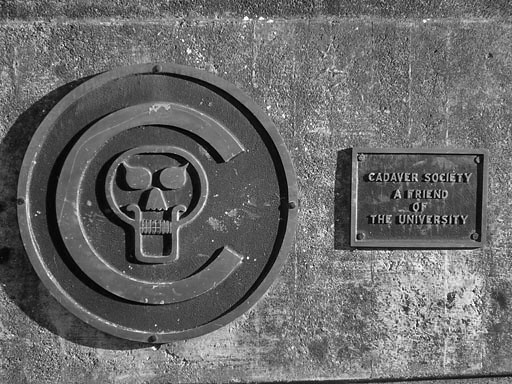
9. THE CADAVER SOCIETY, WASHINGTON AND LEE UNIVERSITY // BLACK CLOAKS AND SKULL MASKS

Cadaver_society

Cloaked in secrecy, very little concrete is known about the Cadaver Society of Washington and Lee University, but the rumors of this secret society are so intriguing it deserves a mention. It is thought that members of the Cadaver Society are mostly pre-med students with the best grade averages and they are said to wander the campus at night, dressed in black, their faces covered with skull masks as they scrawl the sign of the society (a skull and the letter “C”) around the place.

Certainly the graffiti is one of the most tangible signs of this clandestine group, but the society is also visible through its philanthropy: in 1988 the Cadavers reportedly gave $150,000 to the university to renovate the frat houses. Perhaps the most alluring rumor about the Cadavers is that they travel around campus via a series of secret tunnels, and one of the more far-fetched stories says that the Cadavers are a branch of the mother of all secret societies—the Illuminati.


September 14, 2016 – 12:00pm

091516 newsletter

Newsletter Subject: 
The 20 Happiest States in America (Plus: How High Your Salary Has to Be to Buy a House in Your City)
Featured Story: 
Newsletter Item for (86055): The 20 Happiest States in America
From the Editors: 
Newsletter Item for (86055): The 20 Happiest States in America
Newsletter Item for (79664): Can a Daily Bacteria Spray Really Make You Smell Better Without Soap?
Newsletter Item for (86060): How to Find Your Chronotype—And How Knowing It Can Help You
Newsletter Item for (86018): Disney Once Considered Building a 'Myst'-Inspired Theme Park
Newsletter Item for (86020): How High Your Salary Has to Be to Buy a House in Your City
Newsletter Item for (83619): Why Is an Informant Called a “Stool Pigeon”?
The Grid: 
6 Math Concepts Explained by Knitting and Crochet
West Michigan Is Home to a Giant Lavender Labyrinth
Drones Are Now Cleaning Up Ocean Trash
14 Prickly Cactus-Themed Products
Fun Fact Text: 

Jackie Kennedy is the only First Lady to win an Emmy. 

Fun Fact Image: 
Fun Fact Url: 
http://mentalfloss.com/article/85067/15-star-studded-facts-about-emmy-awards
Use Grid Ad: 
Scheduled Send: 
Fun Fact Caption: 
Getty Images 
More Info Text: 

New Pop Chart Lab Poster Categorizes Magical Items from ‘Harry Potter’

filed under: books, design
Image credit: 

If one of your most prized possessions is the wand you purchased during your last vacation to The Wizarding World of Harry Potter in Orlando, you’ll want to pre-order Pop Chart Lab’s latest poster. The data visualization pros collaborated with Pottermore (and got the seal of approval from J.K. Rowling) to create “Magical Objects of the Wizarding World,” a poster that catalogues the many magical objects mentioned in the books.

More than 60 items are arranged according to utility, ownership, and supernatural properties. For example, broomsticks, Hagrid’s motorcycle, and the Hogwarts Express are all filed under “Transportation,” while pensieves, the Sorting Hat, and moving portraits are grouped under “Hogwarts Property.” Deathly Hallows items like the Resurrection Stone, Elder Wand, and the invisibility cloak receive their own category. At the poster’s bottom, you’ll find annotations that provide context for objects of particular obscurity or interest.

Priced at $29, “Magical Objects of the Wizarding World” is available for pre-order online. Purchases will begin shipping on September 22. Want to get an up-close view of its illustrations? Take a look at the full print below, and click for a larger image.

Know of something you think we should cover? Email us at tips@mentalfloss.com.


September 14, 2016 – 11:45am

New Pop Chart Lab Poster Categorizes Magical Items from ‘Harry Potter’

filed under: books, design
Image credit: 

If one of your most prized possessions is the wand you purchased during your last vacation to The Wizarding World of Harry Potter in Orlando, you’ll want to pre-order Pop Chart Lab’s latest poster. The data visualization pros collaborated with Pottermore (and got the seal of approval from J.K. Rowling) to create “Magical Objects of the Wizarding World,” a poster that catalogues the many magical objects mentioned in the books.

More than 60 items are arranged according to utility, ownership, and supernatural properties. For example, broomsticks, Hagrid’s motorcycle, and the Hogwarts Express are all filed under “Transportation,” while pensieves, the Sorting Hat, and moving portraits are grouped under “Hogwarts Property.” Deathly Hallows items like the Resurrection Stone, Elder Wand, and the invisibility cloak receive their own category. At the poster’s bottom, you’ll find annotations that provide context for objects of particular obscurity or interest.

Priced at $29, “Magical Objects of the Wizarding World” is available for pre-order online. Purchases will begin shipping on September 22. Want to get an up-close view of its illustrations? Take a look at the full print below, and click for a larger image.

Know of something you think we should cover? Email us at tips@mentalfloss.com.


September 14, 2016 – 11:45am

091516 newsletter

Newsletter Subject: 
The 20 Happiest States in America (Plus: How High Your Salary Has to Be to Buy a House in Your City)
Featured Story: 
Newsletter Item for (86055): The 20 Happiest States in America
From the Editors: 
Newsletter Item for (86055): The 20 Happiest States in America
Newsletter Item for (79664): Can a Daily Bacteria Spray Really Make You Smell Better Without Soap?
Newsletter Item for (86060): How to Find Your Chronotype—And How Knowing It Can Help You
Newsletter Item for (86018): Disney Once Considered Building a 'Myst'-Inspired Theme Park
Newsletter Item for (86020): How High Your Salary Has to Be to Buy a House in Your City
Newsletter Item for (83619): Why Is an Informant Called a “Stool Pigeon”?
The Grid: 
6 Math Concepts Explained by Knitting and Crochet
West Michigan Is Home to a Giant Lavender Labyrinth
Drones Are Now Cleaning Up Ocean Trash
14 Prickly Cactus-Themed Products
Fun Fact Text: 

Jackie Kennedy is the only First Lady to win an Emmy. 

Fun Fact Image: 
Fun Fact Url: 
http://mentalfloss.com/article/85067/15-star-studded-facts-about-emmy-awards
Use Grid Ad: 
Scheduled Send: 
Fun Fact Caption: 
Getty Images 
More Info Text: 

Help Wanted! Join Our Growing Video Team

We have several roles to fill in our growing multimedia department. This is a unique opportunity to join a small, hardworking team at the ground level.

Our studio is editorially driven and mandated to innovate. For us, it’s not about the news cycle or hot takes or not believing what happened next. Our goal is to tell the kind of stories people remember and want to share, and not just in the social media sense. There are so many incredibly interesting stories out there. Can you help us bring them to life in video?

All of these positions are full-time, in-house, based in Manhattan. We offer health, dental, vision, and life insurance coverage, 401K, FSA/transit flexible spending, vacation time, plus various discounts on gym memberships, entertainment, etc, all in a flexible and fun working environment. (We have a strict no drama policy!)

To apply, please send the relevant materials (detailed in descriptions below) to videojobs@mentalfloss.com. Include the title of the position you are applying for in the subject line.

Video Producer

You will create multiple videos during the course of a week, taking story ideas from our team of writers (as well pitching lots of your own) and seeing them through every stage of production to the final product. This includes:
– Writing engaging scripts that fit seamlessly with the Mental Floss voice
– Shooting single and multi-camera footage in studio and on location; lighting and rolling audio
– Editing video and coordinating graphics and post-production
– Strategizing distribution for different platforms
– Managing production schedules, workflow, and budgets
– Coordinating studio and field productions, managing freelancers and talent, and acquiring resources (props, catering, equipment, etc.)

You should be ambitious, detail-oriented and deadline-driven, and comfortable being a key player on a team as well as managing independent projects. You have an eye for finding the Mental Floss angle for any given subject, and an ability to tell the story conversationally and creatively. A sense of humor, wit, and the proclivity to pitch in and do whatever needs doing to get the job done are essential.

You should have:
– 3+ years making short-form digital video
– Experience shooting (single and multiple cameras), lighting, and audio recording in the studio and on location
– Experience editing videos and guiding other editors’ work
– A knowledge of “what works” across platforms — but also an inclination to push the boundaries and innovate
– Comfort and creativity with managing budgets and resources: you can produce Perrier shoots on La Croix budgets
– A strong and wide network you can draw on as unanticipated needs arise
– Strong scriptwriting skills
– Proficiency in Adobe Premiere and Adobe After Effects
– Efficiency and grace under tight deadlines

Please send your resume and provide 3 or more relevant links to work you have done. In your cover letter please tell us:
What unique personal or professional qualities you bring to a team
What are 3 videos you would make for Mental Floss, if you could make ANYTHING?

Video Editor

This editor will be responsible for helping a high volume of original short-form video for our site and other platforms, on quick turnaround times.

We’re looking for someone who can:
– Work with producers, writers, and designers to create videos combining raw footage, photography, motion graphics, and audio
– Search and acquire appropriate assets
– Handle multiple projects at a time, producing many completed projects in a week
– Review video performance across various platforms to hone design practices
– Brainstorm and contribute video ideas
– Troubleshoot technical issues

You should have:
– Expertise with Adobe Premiere, Adobe AfterEffects & the Creative Suite
– Ability to stage and shoot film in both field and studio
– An eye for the mental_floss aesthetic
– A sense of humor, wit, and a sharp eye for what makes visual content fun
– An understanding of the different forms videos need to take across different platforms
– Strong visual design, typography, and color theory knowledge and skills
– Strong organizational and prioritization skills along with keen attention to detail
– Ability to handle tight deadlines

Please send your resume and provide 3 or more relevant links to work you have done in your cover letter.

Motion Graphics Designer

We’re looking for a highly creative individual to oversee graphics and design (animating typography, images, etc) for videos on quick turnaround times. You’ll be taking an idea from our team of writers and seeing it through all stages of production, creating fun layouts and imagery, typography, and effects. There will also be opportunities to work on larger-scale animation projects with other team members. You should have an understanding of the different social media platforms and what works best on each of them, and a willingness to innovate and adapt as platforms evolve.

We’re looking for someone who can:
– Design sharp, fun, engaging graphics, motion graphics, and typography
– Work closely with editorial staff and producers to help bring ideas to life in video
– Understand the mental_floss aesthetic and enforce it across video platforms
– Search and acquire appropriate assets
– Handle multiple projects at a time, producing many completed projects in a week
– Review video performance across various platforms to hone design practices
– Brainstorm and contribute video ideas
– Operate a camera when needed in the field and in the studio
– Troubleshoot technical issues

You should have:
– Outstanding design and typography skills
– Proficiency with graphic design software packages (After Effects, Photoshop, Illustrator, 3D Software)
– Ability to stage and shoot film in both field and studio
– A working knowledge of “what works” in video — but also an inclination to push the boundaries and innovate
– A sense of humor, wit, and a sharp eye for what makes visual content fun

Please send your resume and provide 3 or more relevant links to work you have done in your cover letter.

Assistant Producer

This is a unique opportunity for an ambitious entry level candidate to join a creative team and learn on the job while also making valuable contributions right away.

You’ll be assisting writers, editors, and producers in the creation of original video for our site and other platforms. Day to day, the job will vary quite a bit and will require you to be flexible, proactive, and self-starting. Duties might include sourcing graphics and audio assets, drafting scripts, research and fact-checking, assisting on field shoots, helping keep records and accounting, managing communications and scheduling for shoots and other projects. You won’t just be sitting at a desk! And you won’t just be fetching coffee.

We are a small, highly productive team and every member is expected to contribute creatively: the Assistant Producer will also take part in brainstorming meetings, pitch ideas, and create their own video projects. We’re looking for someone with a lot of ambition and an eagerness to learn.

You should be passionate about media and fascinated by video. Formal training in video production, writing, and/or design is helpful, but if you’re a quick learner with good instincts, we’ll teach you the technical skills you need. It’s more important to us that you have an interest in the type of smart, fun content we produce, ideas you’re excited to contribute, and the willingness to do whatever it takes to get a job done.

You should have:
– An immaculate attention to detail
– Excellent written and verbal communication skills
– Research skills that go beyond Googling
– Proactive tendencies: you are the type of person who can figure out what needs doing and get started on doing it without a lot of direction (that said, you should also be able to take direction well)
– A love of spreadsheets and organization in general
– A sense of humor, wit, and a sharp eye for what makes visual content fun and funny
– A fascination with video and a familiarity with all of the various platforms it lives on

Please send your resume and provide 3 or more relevant links to work you have done in your cover letter. These might be writing, design, video, or other digital projects. Please also include links to 3 videos online that you really loved, and tell us what you loved about them.


September 14, 2016 – 11:25am