15 Curious Quack Remedies From the Age of Patent Medicine

Image credit: 

Traveling salesmen and pharmacies packed with colorful bottles claimed to have all the medical cures for what ailed you in the 19th century, although the contents of their remedies were more likely to be opiates or snake oil than any scientifically sound healing. The era of patent medicine—which stretched from the 17th into the 20th century and was especially prolific in the United States and England—was a response to the shortcomings of medicine at the time, which often relied on questionable treatments like bloodletting and purging. The patent in the name didn’t refer to any government approval, but proprietary concoctions marketed with extreme promises and flamboyant showmanship.

Brimming with alcohol, opium, cocaine, and other unregulated substances, it’s no surprise their users felt like the pills and tonics were doing something, even if they became addictive or, worse, fatal. Federal regulations eventually cut off this free trade of drugs, as did exposés like a 1906 issue of Collier’s that depicted the industry as “death’s laboratory” with an illustration of patent medicine being pumped out of a skull flanked by moneybags. Nevertheless, you can still find popular treatments like Sloan’s Liniment and Lydia Pinkham’s Vegetable Compound nestled in the drugstore, survivors from the golden age of quackery.

1. OPIUM

Opiates were readily available as painkillers, and also marketed for all sorts of woes, even the treatment of children’s coughs and colds or just to keep fussy babies quiet. McMunn’s Elixir of Opium [PDF] was developed in the 1830s by John B. McMunn in New York, who mixed it with alcohol and advertised the result for “nervous irritability” as well as rabies and tetanus. Meanwhile shoemaker Perry Davis [PDF] manufactured his opium-based cures for cholera and other infectious diseases, the benign bottle boasting the medicine was “purely vegetable” and “no family should be without it.”

2. BLOOD

The consumption of blood is not itself an oddity, and became part of the tonic offerings in patent medicine through manufacturers like the Bovinine Company in Chicago. A truly unsettling 1890 ad for Bovinine shows a woman with her eyes closed, a small glass of red liquid beside her, and the words: “Look on me in my lassitude reclining / My nerveless body languid, pale and lean; / Now hold me up to where the light is shining / And mark the magic power of BOVININE.”

When the postcard is held up to a light, suddenly her eyes open and a ghostly steer appears outside the window with the words “My life was saved by Bovinine.” And the drug probably was quite eye opening, being a tantalizing and alcoholic mix of beef blood, glycerine, and sodium chloride (salt).

3. COCAINE
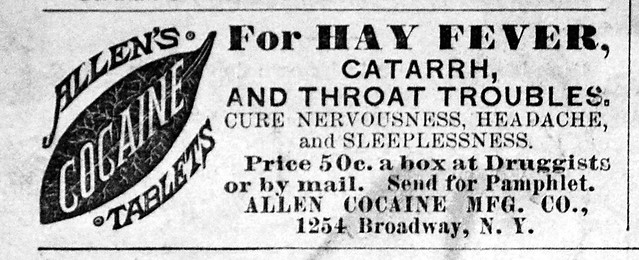
Allen's Cocaine Tablets for Hay Fever, Catarrh, and Throat Troubles 

Famously, Coca-Cola was named for one of its more shocking 1880s ingredients: coca leaves. It’s unclear exactly how heavy the cocaine dose was in the soda, then marketed as a “brain tonic,” and it was among many medicinals that included coca leaves in their brews. The drug was legal until 1914. In 1890, you could pick up Allen’s Cocaine Tablets for your hay fever, “throat troubles,” or headache at 50 cents a box, and in the early 1900s both Ernest Shackleton and Robert F. Scott carried “Forced March” cocaine and caffeine pills for endurance on their Antarctic expeditions.

4. PRAIRIE FLOWERS AND INDIAN OIL

Being an Englishman from Yorkshire didn’t stop William Henry Hartley from adopting an eccentric Buffalo Bill-like persona to sell his Sequah’s Prairie Flower and Sequah’s Oil, cures supposedly based on Native American traditions. The evocation of the exotic and indigenous in advertising was prominent in patent medicine, although almost always completely fictional. Hartley, who operated his Sequah Medicine Company in the UK between 1887 and 1890, was one of the more bombastic personas in this appropriation, with a Wild West-styled circus that rolled into town. The show would start after dark, with teeth pulled to the music of a brass band (playing loud, to drown out noises of pain) to draw in the crowd. On more atmospheric evenings, there were even séances. All this pomp was aimed at selling Hartley’s Prairie Flower and “Indian oil” cures for a variety of ailments, like stomach issues and liver disorders. Later the ingredients were revealed to be organic material from the East Indies and cheap fish oil cut with turpentine.

5. PETROLEUM

Petroleum jelly is still a common part of our medicine cabinets, but in the 19th century oil was marketed as a treatment for everything from ulcers to blindness. Samuel Kier in Pennsylvania was trying to use up the incredible amount of oil created by his salt wells, and in 1852 launched his “Kier’s Petroleum, or Rock Oil” as a 50-cent cure-all. It likely was potent, as he later distilled the same petroleum and successfully sold it as a lighter fluid.

6. CANNABIS

Wikimedia Commons // Public Domain

Cannabis appeared in Western medicine through William O’Shaughnessy’s studies with the British East India Company in the 1830s; he saw it as an effective prescription for pain. Soon patent medicine was getting in on the action, selling it as a cure-all. For instance, Piso’s Tablets were advertised for “women’s ailments,” and contained a punchy mix of cannabis and chloroform.

7. TOMATOES

“Tomato Pills Cure Your Ills” crowed the ads for Dr. Miles Compound Extract of Tomato. Before ketchup took off as a condiment, people were ingesting tomato pills for remedies for all sorts of illness. Others like John Cook Bennett, a physician in Ohio, also proclaimed the benefits of tomatoes to treat stomach issues like diarrhea and indigestion. It’s likely the lycopene in the tomatoes actually did some good, and eventually the vegetable that was once nicknamed the “poison apple” in the 18th century was on its way to 20th-century popularity.

8. ARSENIC

Arsenic was long used in traditional Chinese medicine, as well as a Victorian cosmetic. Patent medicines regularly incorporated the poison, with or without the user’s knowledge. Mercury and lead were also sometimes present in the more toxic remedies, and both arsenic and mercury would be used to treat syphilis. Pharmacy offerings, like Fowler’s Solution, proposed arsenic as a tonic and treatment for ailments like leukemia and malaria, while Donovan’s Solution was advertised for skin diseases, and “Tabloid” had arsenic mixed with iron for heart conditions.

9. HAIR TONICS

Hair tonics were big business for patent medicine purveyors, promising to stop grayness, dandruff, and regrow lost locks. Ingredients included lead, borax, cochineal (smashed red insects), silver nitrate, arsenic, and heavy doses of alcohol. Not surprisingly, these tonics were popular during Prohibition in the United States, packing the same boozy bang as a shot of whiskey. And having about the same effect on hair loss.

10. RADIOACTIVE SUBSTANCES

Sam L., via Flickr // CC BY-SA 2.0

Radioactive solutions emerged in the early 20th century after radioactive decay was identified in 1896. One of the more infamous of these was Radithor, a patent medicine with distilled radium, made by self-proclaimed doctor William Bailey, who had previously sold strychnine as an aphrodisiac.

Socialite and industrialist Eben Byers took Radithor following an arm injury in 1927, and continued consuming it through the 1930s, when he slowly died a grotesque death involving snapping bones and lost teeth. Byers’s demise prompted an investigation into Radithor, and ultimately its removal from pharmacies, although poor Byers was buried in a lead coffin due to the contained radiation in his body. As a 1932 Wall Street Journal article quipped: “The Radium Water Worked Fine Until His Jaw Came Off.”

11. MERCURY

Victorians were fanatics for pallid skin, and freckle removers were marketed to this obsession. Some of these products included mercury, such as Dr. Berry’s Freckle Ointment made in Chicago. Amelia Earhart was known to detest her freckles, so when a pot of the poisonous cream was found on the Pacific island of Nikumaroro, many believed it was a sign of the lost aviator’s crash.

12. OBESITY BATH POWDER

If a hot bath with the right powder could reduce obesity, humans would have evolved gills by now. Sadly, remedies like “Healthone-Obesity Bath Powder” were all quackery. The pitch was that soaking with the powder a couple times a day would take the extra pounds away. Examining the powder revealed it was mostly perfumed sodium carbonate, which probably did make for a mineral-feeling soak.

13. SWAMP ROOT

 
Swamp root doesn’t sound like something you’d want to ingest, yet it was wildly popular as an advertised ingredient in patent medicine. Products like Dr. Kilmer’s Swamp Root were said to “promote the flow of urine,” as well as treat invented illnesses like “internal slime fever” [PDF]. Whatever organic material it contained, like so many patent medicines, it seems the most active ingredient was alcohol.

14. DR PEPPER

Wikimedia Commons // Public Domain

Like Coca-Cola, Dr Pepper has its roots in patent medicine. The drink was created in 1885 by a Texas pharmacist named Charles Alderton, and sold as a “brain tonic.” The period after “Dr” was reportedly later removed during its 20th-century mass marketing in order to not suggest any medicinal properties.

15. PINK PILLS FOR PALE PEOPLE

Wellcome Images, via Wikimedia Commons // CC BY 4.0

 
Dr. Williams’ Pink Pills for Pale People were among the treatments aimed at anemia, with the alliteration intended to catch the attention of customers—particularly British colonists. Made of iron oxide and magnesium sulfate, they certainly weren’t among the most dangerous of patent medicines, but they far from fulfilled their promise of curing everything from paralysis to cholera. George Fulford, who sold the remedy around the world, is often remembered for quite a different legacy. His vehicle was hit by a streetcar in 1905, and at the age of 53 he became Canada’s first automobile death.


September 15, 2016 – 4:15am

How to Avoid Awkward Hot Tub Moments in Iceland

filed under: travel

Iceland is currently a hot tourist destination. The number of foreign visitors more than tripled from 2000 to 2014—and to attract even more vacationers, marketing campaign Inspired by Iceland launched a quirky video series called “Iceland Academy” earlier this year. The short films highlight local customs, provide travel tips, and offer crash courses on Icelandic etiquette.

In the clip below, which was spotted by Condé Nast Traveler‎, a man named Gudmunder—who describes himself as “Head of Spa Etiquette”—explains how foreigners can avoid awkward moments in the country’s hot tubs. (Hint: Make sure to shower before taking a dip.) Take a minute to improve your spa manners, or check out the Academy’s YouTube channel for more advice.

[h/t Condé Nast Traveler‎]

Banner image courtesy of iStock.

Know of something you think we should cover? Email us at tips@mentalfloss.com.


September 15, 2016 – 3:00am

15 Incredible Things Revealed by Extreme Weather

filed under: Lists, weather
Image credit: 

High waves, violent winds, and extreme droughts can wreak terrible destruction—but they can also uncover amazing treasures. Severe weather has exposed Mayan hieroglyphics, medieval skeletons, ancient footprints, and much more. Here are 15 remarkable things revealed by weather.

1. THE OLDEST HUMAN FOOTPRINTS OUTSIDE OF AFRICA

In 2013, strong storms and erosion at Happisburgh, England cleared away sand and revealed curious depressions in mud. Archaeologists determined that they were human footprints—the oldest ever found outside of Africa. These people who made the footprints belonged to a different species of Homo than our own, and they lived between 1 million and 0.78 million years ago.

2. A CIVIL WAR SHIP—AND A BOTTLE OF TERRIBLE WINE

During the U.S. Civil War, President Lincoln ordered a blockade around southern ports to stop goods from passing through. The Confederacy responded with blockade runners, ships helmed by daring captains who ran cotton, medicine, ammunition, and other goods through the blockade.

The Mary Celestia was one such vessel. It served in this role for only two years before it hit a reef and sank. In recent years, severe hurricanes have stripped away sand from the wreck, and they’ve exposed all sorts of interesting archaeological artifacts—including a sealed bottle of wine. Was the vino still drinkable? Experts sipped it and declared that it mostly tasted like sludgy seawater with notes of … gasoline. Eww.

3. A MEDIEVAL SKELETON HANGING FROM TREE ROOTS

In 2015, a tempest in Collooney, Ireland toppled a huge beech tree—and hoisted half of a skeleton into the air. The bones belonged to an early medieval man who met a violent death from some sort of sharp blade. When the beech tree was toppled last year, the roots popped up from the soil, carrying the top half of the skeleton with them.

4. A PREHISTORIC FOREST

Wild weather at Cardigan Bay in Wales periodically strips away sand and uncovers an unusual sight: an ancient forest of tree stumps. In 2014 an especially powerful set of storms exposed much of the forest, giving us amazing views of the ancient trees, which died over 4500 years ago as sea levels rose and salt water inundated the land. Archaeologists also found a wooden walkway dating to between 3000 and 4000 years ago; perhaps the local people built it in an attempt to deal with rising seas.

5. THE WRECK OF A COAL SCHOONER—PROBABLY

When Hurricane Sandy blew through New York state’s Fire Island, it exposed the hull of a large ship. Experts believe—though they can’t confirm—that this vessel is the Bessie White, a Canadian coal schooner. The ship ran aground in 1919 or 1922 after it became lost in heavy fog. Fortunately, the naval disaster didn’t claim any lives. The whole crew survived, including the ship’s cat.

6. UNEXPLODED SHELLS FROM WORLD WAR II

Explosives from past wars can still be found in our seas, and bad weather sometimes washes them ashore. In 2012, for example, crews in New Jersey found two unexploded shells while combing the beach after Superstorm Sandy. And in 2014, the Royal Navy was called in to examine a shell on a beach in Devon, England.

7. A CALIFORNIA “SIN SHIP”

SS Monte Carlo Shipwreck

In the 1920s and 30s, you could evade the law and gamble to your heart’s content on “sin ships” off the California coast. Many of these vessels had once been used for honest work—some had belonged to the military—but they were rebuilt for drinking, gambling, and partying.

The Monte Carlo, a former oil tanker, was one such vessel. As a sin ship, it hosted such illustrious visitors as Mae West and Clark Gable. But on New Year’s Eve in 1936, a tremendous gale arose and the ship broke free of its moorings. Luckily, there were only two caretakers aboard, and they were safely rescued.

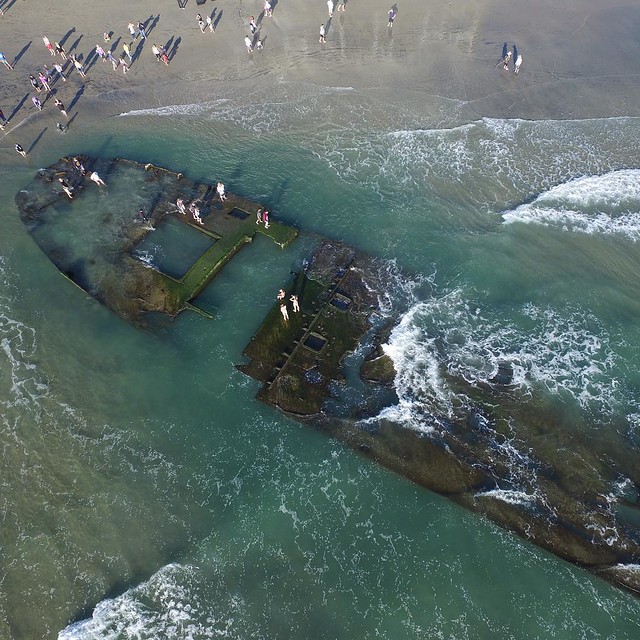
The ship washed up on the beach at Coronado the next day, New Year’s Day, and it still lies buried in the sand. But every now and then, storms remove enough sediment and it reappears. This past winter, El Nino storms gave beachgoers an impressive view of the wreckage— and a chance to stand where Hollywood stars once partied the night away.

8. IRON AGE SKELETONS

Rough weather battered Shetland in Scotland during the 2012-2013 holiday season. It caused a cliff collapse that exposed a grisly sight: human remains. Archaeologists and police were quick to the scene—but it soon became apparent that the remains were a little too old for a homicide investigation. The bones dated from perhaps 2000 years ago. Unfortunately, a further cliff collapse reburied the site, laying the bodies to rest once again.

9. A NEOLITHIC TOWN

In 1850, a tremendous squall hit the Orkney Isles in northern Scotland. It stripped grass and dirt from a large, lumpy knoll known as Skerrabra—and revealed something amazing. The knoll was actually an ancient town. This settlement, known as Skara Brae, dated back to 3200-2200 BCE. It gave archaeologists a glimpse into Scotland’s remarkable ancient past: Skara Brae’s inhabitants raised sheep and cows, feasted on now-extinct great auks, and slept on beds filled with heather.

10. A HUGE WOODEN STEAMBOAT

The steamboat Montana, built in 1882, was the largest ship that ever traveled on the Missouri River. But she lasted just two years before she struck an underground tree and was sunk. During a severe 2012 drought, water levels in the Missouri dropped low enough to expose the enormous wreck.

11. A GIGANTIC ANCIENT POT

In 2015, a storm’s powerful waves uncovered a nearly 5-foot-tall pot at Palmahim Beach National Park in Israel. Dating from between 300 and 500 CE, the vessel contained artifacts such as an incense pipe and an oil flask. Why would anybody make a piece of pottery as tall as a person? The ancient Romans used these containers, called dolia, to store food and drink.

12. A WHOLE BUNCH OF OIL

Earlier this year, an oil spill hit a beach in Norfolk, England. But no oil tanker had sunk or run aground in the area …. at least, not for 40 years.

In 1978, the Greek oil tanker Eleni V collided with another ship and capsized. It was later blown up by the army. At the time, policy dictated that the ship’s oil should be buried in trenches along the shore. But storms and erosion eventually exposed the oil, coating a mile of coastline in dark glop—nearly four decades after the offending shipwreck.

13. A SHIPWRECK INCLUDING A BODY DELIVERY GONE WRONG

shipwreck,longrock cornwall.

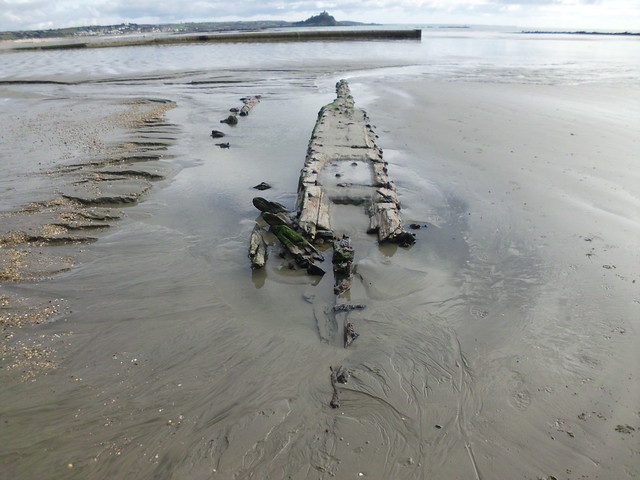
In 1888, the French vessel Jeune Hortense approached the shore at Cornwall, England. It was carrying the body of a Cornish man who had died in France. The crew of four hoped to return the body to its homeland. Unfortunately, the ship ran aground. Fortunately, the crewmembers—and most of the 450 cows onboard—were rescued.

Over time, sand covered the vessel. Now and then, though, wild waves blast away the sediment and expose it, giving visitors a glimpse of the wreck.

14. MAYAN HIEROGLYPHICS

In 2001, a hurricane hit Guatemala and blew away the sediment that had covered a Mayan staircase. But these were no ordinary stairs. They were covered in hieroglyphics [PDF]—and they told a remarkable story of a massive and incredibly bloody regional conflict, complete with a huge pile of skulls.

15. AN UNUSUAL WHALE SKELETON

In 2012, Hurricane Sandy caused massive beach erosion in Volusia County, Florida. An Orlando couple who were searching for sand dollars made an incredible discovery: the skeleton of a whale that had been buried for decades. But it was no ordinary whale: it was a Gervais’ beaked whale, a member of a group so poorly known and mysterious that we’re still discovering new species even today.


September 15, 2016 – 2:15am

Where U.S. Home Sizes Have Grown the Most Over the Past Century

Image credit: 

Chances are, you live in a much bigger place than your grandparents did decades ago. Average American home sizes have substantially increased since the early 1900s and have grown especially quickly in the past 50 years. However, data gathered by the real estate site PropertyShark.com shows that not all of the U.S. has grown equally.

The average new homes built across the country in the last six years were 74 percent larger than houses built in 1910, showing a 1000-square-foot increase. And because the number of people in each household is dropping (Shout out to all those single ladies!) that means the average American has more living space than previous generations. The average person in the U.S. has about 957 square feet of living space more than their grandparents—an increase of 211 percent.

Each city has experienced a different pattern of growth in living space, though. Miami began the 20th century with new homes slightly above the U.S. average size, but in the ‘60s, houses started getting smaller. Residential real estate in the city has actually grown in size over the last five years, but it still pales in comparison to the spacious houses of the Miami of 1910. San Antonio, by contrast, has been building bigger and bigger homes for more than a century.

Chicago has managed to largely evade the McMansion trend, although no doubt its suburban homes are a different story. The city’s new homes are only 4 percent larger than its 1910 homes were. Nashville, meanwhile, saw median square footage rise 7 percent from the 1910 level, but that’s not necessarily a great indicator of the city’s housing stock. The Music City has always had larger houses than the national average, and in the ‘90s, its median home size was almost 3000 square feet, compared to 2700 now.

These square footages are averages, so that doesn’t mean that every house built is a giant mansion. It’s also possible that in some of these areas, most new houses built are a reasonable size, but a handful of large developments skews the numbers. Head over to PropertyShark.com to see the interactive data.

Know of something you think we should cover? Email us at tips@mentalfloss.com.


September 15, 2016 – 1:00am

15 Times Lemonade Stands Made History

Image credit: 
iStock

When life gives you lemons, make lemonade. But if you’re a kid who plans on selling this tangy beverage, it might be a good idea to speak with a lawyer first. In America and elsewhere, ordinary lemonade stands have been a driving force behind everything from world record attempts to life-altering charities. On the other hand, they also have a knack for starting legal controversies. As many city halls can attest, these scuffles often have big repercussions for entire communities. Here’s a look at 15 lemonade stands that—for better or for worse—left a mark on the world at large.

1. TROUBLED STAND INSPIRES BIPARTISANSHIP AND A FRESH “LEMONADE BILL”

Louisiana is synonymous with Mardi Gras parties and Cajun cuisine. In the near future, it might also become the lemonade stand capital of the world. Earlier this year, a Democratic state senator from the Bayou State introduced a bill that would exempt minors from needing to obtain an occupational license before setting up a lemonade stand—so long as the kiddies’ profits don’t exceed $500 per year. The politician says that he was inspired to take action when a child-run stand was cited for not having its paperwork in order. Disgusted by the incident, Democrats and Republicans alike rallied to support young entrepreneurs throughout their state. The proposal—dubbed the “Lemonade Bill” by the press—was unanimously approved in the Louisiana House and Senate, and signed into law on May 27.

2. LEMONADE CONTROVERSY PROMPTS FORT WORTH TO RE-EXAMINE ITS ZONING LAWS

In 1987, three brothers in Fort Worth, Texas, scored a sweet victory. To raise money for their church and fund a family vacation, the boys started a lemonade stand. Things were going well, until a neighbor anonymously complained to city hall about the tiny business. Once these remarks had been filed, zoning officials had no choice but to shut down the operation. A sign that read “closed by city order,” was slapped onto the stand, resulting in a huge public outcry. When asked to justify this decision, public servants claimed that the boys were illegally running a commercial enterprise in a residential area. Fortunately, this setback proved to be temporary. After a week of bad press, the city changed its tune when an overlooked provision in the law was discovered. Since the stand wasn’t open year-round and didn’t sell pre-packaged products, Fort Worth reclassified it as a home-use business. Thus, the children were allowed to re-enter the beverage game. The town’s mayor extended an olive branch by offering them a new venue on his nearby property. They politely turned him down.

3. STAND OWNERSHIP TEACHES FUTURE BILLIONAIRE THE WAYS OF CAPITALISM

With a net worth of more than $66 billion, one of America’s most famous investors is easily one of the wealthiest men alive. In his youth, the Omaha native did what budding entrepreneurs often do: open a lemonade stand. But unlike most kids, this future businessman recognized the value of a good location. The child noticed that more pedestrians walked past a friend’s house than his own home—and so he arranged to build the stand on his pal’s lawn.

4. PLUCKY BROOKLYNITE HELPS TURN THE LEMONADE STAND INTO AN AMERICAN INSTITUTION

Historians don’t know where, when, or by whom the first lemonade stand was established. However, one journalist is often credited with popularizing the concept. Born in the Netherlands, Edward Bok (1863-1930) immigrated with his family to Brooklyn, New York as a boy. By the time he passed away, Bok had achieved national fame as the longtime editor of a women’s lifestyle periodical, and was a vocal women’s suffrage advocate. In 1921, his autobiography was released. The book was a huge critical success and even won a major literary prize. Inside, the author reviews his childhood business ventures. Bok claimed that, as a boy, he used to make money during the summer months by selling ice water on Brooklyn’s muggy streets. When competitors started to peddle their own ice water, Bok wrote, he upped the ante by squeezing “half a dozen lemons into each pail of water.” Then, he’d add some sugar and shout “Lemonade, three cents a glass!” Today, it’s believed that this published anecdote helped inspire a generation of kids to follow suit.

5. FLORIDA TOWN DRAGGED INTO THE LIMELIGHT BY LEMONADE STANDOFF

Naples, Florida, got some unwanted press in 2003. It all began when a neighborhood dispute resulted in the hasty closure of a six-year-old’s lemonade stand. The girl’s parents elected to shut down her business after their next-door neighbor informed the police that it was operating without a permit. A local station picked up the story and before long, pundits on national television were weighing in. The girl received several hundred dollars’ worth of unsolicited donations from sympathizers; meanwhile, the girl’s neighbor was given something else to complain about. Angry passersby took to pelting her house with lemons.  As a result of the brouhaha, Naples considered some new beverage policies. But by a margin of three votes, the city council rejected a proposed law that would have required all lemonade stands to obtain a business license.

6. HIGH-PROFILE LEMONADE STAND BECOMES A PRESIDENTIAL CAMPAIGN ISSUE

When one American president ran for our country’s highest office in 1976, his daughter kept herself busy with a lemonade stand. Then just eight years old, the girl (and one of her friends) set up shop just outside of the family residence, where thirsty journalists made for reliable customers. At one point, a reporter lightheartedly told the candidate that members of the press ought to receive a discount. The candidate’s response? “Reporters should pay double.”

7. TURF WAR LEADS TO HISTORIC “MERGER”

A sausage stand owner in Salem, Massachusetts, faced some stiff competition in 2005. That summer, two local boys began selling homemade lemonade on his turf. Since the professional vendor also sold this citrusy beverage, conflict was inevitable. The sausage man asked Salem’s finest to talk the kids into relocating. Instead, the officers shut down the children’s lemonade business because neither boy had purchased a $2200 vendor’s license. But the story didn’t end there. Hoping to make peace, the mayor of Salem negotiated a special arrangement between the two rival parties. In what was described as a “corporate merger,” the salesman allowed the boys to sell lemonade under his own license as sub-contractors—at least until the school year started.

8. CANADIAN AGENCY APOLOGIZES AFTER TERMINATING STAND

In July 2016, Canada’s National Capital Commission (NCC) found itself in hot water when it closed an Ottawa lemonade stand that was owned and operated by two little girls. The entrepreneurs were sisters—just five and seven years old—who’d been saving dough so they could attend summer camp. In order to take advantage of a public road’s foot traffic, the girls opened up on NCC-regulated land. An officer promptly informed their parents that if the sisters didn’t take their business elsewhere, they’d be fined. What followed was a public opinion battle that the NCC couldn’t possibly win. The commission formally apologized and issued the girls a special permit that allowed them to re-open the stand. In return, the girls donated all of their profits to charity, as per the NCC’s request.

9. CHILD-RUN STAND RAISES RELIEF FUNDS FOR HURRICANE KATRINA VICTIMS

In 2006, an 11-year-old humanitarian came up with one delicious way to raise funds for the Hurricane Katrina disaster relief effort. Determined to help out, the boy and his family rented some space at a merchants’ market near their Kyle, Texas, home. There, the whole gang opened up a charity lemonade stand that generated $540 for the American Red Cross over the course of a single weekend.

10. VOCAL GRANDMOTHER ADVOCATES LEMONADE REFORM

For a $5 fee, anyone can set up his or her own lemonade stand within the city limits of Okmulgee, Oklahoma. But this wasn’t always the case. In June 2016, a local seven-year-old tried getting one off the ground but was told to cease operations by a police officer. That’s when her grandmother took action. When the woman complained to city hall, officials put the current, business-friendly lemonade legislation in place. 

11. BEVERAGE-TOUTING ANIMAL LOVER GIVES LOCAL SHELTER A BOOST

Last July, a girl on Long Island raised several hundred dollars for a local animal rescue and adoption center. How’d she do it? With lemonade, of course. One day, the precocious six-year-old told her folks that she wanted to help homeless pets find new families. To accommodate the girl, her parents and neighbors constructed a charming lemonade stand. Upon settling in, the wee activist began to selling off her sugary drinks at 50 cents apiece. Customers were also given flyers promoting the nearby shelter. Thanks to the girl’s profits—plus some free advertising—the organization was able to purchase tracking chips for some 59 animals, all of whom were adopted.

12. MARYLAND COUNTY IGNORES PERMIT LAWS TO HELP LEMONADE STAND CAPITALIZE ON GOLF CHAMPIONSHIP

“What happened to the entrepreneurial spirit? I mean this is the American dream.” Such were the protestations of one parent after local government officials closed a lemonade stand that her child had co-founded in Bethesda, Maryland, in 2011, the year the town hosted the U.S. Open Championship. Four business-savvy kids decided to take advantage of the situation by planting a lemonade stand near Congressional Country Club, where the big-time sports event was taking place. It looked like the kids were in for a big score—and then the town bureaucracy got involved. A representative from Montgomery County’s Department of Permitting fined the children $500 for (you guessed it) operating without a permit. As it happens, a TV news team was on hand to film part of this exchange. The resultant backlash from viewers and eyewitnesses was both immediate and unrelenting. By day’s end, the county decided to cancel the fine. Officials also allowed the kids to continue selling their drinks if they’d agree to move the stand two feet away from its previous location, which had bordered a congested street.

13. SOLITARY STAND GIVES BIRTH TO CANCER FOUNDATION

The little girl behind one nationwide charity hadn’t even reached her first birthday when she was diagnosed with childhood cancer. At age four, the heroic girl found a way to fight back, asking her parents to help her set up a lemonade stand that would raise money to help other children who were suffering from cancer. Word spread and, within a single day, she earned an astonishing $2000. Encouraged, she launched a second stand one year later. These inspired copycat establishments from a host of other kids, who also began selling lemonade for cancer relief. Sadly, the young philanthropist passed away in 2004, at just eight years old. But she left an impressive legacy behind: The girl, and those who’d followed her lead, had raised more than $1 million total. The following year, her parents launched an official foundation, dedicated to finding a cure for cancer. To date, the charity has funded more than 650 cancer research projects and raised upwards of $127 million.

14. EUSTIS, FLORIDA, PULLS A 180 ON LEMONADE STAND LEGALITY

On one peculiar day in 2000, a lemonade stand that had been running for years was shut down, only to be hastily re-opened in a matter of hours. The booth was the pride and joy of a local nine-year-old girl, who’d long been selling juicy beverages there. Despite its longevity, a zoning law enforcement official instructed the child to close her stand for reasons unknown. That evening, the girl’s father contacted City Hall to protest. Improbably, the code and zoning commissioner took his side. Without a moment’s hesitation, this high-ranking government employee said that the stand’s forced closure was triggered by “an error in judgment” and that it could be reopened. However, the administrator also insisted that the establishment be moved eight feet away from the nearest roadside.

15. LEMON-LOVERS SET WORLD RECORD

At a 2011 charity fundraiser, community members in Birmingham, Michigan, were encouraged to purchase wooden lemonade stands at a cost of $50 each. Afterwards, 349 of these were merged together into a single, marvelous unit by parents, teachers, and students of the Birmingham Public School District. From end to end, the amalgamated lemonade stand measured 1399 feet and 11 inches long—enough to secure its place in history. Profits from the event were used to support both public schools and an assortment of educational initiatives.

There’s nothing more refreshing than an ice-cold glass of lemonade—but GEICO’s friendly customer service may be a close second. Their agents can help you find an insurance plan that fits your needs and your budget. You may even be able to save by switching.


September 15, 2016 – 12:15am

Leica to Release New Instant Camera

Image credit: 
Leica

We might all carry a digital camera around with us all the time, but old-fashioned instant cameras have recently made their way back in the mainstream. From Fujifilm to Polaroid, there are plenty of sleek new ways to print images right on the spot. Now camera manufacturer Leica is getting into the mix with their own line of fancy instant cameras. The Leica Sofort series includes three bold, square cameras that come in blue, white, and orange. Each has a Lecia-designed menu navigation and comes with much-needed accessories like a strap and case. The designs are meant to mimic the feel of a proper film camera, complete with optical viewfinders and retro appearances. There are also four “scene modes”—”party,” “selfie,” “sport,” and “macro.” Leica worked with Fujifilm on their instant film, which comes in color or black and white. All the Leica instant film will also work on a regular Fuji Instax Mini.

The development was first leaked in the most recent issue of Leica Fotografie International (LFI), but will be officially announced tomorrow, and shipping will begin in November. The cameras will be €279 (about $315) and the film will be €12 to €14 (about $14 to $16).

[h/t Design Taxi]

Know of something you think we should cover? Email us at tips@mentalfloss.com.


September 14, 2016 – 8:30pm