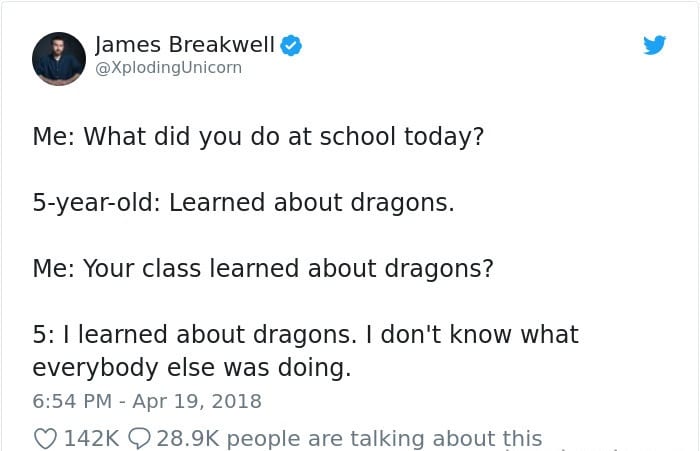
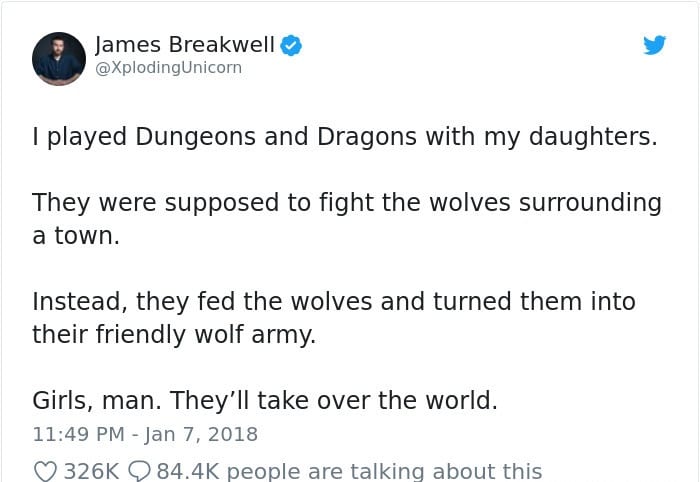
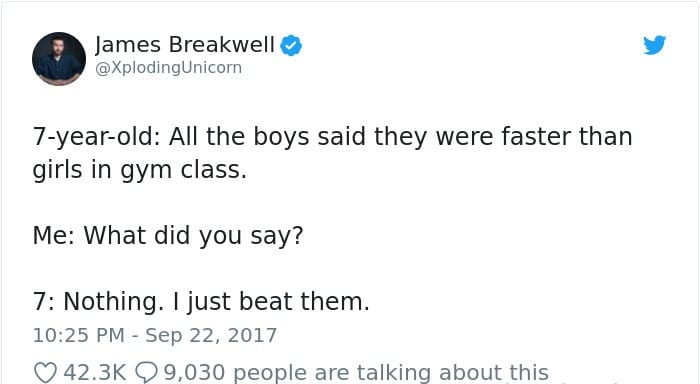
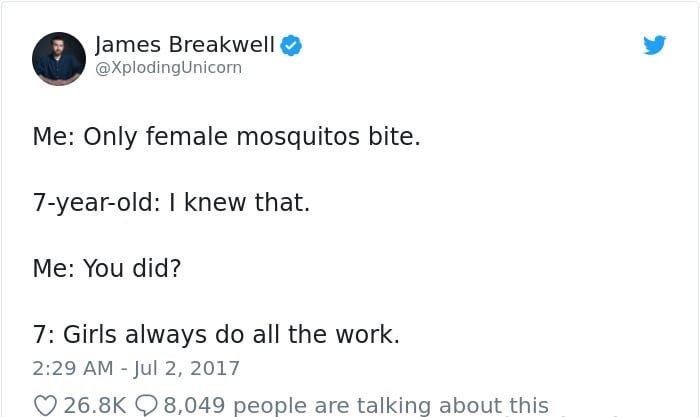
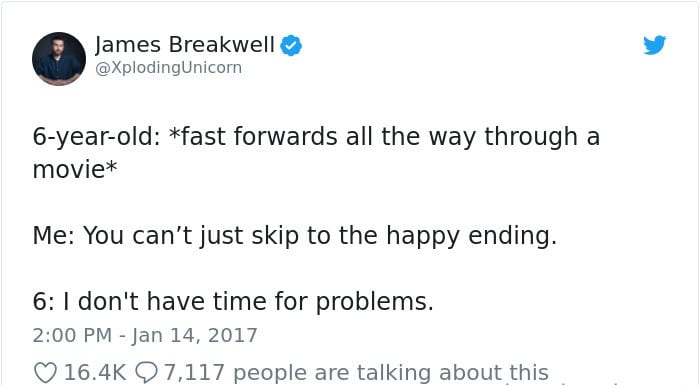
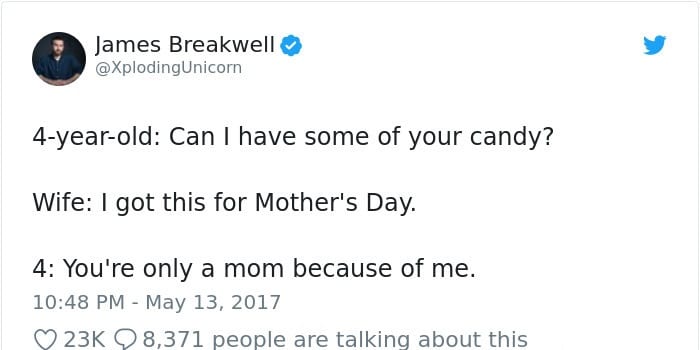
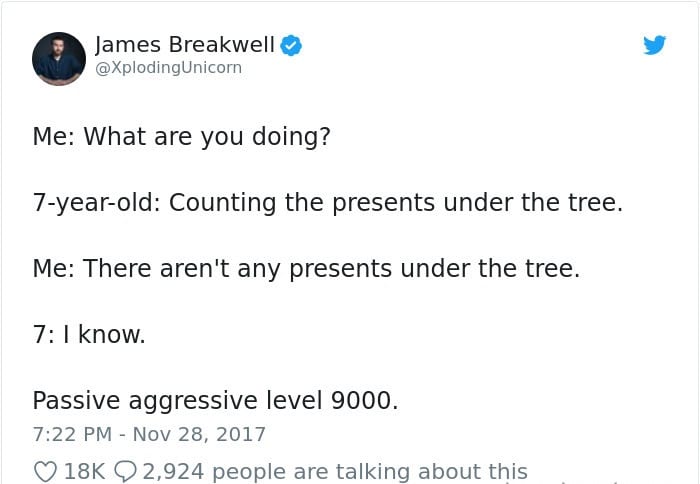
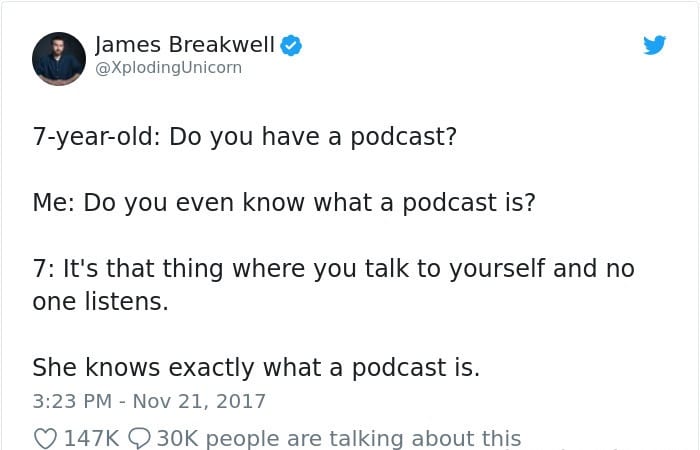
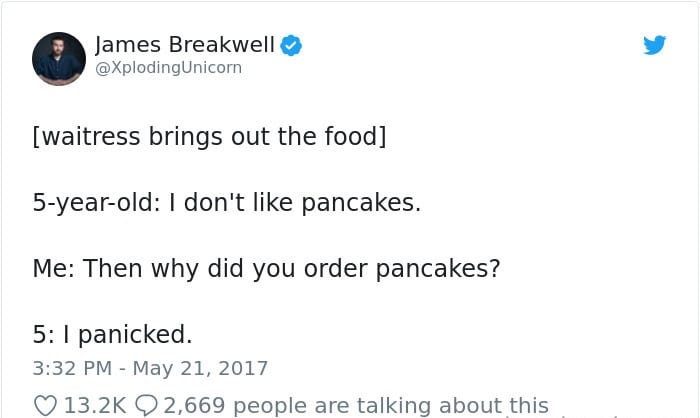
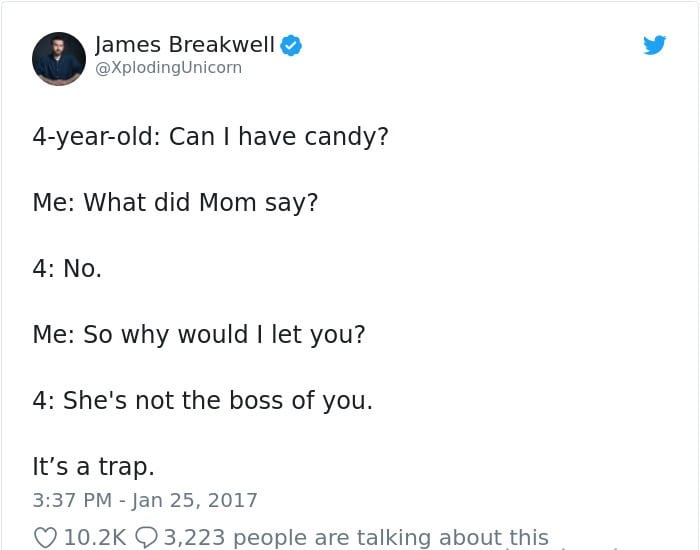
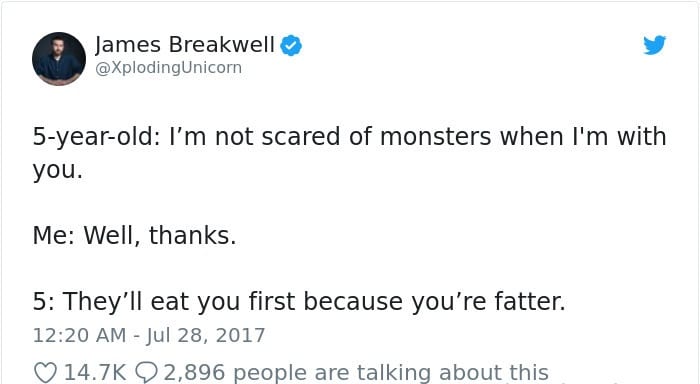
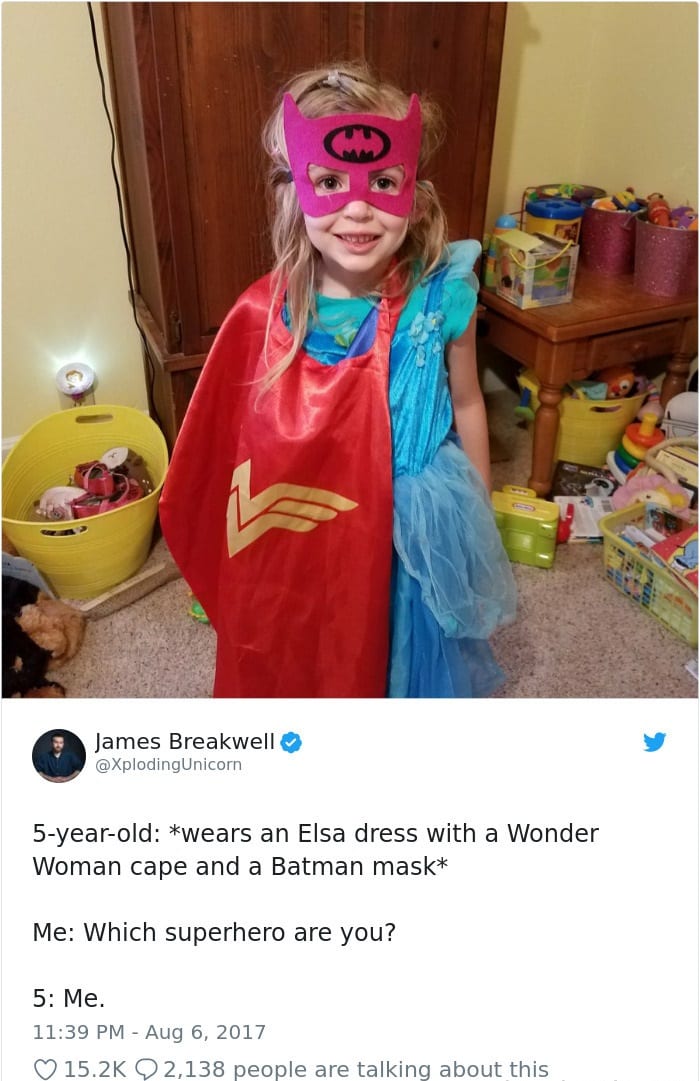
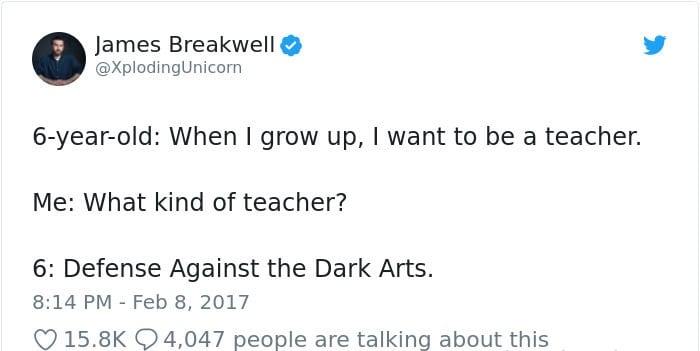
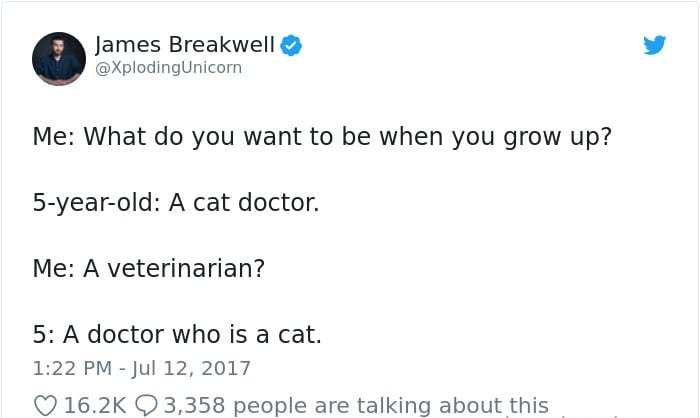
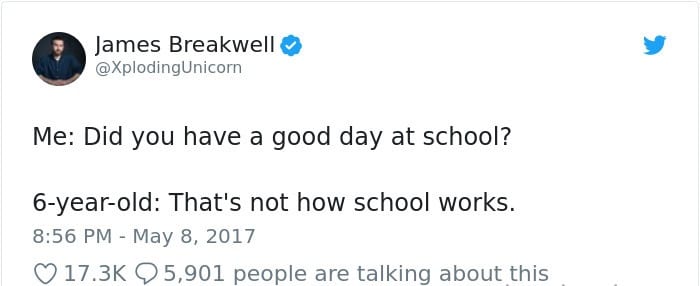
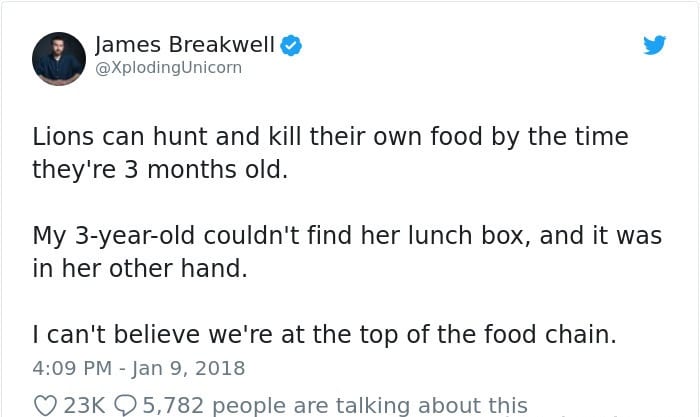
Parents tend to record the memories of their children via photographs and videos, however, James Breakwell has been documenting his time with his four daughters on social media in a different way. The comedy writer and family man from Indianapolis has been using Twitter to share his daily conversations with his daughters – and it’s earned him over a million followers since he started in April 2016. Here are some of the best posts he’s shared.
Imagine having to pay a daily tax to use social media apps like Facebook, Twitter, and WhatsApp. Well, that’s exactly what is happening now in the country of Uganda because it’s the law.
Many in Uganda believe the tax is meant to control young people and to stop the spread of ideas through social media. And Ugandans are worried about how it will affect the economy.
Amnesty International’s director for East Africa said, “It is not the place of the Ugandan authorities to determine what discussions taking place on social media platforms are useful. Rather, it is their responsibility to uphold and nurture unfettered enjoyment of the right to freedom of expression, both online and offline. Social media platforms like Facebook and WhatsApp have opened up cheaper avenues of communication and information sharing in Uganda. By making people pay for using these platforms, this tax will render these avenues of communication inaccessible for low-income earners, robbing many people of their right to freedom of expression, with a chilling effect on other human rights.”
“This is a clear attempt to silence dissent, in the guise of raising government revenues.”
YouTube is the new TV. In fact, they’ve even launched their own version of the standard cable TV subscription that lets you watch live TV via YouTube. And with billions of views across all its videos YouTubers are cashing in.
All this is to say that there’s no doubt that YouTube has become a major launchpad for tomorrow’s celebrities (Justin Bieber was famously discovered on YouTube). If you’re at the top of your game, there are major bucks to be made in the form of YouTube partnerships, endorsements, and exposure to new opportunities.
The list below features 15 of YouTube’s most popular independent stars (as opposed to mainstream music artists, etc.), as compiled by SocialBlade. These stars aren’t just reaching millions of people worldwide – some are also making millions of dollars in the process.
Brazilian vlogger and comedian Felipe Neto has the distinction of being the first Brazilian YouTube channel to hit 1 million subscribers. He also released a Netflix special in 2017.
Yuya is a beauty vlogger who posts all kinds of beauty tutorials on her main channel. Her popularity has earned her features in Vogue and on TV in her native Mexico.
NigaHiga (Ryan Higa) was one of the earliest breakout stars of YouTube, producing a variety of content from comedy sketches and music videos to musings on pop culture.
Vegeta777 (Samuel de Luque) is a popular Spanish gaming YouTuber who is best known for using video games to create elaborate narratives of his design, including dubbing his own voiceovers.
VanossGaming (Evan Fong) is a gaming YouTuber from Canada. His signature style features the masterful use of editing to compress hours of footage into a single engaging moment.
Comedy duo Smosh (comprised of Ian Hecox and Anthony Padilla) was another one of YouTube’s earlier stars. Recently, Padilla left Smosh to start a solo account.
Jacksepticeye (Seán William McLoughlin) is an Irish gamer and YouTuber who found fame after getting mentioned by PewDiePie (featured later in this list). I particularly like his videos due to his energetic narration and charming Irish accent.
Dude Perfect was started by a group of friends and former athletes who all knew each other from college at Texas A&M. Their videos often revolve around sports and trick shots, with a fun, casual style.
ElRubiusOMG (Rubén Doblas Gundersen) is a Spanish YouTube sensation. As with many of the other entries on this list, his main focus is video game reviews, walkthroughs, and commentaries.
HolaSoyGerman (Germán Garmendia) is arguably the biggest YouTube star in Latin America. The Chilean comedian and musician can boast having not one, but two YouTube channels in the top 20 list – the main one listed here and another, gaming-focused channel called JuegaGerman.
You know you’ve made it when South Park is spoofing you. PewDiePie (Felix Arvid Ulf Kjellberg) is a Swedish YouTuber whose boisterous video game commentary and playthroughs have earned him widespread fame and a sizeable fortune.
Can you believe we’re almost a decade removed from the 2000s? I guess that’s just how fast things move.
What do you miss about the 2000s? The same things as these folks?
1. Gamer
“Nintendo Gamecube – I know it was the third place console, but it had so many games that I played constantly. I still think Rogue Leader is the best Star Wars game ever made – and that was sixteen years ago!”
2. Old-fashioned
“The old-fashioned PC, Windows XP and the pre-Facebook Internet.
I get such nostalgia pangs when I remember sitting on my Dad’s old PC, playing computer games and watching old, non-professional videos.”
3. Me too
“Borders bookstores.”
4. Good times with this one
“MSN Messenger.”
5. Harry mania
“Harry Potter being in its heyday and theorizing about what would happen in the next books.”
6. ‘Toons
“Cartoon Network. It used to be awesome back then.”
7. Top 8
“Myspace. The site was flawed, but it was so much fun. The crazy layouts, the “top 8″ friends, the surveys, the music.”
8. Nothing more
“Buying a game at the store, reading the manual on the car ride home, then popping the disc in the console and immediately playing it, the entire game and what it had to offer, nothing more.”
9. Flip phones
“I miss the flip phone era from like 2006-2010, for me at least.
I was just better at communication back then. I was on 7th grade to mid high school back then and if I wanted to talk to a girl I’d call her. Texting wasn’t unlimited for a lot of people.”
10. Discman
“I graduated high school in 2001. I’ll always remember my yellow Sony Discman connected to the tape deck in my ’94 Saturn SL2. It was a stick shift too! The anti-skip didn’t work great, but I loved my collection of CDs I had going in the visor.”
11. The old days
“Checking my translucent blue VTECH answering machine when I got home from work.”
12. Just enough
“Just enough features on phones where we can make plans and figure out where we’re going. But not SO much functionality that we stare at our phones when we hang out with people.”
13. The aesthetic
“Overall I just miss the overall aesthetic of the 2000s. Everything was all gritty because it was barely a new millenia and nobody knew how the future would look like. Companies back then had over complicated logos to help them stand out from the rest of the crowd. Everything felt more real than the over-simplicity of today, and I truly miss that.”
14. Vh1
“The old Vh1 with all of the stupid reality shows and the “I Love the XX’s” decade shows.”
15. Amen
“I miss the messy culture of the 2000s. People wore ugly accessories, too many layers, messy makeup. Now, everything has to be so perfect, so “instagrammable”.”
Hollywood has loved to imagine what it will be like to discover intelligent alien life one day, as have books and comics, and most other creative mediums for as long as we can remember. Sadly, science is starting to wonder whether or not the chances are actually good that we’re not alone.
According to a new study out of Oxford University’s Future of Humanity Institute, researchers applied existing knowledge of biology, chemistry, and cosmology to the Drake equation, created by astronomer Frank Drake in 1961 in an attempt to calculate the number of intelligent civilizations in our galaxy.
The equation takes into consideration things like the average rate of star formation and the average lifespan of intelligent civilizations, among other things. Using Drake’s model combined with modern astronomy, the researchers at Oxford estimate there’s a 53%-99.6% change we’re alone in the galaxy and a 39%-85% chance we’re the only intelligent life to be found in the entire universe.
They’re also relying on the class Fermi Paradox, which asserts that intelligent extraterrestrial beings exist and that they should have visited earth by now. Since they have not, the conclusion is that they are “probably extremely far away and quite possibly beyond the cosmological horizon and forever unreachable.”
Others, like Seth Shostak of the SETI Institute, are dismissive of the recent claims, mainly because there remains too much unknown about the universe to make any such claims.
“I could walk outside here in Mountain View, California, and not see too many hippos strolling the streets,” he told Mental Floss, “but it would be incorrect for me to say on that rather limited basis that there’s probably no hippos anywhere. It’s a big conclusion to make on the basis of a local observation.”
Not only is so much of the universe still shrouded in mystery, there’s also the idea that scientists and astronomers here on earth aren’t even looking for the right type of communication. So far, we examine potential radio and light signals, but there’s a chance that alien beings are trying to contact us in ways we haven’t designed yet.
The bottom line is that the truth may still be out there, just waiting for our feeble human science to catch up enough to find it.
You might not be someone who is super into sneakers, but after you see what Adidas and Parley for the Oceans have teamed up to create, you just might change your tune. The new, innovative line of shoes is made using upcycled waste from beaches and coastal communities – which prevents the plastic from entering the oceans.
The shoes, called Ultraboosts, not only look cool but each pair prevents 11 plastic bottles from littering the oceans. They’re made with Adidas’ custom “boost” cushioning, too, so no worries about losing performance in your quest to better the environment through your choice of kicks.
If you’re convinced (and why wouldn’t you be?) you can grab a pair of these shoes on their website today – and while you’re there, make sure to sign up for the Adidas x Parley Run for the Oceans. Adidas will donate $1 to Parley School for the Oceans for every kilometer run!
Sometimes we’re so intent on saving money in the now that we don’t think about how purchases could help us out down the road – a return on investment, so to speak. It’s important to think about how long a product will be useful or how often you’ll be able to utilize it when you’re deciding what and how to shell out the big bucks now.
You can shell out the big bucks a couple of times a year for a professional cleaning or you can take a few hours of your own time and do it yourself just as well.
It was made for poor college student, but seeing as many of us are living poor for years and years after college, it can definitely be a good investment for decades to come – all for less than $15.
Save yourself time and the hassle of pulling those dumb plastic bags at the grocery store AND help out the planet in the process with these reusable produce bags from Urban Outfitters.
It sounds weird and like a specialty item you don’t really need in your life, but consider this: your sponges will last so much longer if they’re allowed to air out and really dry between uses.
This is great for people who spend time going to football, baseball, or soccer games where only clear bags are allowed – but it also works great for trips to the pool or beach.
Sometimes we’re so intent on saving money in the now that we don’t think about how purchases could help us out down the road – a return on investment, so to speak. It’s important to think about how long a product will be useful or how often you’ll be able to utilize it when you’re deciding what and how to shell out the big bucks now.
You can shell out the big bucks a couple of times a year for a professional cleaning or you can take a few hours of your own time and do it yourself just as well.
It was made for poor college student, but seeing as many of us are living poor for years and years after college, it can definitely be a good investment for decades to come – all for less than $15.
Save yourself time and the hassle of pulling those dumb plastic bags at the grocery store AND help out the planet in the process with these reusable produce bags from Urban Outfitters.
It sounds weird and like a specialty item you don’t really need in your life, but consider this: your sponges will last so much longer if they’re allowed to air out and really dry between uses.
This is great for people who spend time going to football, baseball, or soccer games where only clear bags are allowed – but it also works great for trips to the pool or beach.
Talking about money can be hard, even for people in relationships without communication issues. That said, it has to be done – disagreeing or not being on the same page about finances is listed as one of the main sources of contention for most couples, and no one wants that.
So, in the spirit of healthy relationships, here are 6 tips on having “the talk” with your significant other and getting something great out of it in the process.
It might sound boring, but life insurance, health insurance, car insurance, etc are other things that should be discussed (and combined if it makes financial sense). It can provide peace of mind and go a long way toward making you feel better about financial security.
Don’t wait too long into your relationship to chat about money – the sooner you do it, the easier it will be to focus on what you want to accomplish together as you grow as a couple. Whenever you do it, though, make sure you have enough time. It’s not something you want to rush.
If you’re the one who has large student loans or credit card debt, talking about it can be embarrassing. That said, your partner deserves to know what they’re getting into, especially if you plan on joining bank accounts or on tax returns. You can bring a financial advisor into the discussion if you think it might be easier to have a third party’s ideas on the best way for you to resolve debt and move forward as a couple.
#3. Make sure you’ve got the meat covered before you move on to dessert.
You’ll want to talk about income, expenses, and lifestyle expectations (including children, if that topic applies) in order to understand how much your significant other makes, spends, and saves. Once you’ve got that down, it will be easier to talk about joining budgets or when you’re okay with splurging.
There is no right or wrong answer when it comes to deciding whether to keep things separate or to combine them, but if you are considering the latter, you’ll want to think through what that means. You’ll need to be open and honest about expenditures – especially large ones – before they happen. On the plus side, it can be good for communication and understanding what your partner considers an acceptable “splurge.”
Remember that the end game of all of these tough conversations is to build a foundation for the two of you going forward. Decide whether to combine finances, whether one or both of you are going to handle the day-to-day spending and bill paying, etc.
Talking about money can be hard, even for people in relationships without communication issues. That said, it has to be done – disagreeing or not being on the same page about finances is listed as one of the main sources of contention for most couples, and no one wants that.
So, in the spirit of healthy relationships, here are 6 tips on having “the talk” with your significant other and getting something great out of it in the process.
It might sound boring, but life insurance, health insurance, car insurance, etc are other things that should be discussed (and combined if it makes financial sense). It can provide peace of mind and go a long way toward making you feel better about financial security.
Don’t wait too long into your relationship to chat about money – the sooner you do it, the easier it will be to focus on what you want to accomplish together as you grow as a couple. Whenever you do it, though, make sure you have enough time. It’s not something you want to rush.
If you’re the one who has large student loans or credit card debt, talking about it can be embarrassing. That said, your partner deserves to know what they’re getting into, especially if you plan on joining bank accounts or on tax returns. You can bring a financial advisor into the discussion if you think it might be easier to have a third party’s ideas on the best way for you to resolve debt and move forward as a couple.
#3. Make sure you’ve got the meat covered before you move on to dessert.
You’ll want to talk about income, expenses, and lifestyle expectations (including children, if that topic applies) in order to understand how much your significant other makes, spends, and saves. Once you’ve got that down, it will be easier to talk about joining budgets or when you’re okay with splurging.
There is no right or wrong answer when it comes to deciding whether to keep things separate or to combine them, but if you are considering the latter, you’ll want to think through what that means. You’ll need to be open and honest about expenditures – especially large ones – before they happen. On the plus side, it can be good for communication and understanding what your partner considers an acceptable “splurge.”
Remember that the end game of all of these tough conversations is to build a foundation for the two of you going forward. Decide whether to combine finances, whether one or both of you are going to handle the day-to-day spending and bill paying, etc.