People Share Myths That a Lot of Folks Still Believe Are True

This is gonna be interesting!

The world is flat. Climate change is a hoax.

These are all examples of myths that are not true that people believed (and some still believe) for years and years.

We live in a superstitious world where people cling to their beliefs and ideas, no matter what kind of evidence is presented to them.

Let’s see what myths folks on AskReddit still think a lot of people out there believe are true.

1. Eat up!

“Carrots being good for your eyes.

It was a myth created in WWII by the Allies to explain how their pilots got so good at shooting down enemy planes all of a sudden.

The real reason was radar technology.”

2. False!

“That Lucky Strike is named such because it used to be that one cigarette in every 20 packs is a joint.

And if you found that joint, you were the lucky one.

In reality, the name comes from striking it lucky as a gold prospector. This joint claim has been disproved.”

3. That’s a tough one.

“The myth that if you work your *ss off during your college days, its gonna be smooth sailing in your adult years.

Nope.”

4. These people…

“That masks are ineffective.

Masks are incredibly effective, for both the wearer and those around them. Mask fibers are woven close enough to block the droplets that carry the coronavirus.

People say it’s like using a chain link fence to stop a fly, but it’s more like using a chain link fence to stop a fly that’s hitching a ride on a baseball. It reduces transmission drastically. It is proven science. I mean, for god’s sake, no one questions surgeons and nurses who wears them.

They do not block your breathing. And yes, they trap your coronavirus particles, but if they’re trapping your coronavirus particles then you already have coronavirus. It won’t make you more sick.

Masks are simple, easy. Put it over you face, and you’re doing your part to bring an end to this pandemic. All you people out there who are refusing for “my freedumbz” are making this thing last longer than it should and kill more people than it should.

You want things to go back to normal? You want the economy to come back? You want business to stop shutting down? You want children to actually go to school in person? THEN WEAR A MASK.”

5. Trippy!

“That LSD, Psilocybin and Cannabis are drugs that are highly addictive and have no medicinal value.

The literal reason for them being schedule 1 drugs and considered extremely criminal.

Its all bullsh*t and not true at all, Nixon made this up to harass and arrest his political opposition in the antiwar left and pro-rights blacks. They even admitted doing this and knowing well that the war on drugs would neither work nor had any sound reasoning behind it, yet 5 decades later we still kill thousands worldwide every year because of Nixon.

Most of the myths in reddit pages like this are silly or benign, while this myth is among the most deadly misconceptions that is only recently being very slowly reversed in younger generations.”

6. Oh, boy…

“The Earth is flat.

I went on a date with a guy that believed this. I laughed because I thought he was joking. He was not.

It was our only date.”

7. The old days.

“That cars were built better back in the day.

No, they weren’t.

Those old cars barely made it to 100k miles before sh*tting out.

Cars these days can go on for 500k+ miles if you do preventive maintenance on them throughout the years.”

8. Don’t wait!

“That you have to wait 24 hours before you can report a missing person.

If someone is missing, go get help!”

9. The numbers.

“10% of people are gay. This is taken from the Kinsey reports, and out of thousands of statistics, 10% appears only once.

It’s actually much more accurate to say (according to Kinsey) 4% are gay, 50% are straight, and 46-48% are somewhere on the bis*xual spectrum.”

10. Nope.

“That tax cuts for the rich result in job creation and a wealthier middle class.”

11. Old George.

“The myth that George Washington’s false teeth were made of wood should be put to rest.

The teeth in the contraption that he wore at times were teeth of different animals like elk, for one. The teeth were held in with wooden pegs.

Hence the myth.”

12. Gross.

“Margarine is healthier than butter.

It’s not, not even close it causes heart disease faster and your body doesn’t even recognize it as food.

Flies won’t even touch it.”

13. All kinds of stuff!

“Lightning round:

That Galileo was the first person to come up with a heliocentric model.

That Copernicus was the first person to come up with a heliocentric model.

That everyone believed the world was flat until Columbus.

That Columbus’ ships were named Niña, Pinta and Santa María.

That Columbus was the first European to discover America.

That tetanus is caused by rusty metal.

That Napoleon was comically short.

That the Great Wall of China is ‘the only manmade structure visible from space’.

That there is a rule in English that you aren’t supposed to boldly split infinitives.

That there is a rule in English that says ‘I before E except after C’.

That pot is a “gateway drug”.

That Einstein flunked math as a child.

That Mrs. O’Leary’s cow started the Great Chicago Fire.”

14. History lesson.

“The European “Dark Ages”

People seem to love the idea that, between the fall of Rome and, like, DaVinci or something, everyone in Europe was just blowing spit bubbles and looking at the funny pictures in the Bible.

Not only was there not a complete absence of classical learning in Europe during the dark ages, but throughout the dark ages and mediaeval period, there actually was a fair amount of progress in fields like architecture, engineering, metallurgy, philosophy, theology and yes, even science.

But then again, I suppose it all ties back to the notion that people in the past were somehow far stupider than we are.”

Now it’s your turn.

In the comments, share some more myths that are still widely believed to be true.

We can’t wait to hear from you!

The post People Share Myths That a Lot of Folks Still Believe Are True appeared first on UberFacts.

What Has 2020 Taught You? Here’s What People Said.

This sure has been some year, am I right?

I for one, have learned a little bit more about what’s really important in life: health, family, and good friends. After that, all the other stuff really isn’t that important.

What has 2020 taught you?

Here’s what folks on AskReddit had to say.

1. Working from home.

“I’ve been open for a long time about how working from home for jobs that can be done remotely should be the norm.

Why would you commute if it’s avoidable? The pandemic has forced lots of employers’ hands and it turns out, many of us can work effectively from home!”

2. I like this one.

“Let me never fall into the vulgar mistake of dreaming that I am persecuted whenever I am contradicted.” – Ralph Waldo Emerson

Sadly, I feel like this is the most relevant this quote has ever been. People conflating science and societal care with tyranny and violation of rights.”

3. Harsh times.

“Nothing can prepare you for the harshness of our society.

If you want to be successful and live you have to take your life into your own hands and make things happen.”

4. Some people don’t change.

“It taught me the red flags of a mentally abusive relationship and that you will never be able to change that person.”

5. Congrats!

“It taught me that my SO is definitely the person I’m going to spend the rest of my life with.

Nothing like a global pandemic and shelter in place order to rapidly progress a new relationship, eh?”

6. Pay attention.

“Authoritarianism is never that far away in any place.

People are too willing to forgo critical thinking and will readily buy the bullsh*t.”

7. Downsizing.

“That I don’t need to shop.

My son and I don’t need to go out every weekend and buy new things. We are perfectly capable with what we have. In fact we’ve pared down what we had.

Money in the bank. Soon as this passes over (if…) we’re going to Disney!”

8. Learn to think!

“That huge swaths of our society lack even the most basic critical thinking skills.

Sorry, but if you outright deny facts and empirical evidence to believe in something comfortable to you, you aren’t some “woke up” great thinker above all the “sheep”.

You’re a moron and a huge drain on the rest of us.”

9. Great!

“I love being a dad.

Being a stay at home dad is awesome. The roles were always reversed until now and I felt like I was missing so much of my kids lives providing for them. Going from bread winner to Mr mom obviously took some adjustments but I feel like I know my boys better than ever.

Helping them doing their online kindergarten classes and teaching my youngest to walk along with another long list of memories has changed my view on fatherhood and taught me so much.”

10. Good points.

“Even if you think you are in control of the things in your life, you really aren’t.

Sometimes the things you want and work hard for aren’t what you thought they would be.

The most important things in life are the intangible ones (good relationships, mental well-being)

We could all stand to be a little nicer to each other

It’s okay to not be okay.”

11. Yup.

“That the more uneducated people are, the more assertive and vocal they are regarding something they don’t have any clue about!”

12. Not so fast.

“I’ve learnt that I’m ready for retirement.

The lifestyle of doing nothing all day and getting paid for the privilege suits me well.

It’s a shame I have 31 more years until I actually can retire though.”

13. Baby steps.

“That a little work on something every day makes a huge difference over a couple of months.”

14. A nice story.

“That despite all those things my parents lead me to believe, I can be successful.

I bought my first house this year, reconnected with a good friend and am starting a business with her. It’s been rough having zero breaks from my kids and they’re missing out on socializing and preschool, but we have grown closer and they’re learning a new resilience that I never learned.

I’m proud of them and myself.”

Now we’d like to hear from you.

In the comments, tell us what you learned in 2020.

Please and thank you!

The post What Has 2020 Taught You? Here’s What People Said. appeared first on UberFacts.

Learn About Debunking the “Scientists” Who Say There’s a Black Hole in the Center of the Earth

A story like this one just goes to show that academic degrees don’t always mean a whole lot…

13 scientists actually claimed in a published journal that there’s a black hole in the center of the Earth. Basically, it’s close to the most unscientific claim ever.

Though this paper might be a clever hoax, the hypothesis here is still close to crazy. Science can be weird, but surely it’s not supposed to be this weird.

Image Credit: iStock

The essay, “A Black Hole at the Center of Earth Plays the Role of the Biggest System of Telecommunication for Connecting DNAs, Dark DNAs and Molecules of Water on 4+N- Dimensional Manifold,” squeaked by peer review and got published last year in the Open Access Macedonian Journal of Medical Sciences.

Wait… what?!? First of all, as if that title isn’t a GIGANTIC red flag.

Second, one look at the paper is a deep-dive into some word salad. For example, the abstract reads:

“The earth’s core is the biggest system of telecommunication which exchanges waves with all DNAs and molecules of water.”

From there, the essay goes on to claim that DNA imprints on the Earth’s core created a black hole… Which resides conveniently in the middle of the planet. That idea has naturally given other scientists some pause.

If your jaw is already on the floor, just wait. It gets a whole lot crazier.

What’s even more shocking is the fact that this happens in the academic world pretty often. There’s also a VERY likely chance that this essay is just a regular part of trolling in the science world.

Researchers use this method of “peer-review-tricking” to ensure that journals stay accurate and reputable. They’ll sprinkle blatantly unscientific claims throughout their papers just to make sure readers are paying attention.

Sometimes, it works; other times, it totally backfires.

For instance, take this mind-blowing sentence:

“Each DNA has two parts which one can be seen on the four-dimensional universe, and another one has existed in extra dimensions.

This dark part of DNA called as a dark DNA in an extra dimension.”

Yes, sci-fi language actually made its way into an academic journal. (Note to self, never take anything from that journal seriously. They definitely give a whole new meaning to “open access.”)

Image Credit: iStock

When crazy theories like this one manage to slide by, it shows a serious issue with the peer review system. But hey – it sure beats Flat Earthers!

Well, this paper proves that anything is possible if you just set your mind to it. Then again, it sure helps when you have 13 other people in on the plan with you.

What are some crazy scientific theories you’ve come across?

Share them with us in the comments!

The post Learn About Debunking the “Scientists” Who Say There’s a Black Hole in the Center of the Earth appeared first on UberFacts.

People Talk About the Question: How Are We Supposed to Save The Planet When It’s Cheaper to Trash It?

Reddit has a forum called “No Stupid Question,” and this one is pretty great.

The OP (original poster) points out that even if a person wants to do the right thing for the environment and the planet and such, the fact that it’s literally cheaper to like, throw out your entire printer instead of buying a new ink cartridge make it hard.

How are you supposed to do what’s best for the environment when it’s cheaper to purchase a whole new printer than it is to buy ink cartridges? from NoStupidQuestions

That’s just one example of course.

Let’s see what these 16 folks had to say in reply to his not-a-stupid question, shall we?

16. Be the bigger person.

Same way you expect governments and corporations to spend money to protect environment – you do what you know is best even if it costs more or is less convenient.

Also last I heard you can refill the cartridges instead of buying new ones

15. You might just have to work harder.

Assuming you’re using printers and cartridges as an example, that’s the point. Environmental damage exists because it is in general easier and cheaper to do things that are worse for the environment.

This ranges from throwing recyclables away instead of recycling, to chemical plants throwing unprocessed waste away directly into rivers.

At some point, you have to evaluate whether the damage to the environment of some action is “worth” the alternative.

In your case, this would be the cost of buying ink cartridges rather than new printers (buy a laser printer).

14. Make a choice.

If you’re concerned about the environment, you do the thing that’s better for the environment… If and when you can.

You’re not compelled to do the cheapest thing possible all the time, to the detriment of your values.

13. A fair alternative, at least in this case.

I guess the best you can do is recycle the old printer, but even then, you can’t guarantee that any of the components will actually be put to use.

12. They’re trying…sort of.

Fortunately, manufacturers have started bringing refillable ink tanks to their printers. Canon G2000 for example, comes with a full tank of ink that should last a home user a couple of years.

And refilling it is quite reasonable. 40$ gets you all the colors you need and lasts another couple of years.

It has it’s drawbacks though. For example if you don’t print that much, air can get into the ink tubes which is easily fixed by a printer cleaning but it’s troublesome.

11. The more you know.

Here. From PC World:

Costco inkjet refills ($8 to $10, plus sales tax where applicable; HP 60 refill for black or tricolor cartridge, $8) Vendor URL: Costco Inkjet Refill Service

10. You’re probably wrong.

I simply stopped using a printer. I have “needed” to print something exactly 4 times at home since 1999.

When I need to print, I go to Staples/FedEx/whatever is nearby somewhere I will already be anyway.

You may think “that’s ridiculous, I cant stop printing?!?”… Well tbh, you’re probably wrong, and if you think about it very little of what you’ve printed has needed to be printed, or at least been printed immediately at home, on demand.

9. If you want to get technical about it.

The best thing you can do for the environment is elect a government that will enact systemic reforms forcing corporations to pay the cost of repairing the damage they do to the environment.

The printer isn’t particularly relevant.

8. Yeah, man. Totally.

Planned obsolescence is the enemy of the environment.

7. Damn the man.

You’re not. The idea that any individual person can significantly impact the environment—by reusing bags, by buying a Prius, by turning down the AC in the summer, by buying organic—is a myth propagated by large corporations to shirk responsibility for modern climate change.

Within the current dominant economic system (i.e., capitalism), not only is it completely impossible to live in an eco-friendly way, but even if you could do that, you’re only 1 person out of 7.5 billion (and counting). You have no power to help the planet except by fighting capitalism. Capitalism’s only way to exist is to grow, extract, grow, extract, grow, extract, ad infinitum, which is not sustainable. Capitalism can never coexist with widespread, genuine care for nature.

Also, capitalism is inherently both racist and imperialist (look up “mlk three evils”).

We gotta change this sh%t up.

6. Invest in quality.

As people point out there are better lasting printers out there, but a lot of people think affordable rather than long term.

In terms of printers, i’ve rarely needed one so buying a new one has literally been every 7 or 8 years.

But its the same for a lot of things people buy. Why is it cheaper to buy a heap of junk food instead of eating healthy? Because junk food tastes nice and people will buy more of it than health food.

I once bought shoes from Kmart for $30 and in a month became so uncomfortable, they were torture to stand/walk in. Saved my pennies and bought them from a proper shoe shop for $180 and 6 years later they are still going strong.

Those who make cheap things with shoddy quality dont care about the environment.

5. Well maybe you can make a difference?

This isn’t entirely true, I’m actually studying sustainability and climate change and thought it is true that an individual’s chooses have less of an impact that that of a large company it can still have a significant effect. People indirectly control the industry if 10% of people stop buying beef that’s a 10% drop in profit for beef producers. That can have a serious effect on how a company operates so while it is important to change the policy regulating large corporations it is still important for individuals to live more sustainability especially since the implementation of new policy is painfully slow.

If anyone wants advice on some minor changes you can make to live more sustainability here are some of the best things you can do.

fly only when absolutely necessary. Flying is one of the most environmentally damaging things an individual can do if possible drive or take a train/bus.
reduce your consumption of beef and dairy products. Cows are responsible for a significant amount of global warming due to their emission of methane which is a much better greenhouse gases than CO2. Cows are the biggest offender but generally meat is the worst offender the least environmentally damaging meat that is available is chicken.

try to repair devices and applications whey they have broken and simply buy less stuff especially if it is single use this reduces your impact as you will consume less and will cause you to produce less waste.

4. I think it’s the walking that’s the key.

Personally, I walk to the library or the UPS store.

This is one of the reasons cities are a pretty eco way to live—strangers can share instead of buying their own shit.

3. Just wait for evolution to catch up.

We need to evolve as a people. It has to do with consumer demand. We need to demand longer lasting or products.

Maybe have our government s subsidize the good stuff. And tax the single use type crap.

2. Even that’s a scam.

Recycling has so much better of a reputation than it deserves. It’s just one small step above throwing stuff straight in the garbage.

“Reduce, Reuse, Recycle” is in priority order. Recycling is a last ditch option before throwing stuff away. The best option is to just use less stuff.

1. We can only do so much one person at a time.

Doing what’s best for the environment isn’t really about what you and I do day to day. On an individual level, we could be vegan as fuck and be completely carbon neutral without making a dent on the vast, global environment. Even that #TeamTrees thing on YouTube will do next to nothing, as great as that was.

What needs to happen is companies and governments need to take immediate, drastic action. That’s the only way we can save the planet. If you still want to do something yourself, then the best thing to do is get involved in politics and campaigns, and make sure to vote for people who genuinely want to tackle the climate crisis.

Of course consumers are gonna pick the cheapest options that are worse for the environment. Especially if they have to pick between the environment or feeding their kids. It’s up to companies and those in charge to make the more environmentally friendly options more accessible.

It’s kind of depressing when you lay it all out like that, don’t you think?

What are your thoughts on companies making it harder than it should be to do the right thing?

Let’s talk about it in the comments!

The post People Talk About the Question: How Are We Supposed to Save The Planet When It’s Cheaper to Trash It? appeared first on UberFacts.

What Are Dimensions, and How Many Do We Know About?

You’ve probably heard countless sci-fi flicks wax poetic about entering the ninth dimension, but what does that even mean?

What even are dimensions, and how do we exist in them? Are there really nine and counting?

Well, it all depends on how you look at it.

At our most basic understanding, we exist in a world that’s defined by four dimensions: length, width, height, and time.

Image Credit: Hyperspace

Any of these four coordinates can help us determine where exactly we are at any given time. By including time as one of the core dimensions, we can understand that a dimension does not have to be physical or spatial to exist. It can also be a theoretical, unseen concept. As such, plenty of scientists have speculated about the existence of multiple other dimensions. Some have even suggested that there might be as many as 10 or 11 of them.

Now, that sounds like a world of bizarre polygons.

How could more than four dimensions exist? The answer, to some theorists, it simple: all additional dimensions are simply “rolled up” – or hidden to the human eye.

Image Credit: Unsplash

There are certain limits to what we can and cannot see in terms of multi-dimensional planes:

  • One-dimensional spaces exist on a never-ending line, like an x- or y-axis.
  • Two-dimensional spaces exist on a flat plane, like a sheet of paper or a chess board.
  • Three-dimensional spaces exist pretty much how we see the world around us.
  • And a four dimensional spaces would just factor in time.

But five, six, seven, eight, and all other dimensional spaces of increasing value are a little trickier.

It takes a slightly more complicated explanation to justify the idea of more than four dimensions. Can you imagine that there’s a rolled up, six-dimensional tape hidden within each four-dimensional world? Well, that’s basically the super short way of explaining how ten dimensions could exist, even if they’re not seen.

The long explanation accounts for atoms, particle theory, and a lot more complicated stuff.

Image Credit: iStock

That doesn’t necessarily mean that these theories don’t hold weight, though. Almost anything is possible when it comes to string theory. After all, there’s a lot of empty space between nuclei and electrons in an atom.

What’s going on in that emptiness is still unknown to us. That leaves a lot of possibilities for other dimensions that we just don’t know about yet. There could be 20, 30, even 40 dimensions that exist and effect the world around us. We just can’t see them. That doesn’t make them any less real, though. If all these dimensions do happen to exist, maybe we can find some comfort in the vastness of it all.

What do you think about these possible dimensions? Are they totally bogus, or might they actually be real?

Let us know what you think in the comments!

The post What Are Dimensions, and How Many Do We Know About? appeared first on UberFacts.

Crazy Facts 2020-12-10 15:04:51

After losing her position in her university’s anatomy department in 1938, Rita Levi-Montalcini set up a laboratory in her bedroom and studied the growth of nerve fibers in chicken embryos. This work led to her discovery of nerve growth factor, for which she was awarded a Nobel Prize in 1986.

The post appeared first on Crazy Facts.

This is How to Tell the Difference Between an Asteroid, a Meteorite, and a Comet

I’m not advising that any of us get up close and personal with any of these things. We’ve all seen the movies (so many movies!) and obviously, close encounters with burning hot rock from outer space never goes well for the inhabitants of planet Earth.

That said, wouldn’t you like to sound (even) smarter the next time you engage in a game of Trivial Pursuit, or run into an ex with his new girlfriend?

Of course you would!

So, let’s take a look at the differences between asteroids, meteorites, comets, and for extra fun, meteors, too!

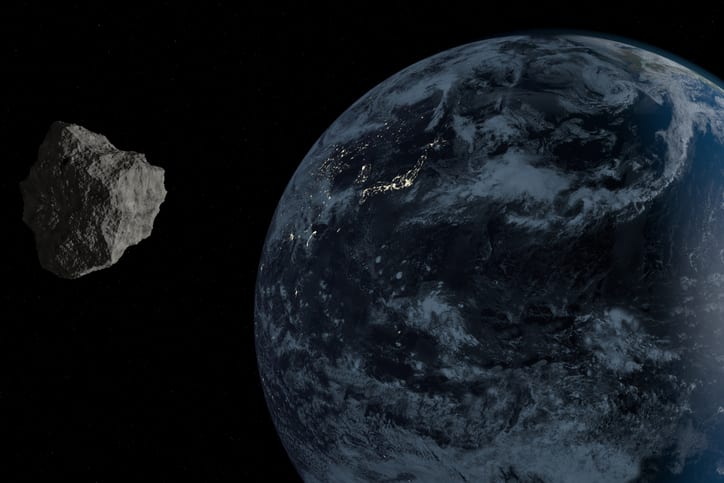
Asteroids

Image Credit: iStock

These rocky objects are smaller than planets, and are left over from the formation of our solar system. Basically, when a cloud of gas and dust collapsed to form our fun, the big chunks of remaining material turned into planets. The smaller fragments of dust are what’s left behind, just floating around waiting to kill us all.

There are millions of known asteroids. the largest, Ceres, is nearly 600 miles wide – big enough to be classified as a dwarf planet, technically. NASA tracks the asteroids that are nearest to Earth (Ceres is not one of them, thank goodness), and plots their trajectories to make sure they’re not coming too close.

Most of them are irregular in shape and sometimes orbit each other and the sun in small groups. Their compositions vary based on how far away they were from the sun when they formed.

The space between Marys and Jupiter is known as the asteroid belt, and that’s where most of them good-sized rocks reside.

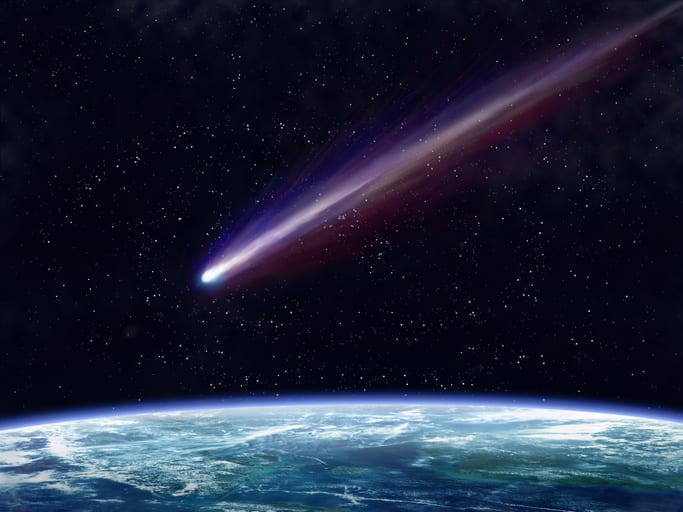
Comets

Image Credit: iStock

Comets are also composed of leftover materials, and they formed around the same time as the asteroids. While asteroids formed toward the inner, hotter regions of the solar system, though, comets formed further out – beyond the frost (or snow) lines, where water can freeze.

That means that, instead of being comprised of only rock or other metals solid enough not to melt, comets are formed from frozen gas, rock, ice, and dust. Some scientists call them “dirty snowballs,” and are easily identifiable by their trailing jets of gas and dust that melt away as they fly too close to the sun.

Meteors

Image Credit: iStock

A meteor is an asteroid that is vaporized when it hits Earth’s atmosphere.

We sometimes see the glowing hot air left behind, and call them “shooting stars.”

We also see meteor showers, when more than one enters our atmosphere at the same time.

Meteorites

Image Credit: iStock

Meteorites are what survives the dive through the atmosphere to land on Earth’s surface.

They’re usually made from iron or stone, a mix of oxygen, silicon, magnesium, iron, and a smattering of other elements.

Studying these fragments has helped us understand the age and formation of our solar system, and how and when Earth came into existence.

Well, now you know!

This information will come in handy one day, I just know it!

The post This is How to Tell the Difference Between an Asteroid, a Meteorite, and a Comet appeared first on UberFacts.

Swimming in Cold Water Might Help Ward Off Dementia

If you’re fast approaching middle age (like I am) or are staring down the later years of your life and hoping to spend most of them lucid and enjoying the fruits of your labor, then keeping your mind in tact is likely something that interests you.

Dementia is scary, and it affects so many of our family and friends – which is why there’s so much research that goes into finding ways to combat it.

Most recently, a team from Cambridge University found that people who regularly swim outdoors in the winter had elevated levels of a protein that plays a key role in forming brain connections.

Image Credit: iStock

The protein in question has been found to help protect the brain against other neurodegenerative diseases like Alzheimer’s, too.

Professor Giovanna Mallucci, the Associate Director of the UK Dementia Research Institute, talked about the results in an online lecture.

Researchers have known for some time that the process of forming new synapses declines over time, and also that this process can be influenced by temperature. Hibernating mammals, for example, experience a loss of synapses when they sleep through the winter, but they are restored upon awakening in the spring.

A previous paper, published in Nature, revealed that a “cold shock” protein in the brain – RBM3 – is responsible.

In mice, exposure to freezing temperatures caused a loss of synapses… but that their RBM3 levels skyrocketed as they warmed up, allowing them to form healthy new ones.

Image Credit: iStock

Researchers then measured RBM3 levels in a group of outdoor swimming enthusiasts, all of whom became hypothermic during their chilly dips.

When compared to a group of non-swimmers, the ones who swam in cold water had higher levels of RBM3 in their blood, leading to the belief that hypothermic conditions does trigger the release of this key protein in humans, too.

This foundation is exciting and strong, but without peer-reviewed research or other, similar findings, we can’t say for sure that taking winter dips in the water will keep your brain healthy for years to come.

Image Credit: iStock

Letting yourself get too cold, or wandering too far down the path to hypothermia, is also deadly – so don’t try this at home until the scientists are sure it’s something that works.

So… just don’t do it alone. Or do it at the gym if they have a cold dip pool. We just don’t want you to drown or get hurt.

The good news for those of us how HATE being cold? If the RBM3 protein is shown to help regenerate skills, we’ll likely see the development of drugs that can help stimulate the desired responses without having to go swimming in the freezing cold.

Three cheers for science!

The post Swimming in Cold Water Might Help Ward Off Dementia appeared first on UberFacts.