
The movie “Independence Day” was originally meant to have support from the United States Armed Forces, but they backed out when the references to Area 51 were not removed from the script.
In 2016, Guinness confirmed…
In 2016, Guinness confirmed that it had changed up its filtration process eliminating the use of isinglass (derived from the dried swim bladders of fish) making it officially vegan.
Wine mixed with coke is an actual…
Wine mixed with coke is an actual thing and it’s called Kalimotxo, it’s one part red wine and 1 part coke and it’s been around since the 1970s. It has become an icon of Basque culture and one of Spain’s most international drinks.
Le Palais Ideal, a castle of stones…
Le Palais Ideal, a castle of stones, was built single handedly over 33 years by postman Ferdinand Cheval. He had no architectural training, but after tripping over an interestingly shaped rock on his mail route he was reminded of a dream he once had of such a palace and made it his life’s work.
The Knights Templar invented…
The Knights Templar invented international banking and payable checks.
Chinese doctor Jiang Yanyong…
Chinese doctor Jiang Yanyong, who exposed the cover-up of China’s SARS outbreak in 2003, was barred from traveling to the United States to collect a human rights award. He spent several months in custody for his efforts.
North Korea has their own basketball…
North Korea has their own basketball rules: slam dunks are worth three points, field goals in the final three minutes of the game are worth eight points, three-pointers are worth four if the ball doesn’t touch the rim, and a point is deducted for missed free throws.
The Irish Elk, an extinct species of deer, stood…
The Irish Elk, an extinct species of deer, stood 7 feet tall at the shoulders and had 12 foot wide antlers. The Irish Elk was the third largest deer to ever live, but had the largest and heaviest antler of any animal in the deer family. It went extinct 7000 years ago.
Writing Is Very Hard: Stop Making These Common Grammatical Mistakes
Writing is very difficult.
I should know, and my editor knows I know [editor’s note: heeeeeyyyy]. Fortunately, I can count on him to gently correct my mistakes or shoot me a message saying, “Can you not use these words in those ways anymore? Thanks.”

Photo Credit: Pixabay
Recently, another editor with the patience of Job started a Twitter thread about some common grammatical mistakes.
Laura Helmuth is the health and science editor at The Washington Post, so she’s clearly seen some funky English in her time. Her list was not only fantastic, but many of her followers, grammar nerds in their own right, chimed in with other ways they see people butchering the English language.
I'm an editor, so a lot of what I do is cut or change words. These are some of the mistakes and misuses I see all the time & how to fix them. This thread is not to shame or subtweet anybody — I learned many of these mistakes by making them myself. Please add your own favorites!
— Laura Helmuth (@laurahelmuth) August 4, 2019
Helmuth listed some good ones:
- “Enormity” means something really bad, not something really big.
- “Japanese/Brazilian/Finnish/Australian researchers discovered…” Science is the most international endeavor in human history. Any team that makes a discovery worth covering almost certainly includes people who aren’t citizens, so instead say: “Researchers in Japan/Brazil/etc.”
- “Men and women” in almost all circumstances should be “people.” The world is over-gendered enough as it is.
- “Famous” is a word you almost never need. If a person or event is known to your reader, you don’t need to tell them it’s famous. If your reader DOESN’T know something, calling it famous risks making your reader feel ignorant or unwelcome in your story. (One exception, as a follower pointed out, is to say someone was “famous in her time” if it’s someone who is relatively unknown now but was a big deal back in the day.)
- It’s spelled “impostor” rather than “imposter,” which I learned only after being quoted in a story about impostor syndrome.
- It’s fine to use “spawn” metaphorically in some cases, but keep in mind that it literally means fish or frogs ejaculating eggs or sperm. Think twice about “seminal,” too.
- Avoid “so and so believes” because you don’t know what they believe, only what they say.
She finished up with:
What are some of your favorite common mistakes or awkward bits of language? In science writing or any other type of writing. Thanks for sharing on a day when it helps to have a distraction.
— Laura Helmuth (@laurahelmuth) August 4, 2019
Other editors and writers added their own grammar pet peeves.
- Putting “The fact that” before something is never necessary.
- Just deserts. Yes, it sounds like desserts, but it’s spelled deserts as in deserves.
- Toward never needs an ‘s.’
- “In order to.” Just “to” does the same job.
- The use of “I” when the object pronoun “me” should be used. E.g. “He took Jean and I to the store.” The trick to knowing what’s right? Take out the other person in the sentence. “He took I to the store” just doesn’t sound right.
- Trying to eliminate “actually” from my vocabulary, mostly speaking vocabulary. Adds nothing.
- “And the reason why is…” is redundant. Just say, “and the reason is…”
- Unique means one of a kind, it is absolute and there are no degrees of uniqueness. Very unique, more unique, most unique etc., are all meaningless.
- I find the word “different” is often unnecessary—12 different people…
Many more goodies were mentioned – check out the thread for the rest. You will either feel smug or ignorant after reading it, but I bet either way you’ll learn something new.
The post Writing Is Very Hard: Stop Making These Common Grammatical Mistakes appeared first on UberFacts.
This is Officially the Hottest Place on Earth
The past ten years were the hottest in recorded history, and it has seen record-breaking average yearly temperatures and single-day temperatures in places across the globe. This is largely due to global climate change, and it’s a dangerous trend.
However…
According to the World Meteorological Organization, the hottest temperature ever recorded was a sweltering 134 degrees Fahrenheit at Furnace Creek in Death Valley, California, way back in July 10, 1913.
Up until 2012, the record on file – 136.4 degrees Fahrenheit – occurred in El Azizia, Libya, and was recorded in 1922. But it was disqualified 90 years later because, according to the Guiness Book of World Records, the temperature could have been off by up to seven degrees due to the type of surface on which the measurement was taken.
Dallol, Ethiopia, is considered the hottest regularly inhabited place.

Photo Credit: Pixabay
Back to Death Valley. Air temperatures there typically reach 120 degrees due to its geographic location and boiling desert environment. The area receives less than three inches of average annual rainfall, and the sun beats down on the ground – 190 feet below sea level and enclosed by mountains.
So, in Death Valley, hot air rises and gets trapped by the surrounding mountain ranges. Then it cools and falls back into the valley. As it falls, where it’s heated again by then sun and the high air pressure down on the valley floor. That’s how the area holds the record for highest recorded air temperature.
Death Valley, though, is not the only hot spot around.
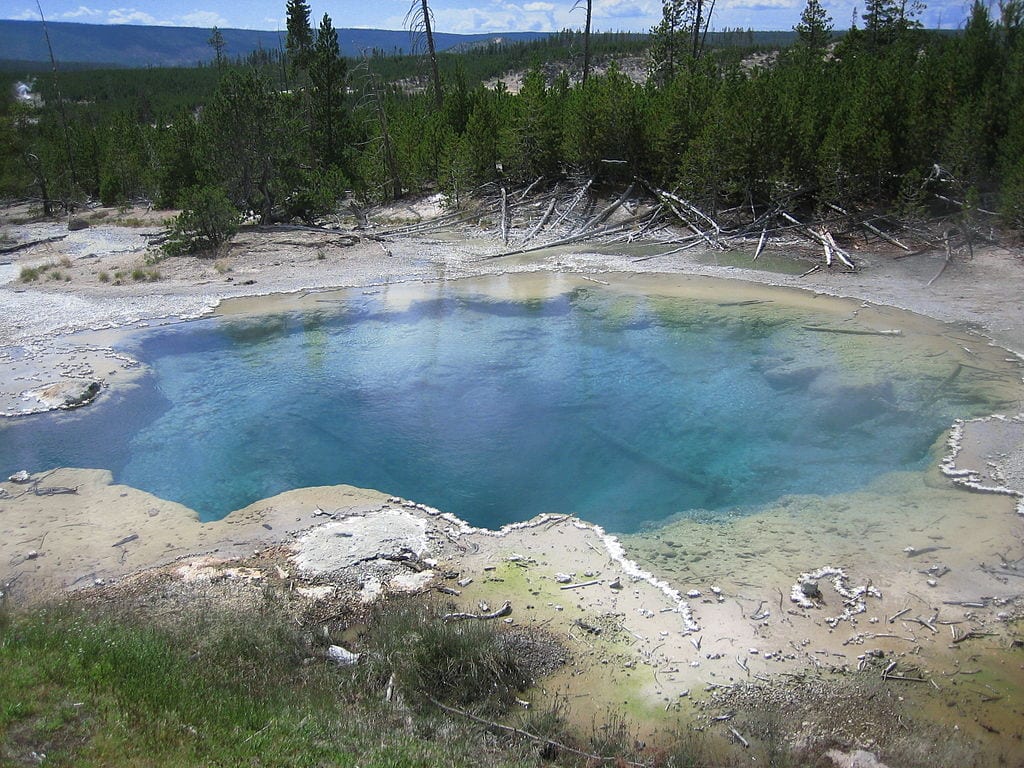
Photo Credit: Billy Hathorn

In Yellowstone National Park, the geothermal pools often reach 250 degrees Fahrenheit and above. According to National Geographic, vents on the ocean floor release liquids at 750 degrees Fahrenheit and higher. The Earth’s core is estimated to have a temperature of a super scorching 11,000-degrees. In our solar system, scientists say the hottest place is the sun’s core which is about 15 million Kelvin, or roughly 26 million degrees Fahrenheit.
If you’re looking for the hottest location in the universe, that seems to be, surprisingly, just outside of Geneva, Switzerland. At the Large Hadron Collider, scientists and engineers smash atoms in their experiments.
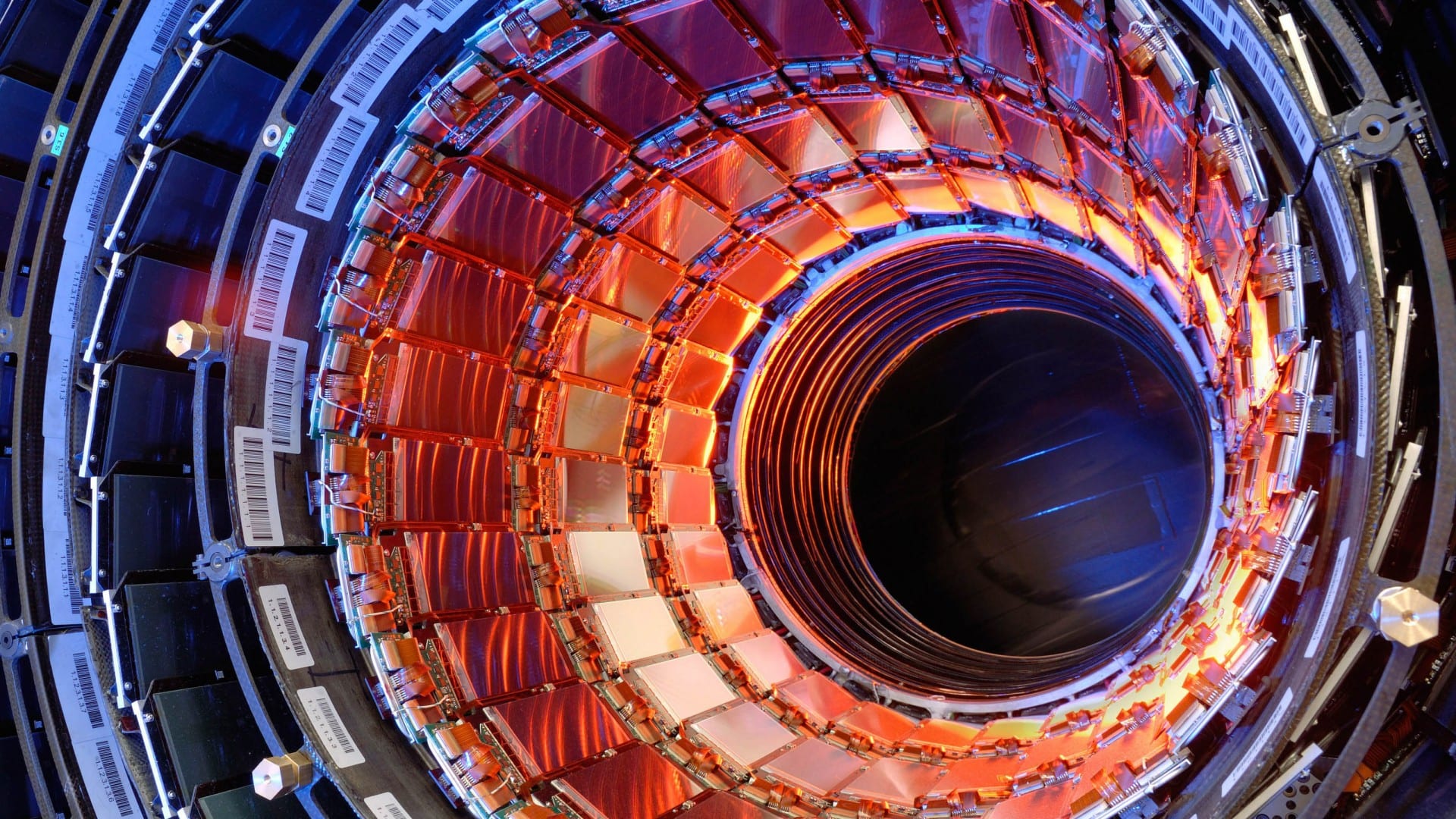
Photo Credit: Flickr
According to Inside Science News Service, the temperature inside the equipment reaches an incredible 7.2 trillion degrees Fahrenheit (if just for short bursts).
That’s a valid excuse for sweating.
The post This is Officially the Hottest Place on Earth appeared first on UberFacts.