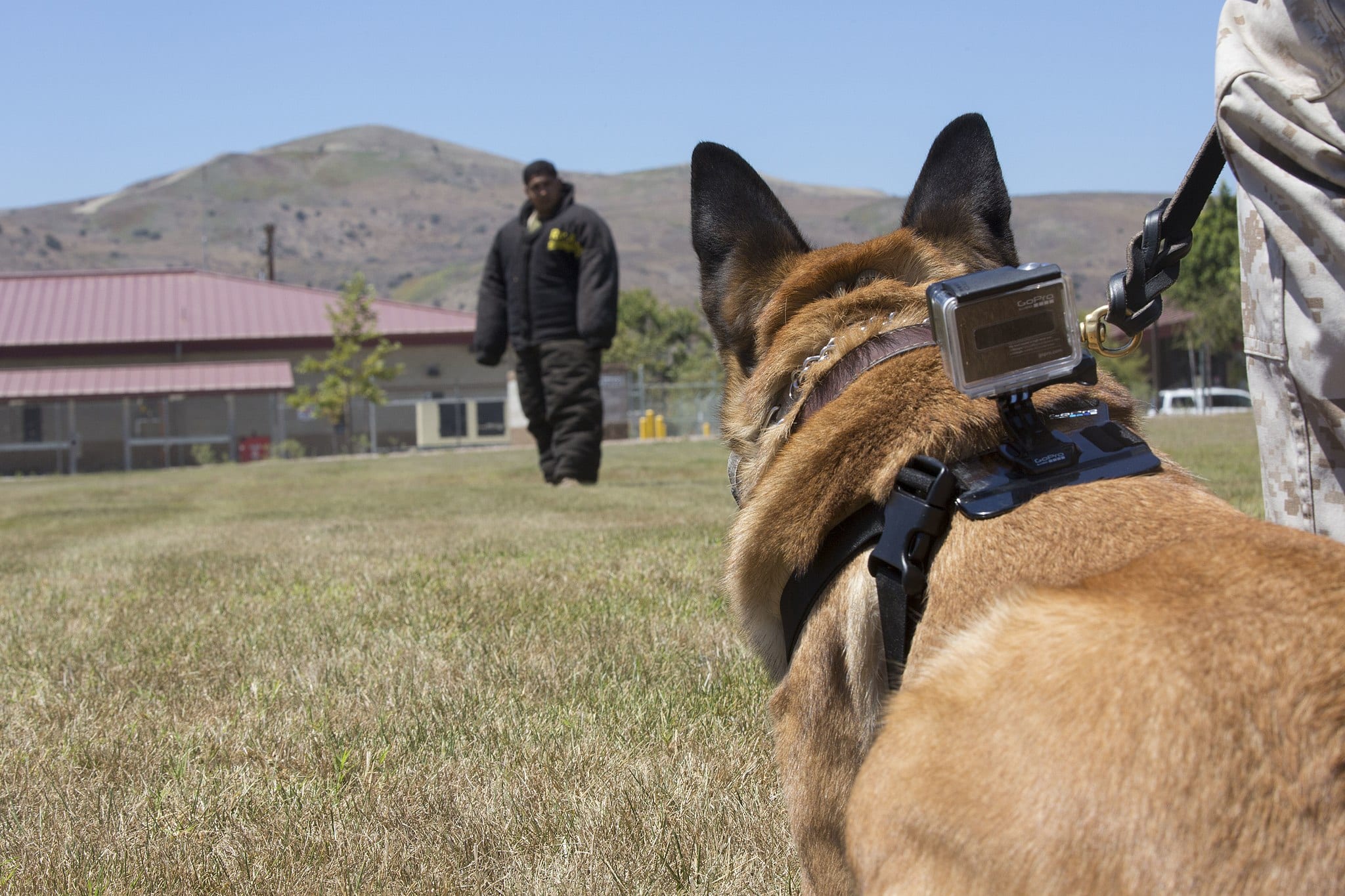
In case you didn’t know, service dogs go through official good citizen training – the and training that allows them to best assist specific disabilities – but that they also typically spend time with foster families so they can learn how to behave in everyday social situations?
One of those everyday situations might be going to the theater – live, musical, or movie – with their trainer, so that if the person they’re paired with wants to take in a show of any kind, they’ll know exactly what to expect and how to behave.
The pups attended a “relaxed performance” at the Stratford Festival theater, which means it’s a showing specifically for people who need more accessibility, accommodations, or reduced noise, lighting, or startling effects.
“Relaxed performances are specifically designed to welcome patrons who will benefit from a less restricted audience environment. Patrons of all abilities are welcome, including but not limited to those with intellectual or learning disabilities, sensory processing conditions or autism. There is a relaxed attitude to noise and movement within the auditorium, and some minor production changes may be made to reduce the intensity of light, sound and other potentially startling effects. Babes in arms are also welcome to our relaxed performances.”
What a great combination of events, all of which prove there are good humans (and pooches) out there with making the world accessible for everyone on their minds.
Hundreds of thousands of Westerners visit Thailand each year, and one of the “must-try” activities is riding a majestic elephant. But tourists are now being urged to stop, thanks to the revelation of some truly heartbreaking photos.
A Twitter user posted several photos of elephants in Thailand being cruelly mistreated. Their keepers, called mahouts, keep them in line by hitting them with sharp metal hooks, often hard enough to draw blood. Their heads are covered in old wounds.
Around 3000 elephants are currently used for entertainment across Asia, and 77 percent are treated inhumanely, according to the World Animal Protection. Elephants are often ripped from their mothers prematurely, violently broken into submission, then subjected to a lifetime of abuse and isolation.
While Thai government agencies are working to end animal cruelty, officials also urge visitors to boycott businesses that treat their animals this way.
“We never support tourists riding the elephants,” a spokesperson for the Tourism Authority of Thailand told Yahoo! News. “Please don’t ride the elephants and don’t support this business.”
There are about 3500 wild elephants in Thailand and about 4500 domesticated elephants. The domesticated elephants are classified as “working animals,” just like livestock. Animal advocates are working to change this classification in order to offer more protections to elephants.
If tourists want to enjoy these beautiful animals, one option is to visit a wild elephant sanctuary. There, tourists can observe and pet the animals, but cannot ride them.
You’ve seen kid shaming, dog shaming, cat shaming, and even bird shaming – but did you ever think the day would come when people’s pet fish would be exposed as naughty?
Well, get ready, because even though they probably don’t understand the internet, these 17 fish definitely deserve all the shame in the world.
You know how your dog or cat’s anxiety can begin the moment they see you drag out your suitcase. They might even try to sit in your suitcase, thinking that you’ll be forced to stay home, or maybe you won’t notice and you’ll just pack around them.
Whatever the reason, these 13 pets are definitely not letting their human go without a fight.
For us humans, the idea of throwing poop is disgusting for multiple reasons: you have to touch poop, it will touch someone else, and there will be an inevitable mess. But for chimpanzees, it’s common behavior.
Why?
First off, the Jane Goodall Institute of Canada says it’s important to realize that the behavior is not common in free-roaming, wild chimps. They do throw things, but they typically stick to rocks or branches when looking for a way to express their annoyance, leaving their feces where they fall.
Whereas for chimps in captivity, there just often aren’t many options when they want to give something a good toss except poop, which is typically abundant.
Chimps throw things when they’re feeling frustrated or anxious, but they’re also smart enough to realize that they can elicit a reaction – horror and disgust, perhaps surprise – when they launch a turd at a zoo employee or a guest.
A 2012 study found that chimps who display good aim had a better-developed motor cortex, and better communications between that cortex and Broca’s area, a portion of the frontal cortex that helps process language in humans. Which is all to say, they were typically the better communicators in their peer groups.
A second study backs up the idea that smart chimps toss poo, by proving that the action is likely premeditated. The study was based on Satino, a chimp at Sweden’s Furuvik Zoo, who enjoyed frightening away visitors by tossing rocks at them. Researchers found that he stockpiled rocks every day before the zoo opened so that a) he would be well-armed and b) no zookeepers would be there to intervene.
Other chimps, though, have been seen pooping directly into their hands and then holding it as they wait for some human to annoy them.
Be careful when viewing the chimps, people. They might find you annoying and use whatever they’ve got at their disposal to make their opinion known – and if you end up wiping poop off your body in a zoo bathroom, I doubt the fact that the chimp who threw it is probably the smartest one of the bunch is going to be much of a comfort.
With King penguins, it’s not unheard of for same-sex couples to form long-term relationships.
Such is the case for male penguins Skipper and Ping at the Berlin Zoo, who recently stepped in to parent an egg that was abandoned in mid-July. Zookeepers aren’t sure what caused the mother to leave, but the two male penguins weren’t going to let the baby die – not if they could help it.
Taking care of an egg isn’t a one penguin job, since, as aquarium curator Vikki McCloskey, points out, “You cannot incubate an egg and eat by yourself.”
She also states that penguins have “fairly strong pair bonds, especially if they’re successful in raising offspring.”
Penguins work together to create and incubate their eggs, and after the eggs hatch, they parents trade off caring for the chicks and going to catch food. That said, McCloskey notes that, as with all species, some individuals are better parents than others.
“There are a whole host of variables as to why a penguin would walk off its egg. In the wild, if your partner doesn’t come back, then you have to eventually go eat.”
The captive penguin may have abandoned the egg due to social reasons, age constraints, sensing that the fetus had stopped developing, or just a lack of interest in mothering.
“We’ve had male-female couples abandon eggs and we’ve had male-male couples do a great job incubating and raising offspring. There’s not really a rule, per se. The main imperative is to produce viable offspring.”
Just something to keep in your back pocket, ladies, the next time your husband tries the excuse that “you’re just better with the kids.”
Remember that urban legend that said if you flushed a baby alligator down the toilet, the poor little fella would end up in the sewer, get enormous, have a major chip on its shoulder for being deserted, and then would go on a killing rampage? It’s actually the basis of a schlocky 1980 movie called Alligator.
Well, there’s a new alligator-centered urban legend you should familiarize yourself with because it’s a doozy…and police in Tennessee had to backtrack after the story went viral. Let’s begin, shall we?
Police in Loretto, Tennessee, posted a photo on Facebook about a drug bust. In the post, they also told people they shouldn’t flush their drugs down the toilet because it ends up in local waterways and that’s always bad news…oh, and it might create meth gators.
“Folks…please don’t flush your drugs m’kay. When you send something down the sewer pipe it ends up in our retention ponds for processing before it is sent down stream. Now our sewer guys take great pride in releasing water that is cleaner than what is in the creek, but they are not really prepared for meth.
Ducks, Geese, and other fowl frequent our treatment ponds and we shudder to think what one all hyped up on meth would do. Furthermore, if it made it far enough we could create meth-gators in Shoal Creek and the Tennessee River down in North Alabama. They’ve had enough methed up animals the past few weeks without our help. So, if you need to dispose of your drugs just give us a call and we will make sure they are disposed of in the proper way.”
People on social media bought into the hype and shared their thoughts.
And now we need to worry about meth gators. #Peak2019
Because the story went viral and people totally believed these doped-up reptiles might be coming to hunt them down, the Loretto Police Department had to clarify that meth gators are not, in fact, real.
Loretto Police chief Bobby Joe Killen said, “As far as I know, there’s no methed-up gators being sighted anywhere. It’s just a joke to let people know they don’t need to be flushing their drugs of any kind down the sewer system. They need to dispose of it in a proper manner.”
Killen added, “We take our job seriously, but we like to joke amongst ourselves at the department. When you work eight, 10-hour shifts in our line of work, there are times when we like to laugh a little bit. Otherwise, you take your problems home.”
I predict a horror movie franchise based on meth gators and I could not be more pleased about it!
There’s not a whole lot of in-between out there when you talk to folks about our feline friends. Most people absolutely adore cats…or they despise them. And I’m pretty sure a lot of people use the excuse “I’m allergic” just so they don’t have to deal with cats on any level, whether at a friend’s house, significant other’s, etc.
Well, the people who pull the “allergy card” might not be able to do that for much longer. And on the flip side, people who really love cats and are legitimately allergic to them will be able to play with all the furry buddies they want to! How, you ask? Because scientists have invented a vaccine that can be given to cats to make us humans less allergic to them. Hallelujah!
Scientists develop vaccine that prevents cats from making you allergic https://t.co/dbXyFZDnAQ
The vaccine is injected into cats (meaning you don’t even have to take the needle yourself), and it makes them produce less of the allergen that causes people to sneeze uncontrollably around them. The researchers have been working on the project for five years, and they call the vaccine HypoCat.
Guilt trip people into taking embracing the "HyopCat" vaccine. Quote: "Fingers crossed that the new vaccine, if successful, will get even more needy kitties out of shelters and placed in happy homes!" https://t.co/rl6gQqhjIo
One of the researchers, Martin Bachmann, said, “We feel the numbers and conclusions are sufficient to drive our investment in further development. This is also reflected by the fact that JACI the Nr 1 allergy journal, published our study. In 2020, more safety and efficacy testing studies will be initiated.”
Bachmann said that once it is released, HypoCat will be affordable for pet owners. According to one of the researchers, the vaccine should be available sometime in 2022. Hooray!
Do you think anti-vaxxers will just have to weigh in on this one as well?
Be prepared to possibly see an unexpected animal on your next flight.
The list of service animal just keeps growing, doesn’t it? And specifically, I’m talking about service animals that are allowed on planes. In addition to dogs, we’ve seen ducks and all other kinds of creatures accompanying their human handlers on flights.
Well, it’s time to add another furry friend to the list of animals allowed to fly on planes: miniature horses. The U.S. Department of Transportation is encouraging airlines to allow miniature horses on flights as service animals.
And while it may sound a little odd, miniature horses are actually quite popular as service animals, right up there with dogs and cats.
The official word from the Department of Transportation says, “After reviewing the comments on this issue, we believe that it would be in the public interest and within our discretionary authority to prioritize ensuring that the most commonly recognized service animals (i.e., dogs, cats, and miniature horses) are accepted for transport.”
Airlines aren’t obligated to allow therapy horses on their flights, but if they ignore the new guideline from the Department of Transportation, they could be penalized. And just to get down to the nitty gritty: this guideline does not apply to emotional support horses, only service horses that help people with visual impairments or issues with mobility. Emotional service animals are often times dealt with on a case-by-case basis at the airport.
The guidelines also say what CAN’T be used as service animals: no snakes, rodents, reptiles, spiders, or ferrets are allowed. Thank goodness for that…