| Questions: | 5 |
| Available: | Always |
| Pass rate: | 75 % |
| Backwards navigation: | Forbidden |

quiz_type:
multichoice
Rich Title:
5 Questions: Got Juice?
CTA Text Quiz End:
Wednesday, January 18, 2017 – 01:45
Schedule Publish:

fact
| Questions: | 5 |
| Available: | Always |
| Pass rate: | 75 % |
| Backwards navigation: | Forbidden |
5 Questions: Got Juice?
Wednesday, January 18, 2017 – 01:45

(Warning: This article contains spoilers from a 22-year-old movie.)
Nearly a quarter-century after its initial release, Bryan Singer’s The Usual Suspects still manages to surprise audiences—and make it onto just about every list of “The Best Movie Endings of All Time” ever compiled. As AMC wrote in just such a list, where the film nabbed the number 21 spot, “For two hours, Kevin Spacey’s spineless Verbal plays helpless lamb being lured to Chazz Palminteri’s slaughter. But with the drop of a coffee cup, and the shaking off of a limp, the true identity of a criminal mastermind is revealed.”
For fans who want to reenact the pivotal moment in which Palminteri’s customs agent Dave Kujan learned he’s been duped by Spacey, this simple white Kobayashi mug is the perfect prop. It’s dishwasher- and microwave-safe—and yes, it comes in one piece. Of course, if you plan on dropping it dramatically to chase after Keyser Söze, you’re going to have to do it in one take (or stock up and buy a couple). You can score one of the elegantly minimalist mugs on Firebox for only $13.
January 18, 2017 – 6:30am

In case you haven’t noticed, the ‘90s are back with a vengeance. Lisa Frank has a brand-new clothing line; TV execs are rebooting classic sitcoms like Full House and Twin Peaks; and your dad’s plaid flannel shirts are suddenly high-fashion. Now, Refinery29 reports, makeup giant Sephora has joined in: The company has released a line of tinted lip balms that’s reminiscent of the lipsticks that were manufactured by the now-defunct Bonne Bell Cosmetics.
The Sephora Collection Sweet Balms are sheer, tinted lip balms that come in an assortment of punchy pastel shades, including violet, pink, and coral. Their selling point, however, is their packaging: The balms come in plastic push-up tubes that look kind of like PEZ dispensers, or even the original Bonne Bell tubes you knew and loved as a tween.
The Sweet Balms are available for purchase on Sephora’s website and cost $6—a small price to pay for a huge dose of nostalgia.
[h/t Refinery29]
January 18, 2017 – 3:00am

As researchers and nutrition experts begin to discover—and admit—how bad sugar is for the body, there’s more awareness of just how much sugar is contained in some of our favorite foods, even the ones that we think of as savory, not sweet. As Co.Exist reports, Antonio Rodríguez Estrada’s photography project sinAzucar (“sugar free”) aims to illustrate how much sugar is in the food we eat in a way that people understand—with sugar cubes.
Each cube is worth 4 grams of sugar. The World Health Organization and other experts recommend that you only eat about 25 grams of added sugar a day, by some counts. Some health groups allow for a little more, like the UK’s National Health Service (30 grams) or the FDA’s proposed 50 gram maximum—which may or may not have been influenced by the powerful Sugar Lobby, which has fought anti-sugar research for decades, including opposing the new “added sugars” designation on nutrition labels. From a health standpoint, the less sugar, the better. Ideally, you should really only be eating a little more than six sugar cubes over the course of your day. Some of Estrada’s photographs show more than that in just one food.

Depressing as they are, some of the images are pretty obvious. Four Chips Ahoy! cookies (if you can manage to eat just four) have 8 and a half sugar cubes. An approximately 24-ounce Coke from Coca-Cola, one of the greatest targets of the fight against obesity, contains almost 20 cubes’ worth of sugar, by Estrada’s calculations. In the U.S., the biggest size of a McDonald’s soft drink, for example, is quite a bit bigger. Not to mention places like 7-11 that sell 64-ounce cups.

Some of the beverages on the list aren’t necessarily thought of as being as sugary as sodas, but are super-sugary nonetheless, like a Venti Starbucks white mocha, which contains some 20 sugar cubes of sweetness. A Powerade bottle, seemingly a healthier option than a Coke, has 9.5 lumps of sugar. (So if you’re drinking it after you work out, you’re probably undoing that healthy activity.) A flavored Activia yogurt, presumably part of a “balanced breakfast” contains four cubes’ worth of sugar.

And some of the other photos might surprise—and terrify—you even more. A frozen barbecue pizza has more than four sugar cubes’ worth (barbecue sauce is notoriously sugary, but a small Domino’s pizza has 13 grams of sugar—7 grams in the crust and 6 in the sauce). Just two pieces of toast adds up to a cube and a half.
The images can be a little misleading, though. The two Petit Suisse yogurt cups pictured have three cubes’ worth of sugar, but those are naturally occurring in dairy and don’t have the same health effects as added sugar. The same goes for the seven cubes of sugar in a 100 percent fruit and vegetable juice. Current research doesn’t support an association between obesity and eating naturally occurring sugars in milk and fruit, though many nutritionists recommend you eat sugary foods like fruit whole, rather than juiced, to maintain the benefits of the fruit’s fiber.
If you’re interested in eating less sugar, try The New York Times’ recent interactive quiz, which tests how little sugar you can eat in a day while consuming a selection of common meals and snacks.
[h/t Co.Exist]
All images courtesy of Antonio Rodríguez Estrada via sinAzucar.
January 18, 2017 – 1:00am

Erik Sass is covering the events of the war exactly 100 years after they happened. This is the 263rd installment in the series.
Germany’s decision to resume unrestricted U-boat warfare at the beginning of 1917 was arguably the worst strategic decision of the First World War – but Germany dug the hole even deeper by attempting to start a war between Mexico and the United States. Together these ill-advised moves turned American public opinion decisively against the Central Powers, setting the stage for U.S. entry into the war in April 1917.
The secret initiative to bring Mexico into the war – which didn’t stay secret for long – was laid out in the “Zimmermann Telegram,” a coded message first sent by the German State Secretary for Foreign Affairs Arthur Zimmermann to the German ambassador to the U.S. Johann von Bernstorff, who passed it along to the ambassador to Mexico Heinrich von Eckhardt (this indirect route was used in an attempt to avoid interception, futile as it turned out; below, the coded telegram from Bernstorff).

In his previous role as undersecretary of foreign affairs Zimmermann enjoyed some success fomenting dissension abroad to distract Germany’s enemies from the European war, most notably the Easter Rising in Ireland, which complicated British war efforts and delivered a stinging propaganda defeat to the Allies, supposedly fighting for the rights of small countries. On taking the reins from the previous foreign secretary, Gottlieb von Jagow, Zimmermann naturally continued his predecessor’s policy of stirring up trouble between Mexico and the U.S. in order to distract the latter – an easy task considering their fraught relations following the Mexican Revolution, Tampico Incident, the repeated depredations of Pancho Villa, and the Punitive Expedition.
But now Zimmermann planned a dangerous escalation, reflecting the mounting stakes. With unrestricted U-boat warfare set to resume on February 1, 1917, Germany’s leaders knew there was a very good chance it would provoke the United States to join the war against them, and so (despite reassuring predictions from military hardliners that the American effort would be desultory at best) were willing to consider any gambit to refocus America’s attention away from Germany – ideally on an enemy closer to home.
The Germans spared nothing in their effort to bring Mexico into the war, at least as far as promises go. The key enticement – and a diplomatic bombshell when revealed – was the offer to help Mexico win back the lost provinces of the American southwest, taken by the U.S. as spoils of victory in the Mexican-American War in 1848. Even more sensational, the Germans wanted Mexico to help convince Japan to turn on the U.S. as well, capitalizing on growing tension between the countries over Japanese expansion in the Pacific Ocean and aggression in China. The full text of the telegram delivered to Eckhardt read:
We intend to begin on the 1st of February unrestricted submarine warfare. We shall endeavor in spite of this to keep the United States of America neutral. In the event of this not succeeding, we make Mexico a proposal of alliance on the following basis: make war together, make peace together, generous financial support and an understanding on our part that Mexico is to reconquer the lost territory in Texas, New Mexico and Arizona. The settlement in detail is left to you. You will inform the President of the above most secretly as soon as the outbreak of war with the United States of America is certain and add the suggestion that he should, on his own initiative, invite Japan to immediate adherence and at the same time mediate between Japan and ourselves. Please call the President’s attention to the fact that the ruthless employment of our submarines now offers the prospect of compelling England in a few months to make peace. Signed, Zimmermann.
Unfortunately for the Germans, Eckhardt and Mexico’s leader Venustiano Carranza (who would be sworn in as president on May 1, 1917) weren’t the only ones privy to this shocking proposal, transmitted by coded telegraph. Unbeknownst to the German foreign ministry the British Admiralty’s cryptography division, “Room 40,” had been monitoring German messages since the war began, and were routinely able to decode these messages with the help of captured codebooks and ciphers.
The Zimmermann Telegram was originally dispatched from Berlin to Washington, D.C. on January 16, 1917 using standard diplomatic channels, which in wartime meant sending it on undersea telegraph cables via a neutral country – in this case Denmark. After receiving a copy of the intercepted message on January 17, 1917, the British code-breakers went to work and almost immediately realized the value of the intelligence gathered from the partially decoded document, which was bound to infuriate American public opinion and hopefully bring the U.S. into the war on the side of the Allies. They continued their work and by February 5 the message was nearly complete.
The Admiralty was understandably careful about sharing or acting on information uncovered by Room 40, in order to avoid arousing German suspicions that their codes were compromised, but the Zimmermann Telegram presented an opportunity too good to pass up. In order to bring the telegram to the attention of President Woodrow Wilson without tipping their hand to the Germans, and without disclosing the awkward fact that they were spying on American telegraph traffic, Room 40 chief Admiral William Hall came up with two clever ruses. First, the British would tell the Americans they obtained the telegram by bribing a telegraph company employee in Mexico; second, when it was time to go public they would make it appear the deciphered message had been obtained by British agents through treachery in Mexico City, rather than intercepted and deciphered as it crossed the Atlantic.

For now the British kept their secret to themselves, in the hopes that Germany’s resumption of unrestricted U-boat warfare would be enough to bring the U.S. into the war; they only disclosed the existence of the telegram on February 24, 1917, when their American cousins seemed to be dragging their feet (at which point the British were able to cover their tracks even more completely with the collaboration of the U.S. government, by staging additional deceptions to make it appear that it was American spies who obtained the text – this time through treachery in the German embassy in Washington, D.C. The full details of this exciting episode are set forth in Barbara Tuchman’s classic book, The Zimmermann Telegram. Above, the decoded version).
Meanwhile the Mexican government responded skeptically to the German proposal. U.S.-Mexican relations, while certainly at a low point during the Punitive Expedition, had apparently been improving since the summer of 1916, when Wilson disavowed war with Mexico and Carranza offered concessions. Further, Carranza’s generals warned that Mexico would never be able to absorb the large “Anglo” populations of the states in question, foreshadowing endless future conflicts with restive natives as well as the irredentist U.S. (top, an American cartoon after the telegram became public).
Worse still, Mexico would bear the brunt of the war by itself, with no prospect of effective help from Germany thanks to the British naval blockade – a daunting prospect considering the Mexican Army could barely secure the country’s own northern territories (Japan was also unlikely to go to war lightly, as it relied on imports of American kerosene, cotton, and steel, and also depended on America as its largest export market).
In short, Germany had unwittingly provided Britain with a deadly diplomatic weapon, sealing its own fate, all for the sake of an improbable – some might say fantastic – foreign adventure. Later, Zimmermann’s inexplicable admission that he was the author of the telegram put the final nail in the coffin of the reputation of Imperial Germany’s foreign service, already discredited by incompetent diplomacy in the lead-up to the war.
See the previous installment or all entries.
January 17, 2017 – 11:00pm

Many women writers have chosen to hide or disguise their identities by adopting a pseudonym—consider J. K. Rowling (who has written as Robert Galbraith), George Eliot, or the Brontë sisters, for example. However, the true identities of these gender-bending writers often became known in their lifetimes, while the same cannot be said for the pioneering British science fiction author Katharine Burdekin and her alter ego, Murray Constantine.
Burdekin began her writing career in the early 1920s, publishing a couple of realist novels under her own name before beginning to write books with a distinctly science fiction theme. Her first in the genre, The Burning Ring in 1927, explored the theme of time travel. In those days, a woman writing science fiction was unusual, and Burdekin gained some notice as well as some famous fans such as the prominent lesbian writer Radclyffe Hall, who wrote to Burdekin in praise of her work.
As political turmoil in Europe grew in the years before World War II, the themes of Burdekin’s writing became darker and more political. In 1934 she began publishing under the pseudonym Murray Constantine. No one knows for sure why she adopted the male name, but it seems likely that the pseudonym allowed Burdekin greater freedom to create more overtly political works and explore gender with less scrutiny. Some scholars, such as Robert Crossley, have suggested that Burdekin may have been influenced by the fate of contemporary writer Naomi Mitchison, a Scottish feminist who spent years battling to get her radical work, We Have Been Warned, published. When that book was finally released in 1935, its open discussion of sexuality and gender politics horrified many, in part because it had been penned by—gasp—a woman.
Freed from the constraints of writing under her own identity, Burdekin began to explore dystopian futures and themes of gender fluidity. In 1937, her most acclaimed work, Swastika Night, was published. Considered one of the first dystopian novels ever written, the book imagined the continuation of Nazism in an alternate future where women were reduced to lesser beings, kept like cattle and used only for breeding. Such was the power of the nightmarish future imagined in the book that during World War II a special edition was published with a note from the publisher, saying that the author “has changed his [sic] mind about the Nazi power to make the world evil … he further feels that Nazism is too bad to be permanent.” Swastika Night has since come to be seen as a significant work of literature, one whose dark imaginings of a fascist future presage George Orwell’s Nineteen Eighty-Four, published more than a decade later.
Burdekin ultimately published four novels as Murray Constantine, the last in 1940. Though she continued writing, she published nothing from that year on and remained obscure, known only for the novels she wrote as Katharine Burdekin early in her career. In 1955 she suffered an aneurysm and came close to death. She survived, but remained bed-ridden until her death in 1963.
In the 1980s the academic Daphne Patai [PDF], now of the University of Massachusetts Amherst, became interested in the work of Murray Constantine while researching utopian and dystopian novels. Patai was familiar with Burdekin’s earlier novels and began to note the similarity in style between Burdekin and Constantine. Patai contacted the original publishers of Swastika Night, Victor Gollancz, persistently questioning Constantine’s real identity. The publishers finally confirmed what Patai had suspected—Burdekin and Constantine were one and the same, a fact that had remained secret for some 50 years.
Patai knew that after Burdekin’s marriage had crumbled in 1922 the writer had gone on to form a life-long partnership with a woman. The scholar managed to contact Burdekin’s partner, who was happy to share her memories of the author as long as she remained anonymous. The pair began a correspondence that revealed much about how Burdekin had worked—at great speed, never spending longer than six weeks writing any one novel. Before starting a project, Burdekin would become withdrawn and stop eating, then enter a sort of frenzy, which her partner described as almost like automatic writing, whereby the words seemed to spill unbidden from Burdekin’s pen. After she had completed a book, Burdekin would fall into a depression.
In 1986, Patai visited Burdekin’s partner at the house they had shared in Suffolk. While there, Burdekin’s partner retrieved from the attic a trunk full of Burdekin’s unpublished writing. As Patai read through the material, she was excited to find a complete manuscript that seemed to have been written in the 1930s. The novel, The End of This Day’s Business, serves as a counterpoint to Swastika Night, presenting a world in which peace-loving women ruled while men have lost all sense of their power and history.
In 1985, after Patai had revealed Burdekin’s true identity, Swastika Night was reissued by the Feminist Press under her real name. In 1990, The End of This Day’s Business was published, introducing the world to a fascinating feminist utopia, although the author points out that a world that subjugates any group of its citizens can never be free. Writing years before the contemporary trend for dystopian sci-fi, Katharine Burdekin was a woman well ahead of her time. Today, she is remembered as a pioneer whose genre- and gender-bending anticipated contemporary movements, and whose dark imaginings still have the power to chill.
January 17, 2017 – 8:30pm

Talk therapy is often considered the soft option when it comes to mental health treatment. Yet millions of patients and numerous studies testify to its long-term effectiveness, and now researchers say one type of talk therapy can produce visible changes in patients’ brains. They published their research in the journal Translational Psychiatry.
One of the best-known and most successful techniques is called Cognitive Behavioral Therapy, or CBT. People in CBT learn skills that allow them to challenge and disrupt unpleasant and negative thoughts, feelings, and behaviors. CBT is especially useful for people experiencing psychosis, a state of mind in which it becomes hard—if not impossible—to tell what’s real and what’s not. CBT for psychosis (CBTp) gives patients the tools to reframe their troubling thoughts and help calm themselves down.
For the study, researchers recruited 22 people who were already on medication to help with the symptoms of psychosis. The participants filled out questionnaires about their health and state of mind, then underwent brain scans.
The researchers divided the participants into two groups: Fifteen people continued taking their medication and did a six-month stint of CBT, while the other seven (the control group) simply continued taking their medication. The researchers tracked the participants’ health over the next eight years. At the end, the subjects filled out another questionnaire and underwent another brain scan.
Seven-and-a-half years after their treatment ended, the people in the CBT group showed clear signs of improvement, in both their brain scans and their health histories. Their brains showed stronger connections between several regions, including the amygdala, which helps identify threats, and the frontal lobes, which are vital for thinking and reasoning. People in the CBT group also reported feeling better about their mental health than people in the medication-only group, and felt they’d made more progress toward recovery.
Liam Mason of Kings College London was lead author on the paper. He says his findings dispel the notion that talk therapy is less important because it doesn’t physically change the brain. “This ‘brain bias’ can make clinicians more likely to recommend medication but not psychological therapies,” he said in a statement. “This is especially important in psychosis, where only one in ten people who could benefit from psychological therapies are offered them.”
January 17, 2017 – 7:30pm

Your passport is the one thing you always have with you when you travel around the world, so it might as well be beautiful. These 15 countries have transformed their passports into works of art.
Norway’s passport, which was redesigned in 2014, is a celebration of Scandi minimalism. The inside pages depict Norway’s natural landscapes using clean lines and shades of teal, grey, and orange. The illustration are gorgeous enough in normal light, but they really come alive when you shine a UV light on them: The colors turn dark, and the Northern Lights appear as dazzling ribbons across the night sky.
No more twiddling your thumbs in the customs line! Finland’s passport, redesigned in 2012, doubles as a flipbook. When you thumb through the document, an illustration of a moose at the bottom right hand corner appears to saunter across the page.
Kangaroos, emus, platypuses: the Australian passport has them all. The illustrations inside pay tribute to the country’s distinctive biology. And beneath the pretty pictures, a host of hidden security features—including an image of a kangaroo that appears to float above the page when tilted—make Australia’s passports extremely difficult to forge.
Canada’s new passport looks fairly ordinary in the light of day. But when you shine a blacklight on the inside pages, they transform into glowing illustrations of iconic Canadian scenes and symbols, from Niagara Falls to Technicolor maple leaves.

Like Canada’s passport, China’s passport has an ultraviolet secret. Pass a UV light over the inner pages, and illustrations of landmarks like the Great Wall of China burst into colorful life.

As a remote nation surrounded by water, New Zealand has always been a nation of travelers—from the early Polynesian explorers who first sailed to the island, to modern-day Kiwis who travel thousands of miles beyond their borders. Each page of New Zealand’s passport—one of the world’s most powerful—tells the story of the many journeys that New Zealanders have taken throughout history.
Like many of the world’s most beautiful passports, Hungary’s passport comes alive under UV light. A blacklight reveals part of the musical score of the second Hungarian national anthem, the Szózat.
The 48 pages of Indonesia’s passport feature brightly colored drawings of the island nation’s impressive flora and fauna, including a turtle, a bird of paradise, and a Rafflesia, one of the world’s largest flowers.
Our new passport celebrates Ireland’s rich heritage in it’s visa pages #HeritageWeek #Yeats #NíDhomhnail @IrishRugby pic.twitter.com/7jv2BkL5wJ
— Irish Passport (@PassportIRL) August 25, 2016
The Irish passport, redesigned in 2013, is a lovely tribute to the music, architecture, and natural beauty of the Emerald Isle. The illustrations inside depict landmarks like the Cliffs of Moher and Dublin’s iconic River Liffey, woven through with Celtic designs.
The Scandinavians seem to know something the rest of us don’t when it comes to stylish passport design. Sweden’s passport, redesigned in 2012, features unusual birds-eye-view illustrations of famous Swedish landmarks and neighborhoods. And yet again, the whimsical drawings take on a whole new life when you slip them under UV light.


The UK redesigns its passport every five years for security reasons. The most recent design, unveiled in November 2015, celebrates the past 500 years of creativity in Britain. The inside pages feature illustrations of British innovators, including the modern artist Anish Kapoor and the first computer programmer, Ada Lovelace. Also, a watermark of William Shakespeare graces every page.
America’s passport is full of colorful illustrations of classic American landscapes, paired with inspirational quotes from U.S. leaders. But the current look may be on its way out; the U.S. passport is getting a makeover, and will debut later this year, or near the start of 2018.
The new Philippine passport, which was released in 2016, features colorful illustrations of the country’s tourist destinations, natural landmarks, and animals. The most dramatic rendering shows the wings of endangered cockatoos framing the face of the national bird, the Philippine eagle.
Each page of Mexico’s colorful passport features a different coat of arms to represent Mexico’s 31 states and Federal District.
Switzerland’s passport (issued in 2010) definitely makes a statement. Instead of the standard dark cover stamped with a country crest, the Swiss went bold, minimal, and modern, with an unusual off-center alignment for the text. The geometric patterns on the inner pages are just as striking.
January 17, 2017 – 6:00pm

Vahana/Airbus
The manufacturer of the world’s largest passenger airplane is setting its sights on a much smaller form of air travel. As Reuters reports, Airbus aims to have a single-person flying car prototype ready for demonstration by the end of 2017.
Since last year, Airbus has been looking into building autonomous aircraft that can be summoned through an app, just like ground-based ride-hailing services. At this year’s DLD digital tech conference in Munich, Airbus CEO Tom Enders revealed just how close they are to reaching that goal. According to Enders, the project is “in an experimentation phase” and a demo vehicle could be ready for takeoff within the year. In addition to personal flying cars, Airbus is also exploring self-piloted helicopter-style aircraft for transporting multiple passengers at once.
Airbus hardly has a monopoly on the future of autonomous air travel. The European flying car company Lilium Aviation recently received a $10 million investment and has plans to launch full-scale test flights within the year. Uber is also looking to take short-distance travel to the skies in the near future. Building flying cars sounds like a costly endeavor, but Enders says it could end up saving cities money in the long run. “With flying, you don’t need to pour billions into concrete bridges and roads,” he said at the conference.
[h/t Reuters]
January 17, 2017 – 4:30pm

When Catherine Cortez Masto was sworn in to Congress on January 3, she became the first Latina senator. A Democrat, the two-term former Nevada Attorney General assumed the seat previously held by outgoing minority leader Harry Reid. Read on for nine facts about this dedicated freshman senator.
Cortez Masto’s paternal grandfather, Edward Cortez, was born in Chihuahua, Mexico and immigrated as a young man to the United States, where he met Mary Tapia, of New Mexico. The two got married and started a bakery in Las Cruces, New Mexico. Edward built his own oven from earthen bricks. In 1939, Cortez Masto’s father, Manuel “Manny” Cortez, was born, and in 1940, Edward was naturalized as an American citizen. He served in the army during World War II, and when he returned home, the Cortez family moved to Las Vegas. Edward worked in a bakery and Mary spent her days as a sales clerk, while Manny attended the local public schools.
After graduating from Las Vegas High School in 1956, Manny spent three years in the army before returning to Las Vegas and marrying Joanna Musso in 1960. Cortez Masto’s sister, Cynthia, came along two years later, and Catherine herself was born two years after that. Meanwhile, Manny was attending Nevada Southern University as a pre-law student and working nights parking cars on the Strip. He eventually left college and continued working on the Strip, but in 1969, wanting to move up in the world, he got a job working as an investigator at the District Attorney’s office. In a few years, he moved on to the Public Defender’s office, where he was trained to administer polygraph tests.
A 1972 bid for local assemblyman was unsuccessful, but caught the eye of Nevada Governor Mike O’Callaghan, who appointed Manny administrator of the Nevada Taxicab Authority the next year. Then, in 1976, Manny ran for a seat on the Clark County Commission and won, eventually serving four terms. As part of his duties as commissioner, he served on a number of boards, and became chairman of the board of the Las Vegas Convention and Visitors Authority (LVCVA) [PDF]. In 1991, he became LVCVA president, a role he held for 13 years. Manny had a very successful career in the Vegas tourism industry—in fact, he was responsible for greenlighting the city’s most famous slogan, “What happens here, stays here.” Upon his death in 2006, he was honored in both houses of Congress.
Reflecting on her family’s journey from an immigrant grandfather with a grade-school education to a father who became an important figure in Nevada’s political and business community, Cortez Masto told Mother Jones, “That, to me, is the American Dream.” She and her sister became the first in their family to graduate from college. In an interview with Fusion, Cortez Masto said, “Can you imagine my grandfather if he were alive today and saw his granddaughter who was the attorney general for eight years in the state now running to be the first Latina ever elected to the United States Senate? That’s incredible.”

Cortez Masto grew up in Las Vegas, watching her parents and grandparents work hard. “Wow, my grandmother was tough,” she told Latina Magazine of her father’s mother, Mary. “You couldn’t put anything past her. She was a sales clerk and went home to work just as hard. I realized the work ethic, and I knew I had to work hard because of her.” Cortez Masto’s own mother was a bookkeeper, while her father, as previously noted, worked his way up from parking attendant to county commissioner. Cortez Masto told the Reno Gazette-Journal in 2005, “Obviously, he’s always been a role model.”
Cortez Masto attended the University of Nevada, Reno, graduating with a bachelor’s in science in 1986, then went on to law school at Gonzaga University in Washington state. She moved back to Nevada, passing the bar exam in 1990 and spending a year clerking for Judge Michael J. Wendell. The judge, who had been on the bench for two decades, also served as a role model for Cortez Masto: “He had great judicial temperament,” she told the Gazette-Journal. “I just learned from him how to be an attorney … how to deal with people.”
She took her first step into politics in 1995, joining the staff of Nevada’s then-governor, Democrat Bob Miller. She was familiar with Democratic politicians: Her father had been a Democrat during his time as county commissioner and he brought prominent Democrats into his family’s life. “Gov. [Mike] O’Callaghan was larger than life and had a big impact on my family,” she told the Gazette-Journal. “My father went to school, and went into the Army with Congressman [Jim] Bilbray. Sen. [Richard] Bryan went to school with my parents.” Cortez Masto found herself thriving in the political environment, and became Miller’s chief of staff in 1998.
While serving as chief of staff for Miller in the late 1990s, Cortez Masto was given the assignment of coordinating the logistics of President Bill Clinton’s visit to Las Vegas. The point person on the president’s side was Paul Masto, a Secret Service agent. She later recalled, “He asked me out on a date and he said, ‘Like a good attorney, I asked you out for dinner and you negotiated for lunch.’”
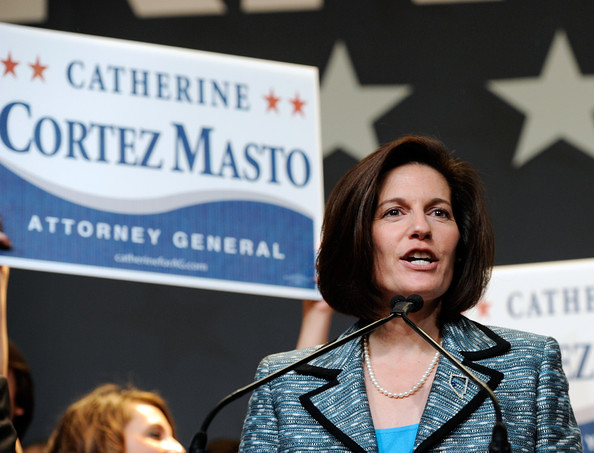
Cortez Masto spent 1999 to 2001 living in Washington, D.C. and working as an assistant U.S. attorney, focusing on drug and victims’ rights cases. In 2002, she moved back to Nevada, becoming assistant county manager of Clark County (where Las Vegas is located), while her husband Paul joined the Secret Service’s Las Vegas office. In 2005 Nevada’s Republican Attorney General Brian Sandoval was nominated for a federal court judgeship, creating a vacancy, and Cortez Masto started to consider her future.
With the support of her parents and Nevada Democratic leaders like Harry Reid, she resigned from her job with the county and began campaigning to become the Silver State’s top prosecutor. “There was never any [political] position I was interested in other than being attorney general,” Cortez Masto told the Gazette-Journal. She had been watching Nevada deal with a methamphetamine crisis, widespread domestic violence, and prevalent elder abuse. She told Remezcla, “For me, those are areas—particularly when it comes to domestic violence prevention and sexual assault—that I had worked in before. I thought it was time to step up and take a leadership role and steer the ship to bring attention to those issues and find solutions to the problems. That’s when I decided to run for Attorney General for the first time in 2006.” She went on to serve two consecutive terms, the limit under Nevada law.
Cortez Masto had watched her own grandparents “become targets of fraud,” an experience she told Gonzaga University’s law blog was “heartbreaking.” As a result, she said, “Elder protection became my first priority as Attorney General.” Upon taking office in early 2007, she pushed the Nevada legislature to give her office jurisdiction to investigate elder fraud and abuse cases. In May 2007, the governor signed into law Assembly Bill 226 [PDF], creating a special unit within the Nevada Attorney General’s office to prosecute crimes against seniors.

From 2004 through 2012, Nevada was the state with the highest rate of women murdered by men. As attorney general, Cortez Masto created a 15-person team to review the domestic-violence fatality rate and provide recommendations to reduce deaths. On the team, she and members of her office worked alongside police officers, representatives from the Division of Child and Family Services, and a member of the UNLV School of Social Work. In 2013, they released a report recommending specific actions for law enforcement, district attorneys, and local legislators in order to combat intimate partner violence. Since 2013, the domestic homicide rate against women has dropped in Nevada, but it remains nearly double the national average.
During her two terms as Attorney General, Cortez Masto introduced over 40 state bills that were voted into law and signed by the Republican governor. She told Elle that her proudest accomplishment came in 2013 with the passage of Assembly Bill 67 [PDF], which defined the specific crime of sex trafficking (replacing previous statues on pandering) and is aimed at punishing pimps. The bill lengthens prison sentences for those convicted, requires that they register as sex offenders, and allows victims of trafficking to bring civil action against the perpetrators. Governor Brian Sandoval signed it into law in June 2013. The same day, he also signed a companion bill setting up a fund for victims of human trafficking. Masto’s office also produced a series of trafficking-awareness PSAs that aired on television in Nevada.

Though Cortez Masto became the first-ever Latina elected to the Senate, during the campaign allies of her Republican opponent, Joe Heck, argued that she wasn’t Latina enough. A former political director for Heck’s campaign quipped on Twitter that Cortez Masto’s ethnicity was only relevant to her when applying for scholarships or running for Senate, and questioned whether she speaks Spanish. Another former Heck aide criticized Cortez Masto’s campaign, calling it “Hispandering at its finest.”
Cortez Masto responded to the attacks, telling Politico: “It’s a criticism for me and other Mexican-Americans. It is an attack on all of us who come here and have worked hard in Nevada to make it home.” Cortez Masto does not speak Spanish fluently, though she can often understand it. Her mother’s family is Italian by heritage, while her father was a second-generation Mexican immigrant who only occasionally spoke to her in Spanish. Cortez Masto noted to Latina Magazine that when her father and his parents moved to Las Vegas in the 1940s, there were very few Hispanic families in the area. “[I]t was about being more American for them,” she said, “that is why my generation doesn’t speak as much Spanish. During that time, it was about assimilating.”

With senators Kamala Harris, Maggie Hassan, Tammy Duckworth, Dick Durbin, and Chris Van Hollen. Image via Facebook.
Cortez Masto identifies significantly with her Mexican heritage, and she argues that it makes her better able to represent a state whose population is 28% Hispanic. She told Remezcla, “I’ve always felt, particularly as the Attorney General of the state, that the people that served in my office should be just as diverse as the community we are representing. I think that should be true of Congress.” She also argues that, as someone with a different background than most people in Congress, she brings “a different perspective” and promises to focus, in particular, on passing comprehensive immigration reform and advocating for Dreamers (undocumented immigrants brought to the U.S. as children). “We’re working on a future for everyone,” she told Remezcla, “and we’re bringing families out of the shadows.”
January 17, 2017 – 4:00pm


.jpg)