12 Uniquely German Illnesses That We Have No Word For

I’ve always had a secret desire to learn German, because it seems like an extremely descriptive language.

Sure, even a simple recipe for cake can sound like you’re summoning the devil because of how harsh German sounds to the ear, but you’ve got to hand it to them for coming up with words to describe things most of us would never think of.

#1. Zivilisationskrankheit

Image Credit: Pixabay

This “civilization sickness” is a blanket term that can encompass any illness brought on by living in the modern world (anxiety, carpal tunnel, type 2 diabetes, etc).

#2. Kreislaufzusammenbruch

Image Credit: Pixabay

This is a super long word that technically means “circulatory collapse” but actually means “feeling woozy.” That’s it.

#3. Ichschmerz

Image Credit: Pixabay

Like the term above, but to describe dissatisfaction with yourself rather than the world.

#4. Fernweh

Image Credit: Pixabay

If you’ve got the opposite of homesickness – a longing for travel or wanderlust – this is the word for you.

#5. Föhnkrankheit

Image Credit: Pixabay

A föhn is a wind that cools air as it draws up one side of a mountain, then warms as it compresses coming down the other side. The winds are believed to cause headaches and other feelings of illness.

#6. Putzfimmel

Image Credit: Pixabay

Putzen means “to clean” and fimmel is a mania or obsession. You can put them together, and even though people go through it elsewhere, in Germany it’s a common occurrence (possibly because it’s fun to say).

#7. Lebensmüdigkeit

Image Credit: Pixabay

Despair or world-weariness, but literally “life tiredness,” Germans use it to describe people taking stupid chances with their own life.

#8. Werthersfieber

Image Credit: Pixabay

Werther, the main character in Goethe’s The Sorrows of Young Werther, is a lovesick lad whose affections ultimately go unrequited (after which he decides to commit suicide). Now, the term translates to “Werther’s fever” and is used to describe a miserable crush.

#9. Zeitkrankheit

Image Credit: Pixabay

It means “time sickness” or “illness of the times” and is used to describe whatever backward mindset and/or practices are attached to a particular era.

#10. Torschlusspanik

Image Credit: Pixabay

This “gate closing panic” describes the anxiety that comes with the awareness that your opportunities wane as the years of your life slip by and the “gates close” forever. Uplifting, right?

#11. Hörsturz

Image Credit: Pixabay

You can actually only contact hörsturz in Germany, because the sudden, stress-related hearing loss pretty much only happens there. Or so they say.

#12. Weltschmerz

Image Credit: Pixabay

It means “world pain” and is a sadness brought on by the reality that the world will never be as you wish it.

Isn’t language fun?

The post 12 Uniquely German Illnesses That We Have No Word For appeared first on UberFacts.

Linguistic Maps Highlight How Americans Say Things Differently Across the Country

In case you weren’t aware: America is a HUGE place. Having driven all over the ap when I was younger, I can tell you that it’s truly surprising how vast our nation is.

With that large landmass comes various regional dialects. People in Boston speak differently than people in Mississippi. The folks in North Dakota sound a heck of a lot different than the citizens of Texas. And so on and so on.

These nifty maps show some of the differences in how Americans say things.

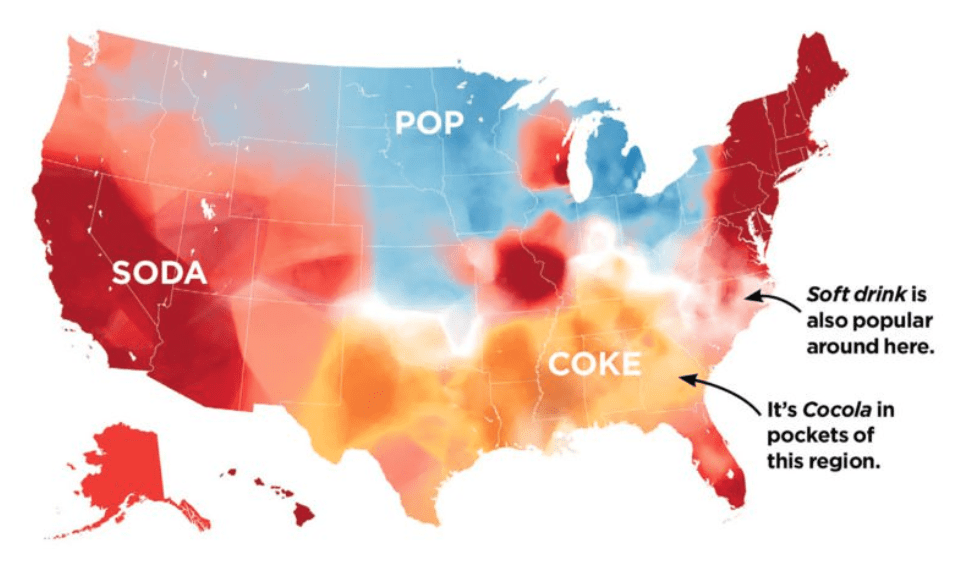
1. This one gets people worked up

Photo Credit: Reader’s Digest

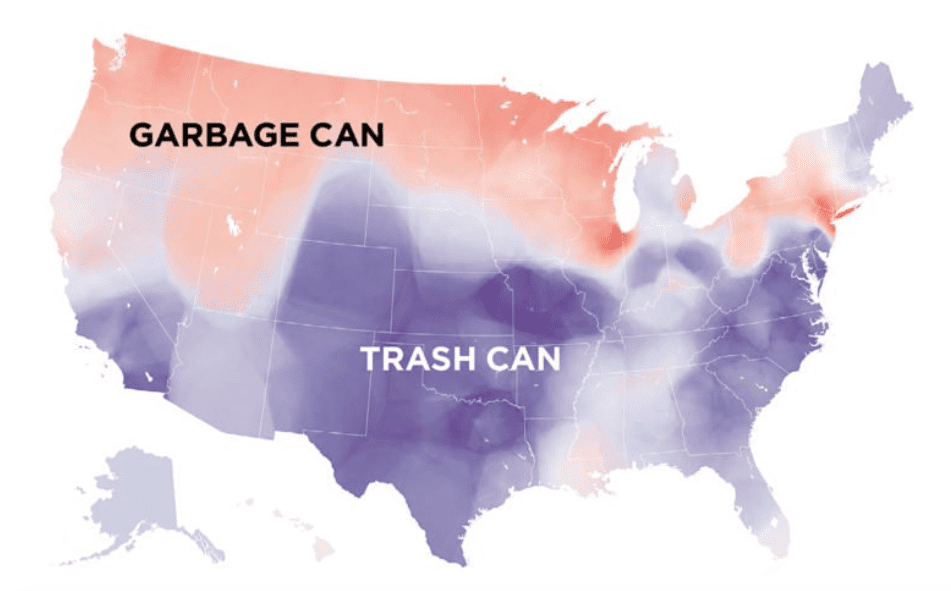
2. Where to put the rubbish?

Photo Credit: Reader’s Digest

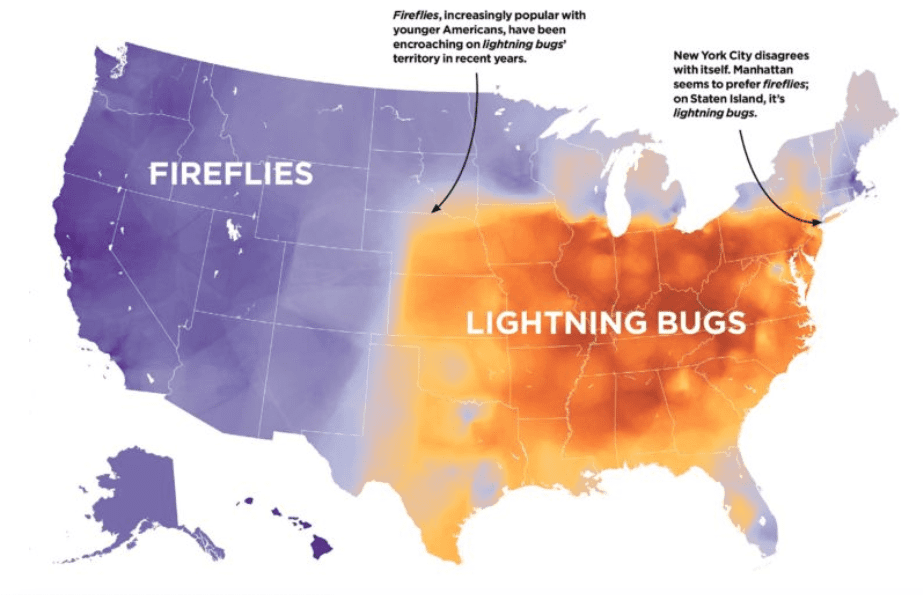
3. Which do you prefer?

Photo Credit: Reader’s Digest

4. Garage sale is dominant

Photo Credit: Reader’s Digest

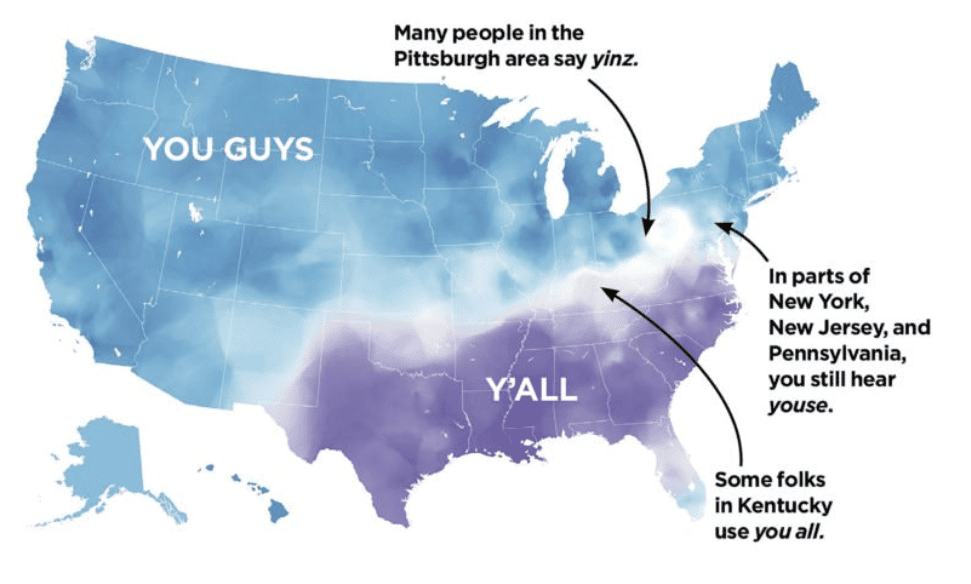
5. Hey y’all!

Photo Credit: Reader’s Digest

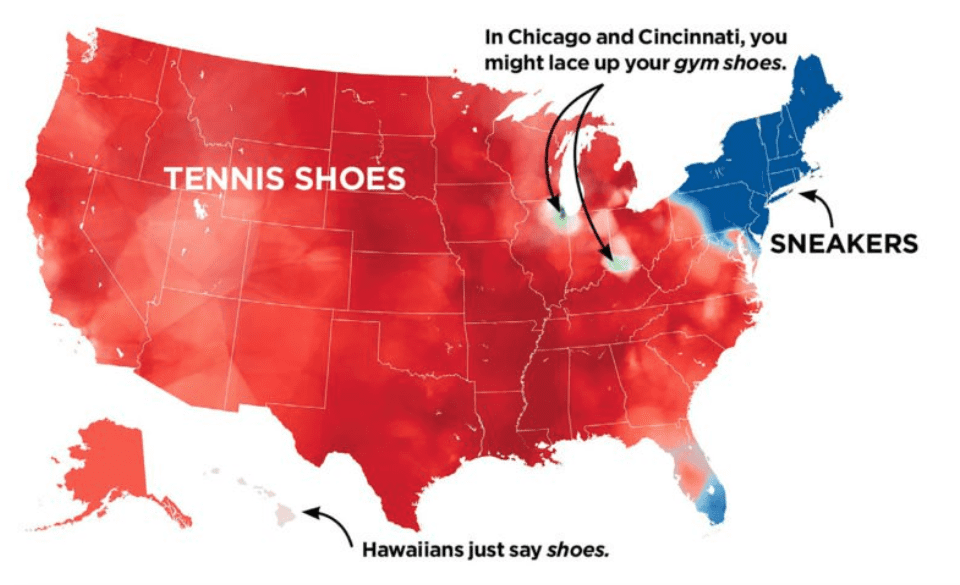
6. What do you call your footwear?

Photo Credit: Reader’s Digest

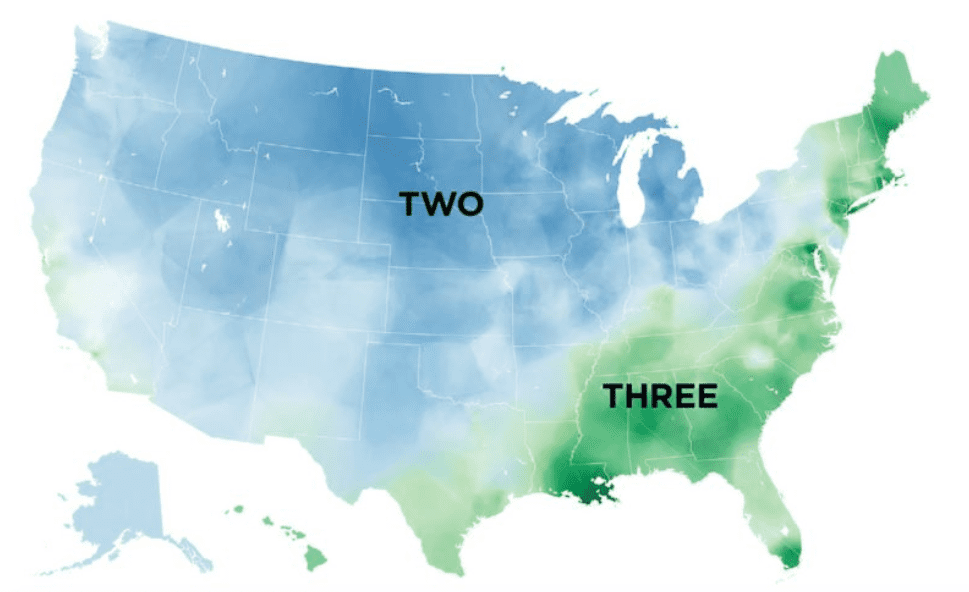
7. And finally, how many syllables are there in “caramel”?

Photo Credit: Reader’s Digest

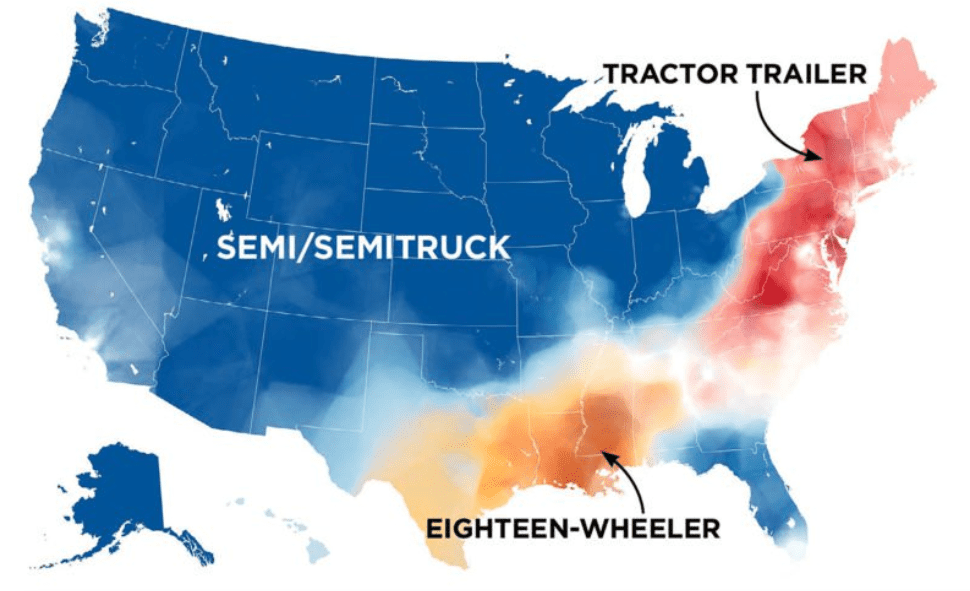
8. Eastbound and Down, loaded up and truckin’

Photo Credit: Reader’s Digest

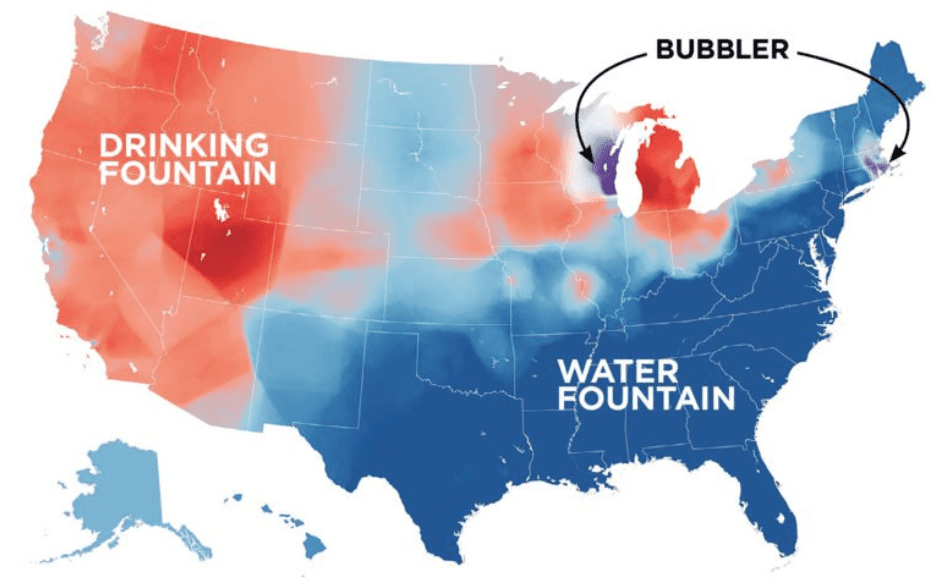
9. I love “bubbler”

Photo Credit: Reader’s Digest

Pop, soda, or Coke? That’ll really get a heated debate started…

The post Linguistic Maps Highlight How Americans Say Things Differently Across the Country appeared first on UberFacts.

Up to 50% of young twins develop…

Up to 50% of young twins develop a secret language that can not be understood by others. The phenomenon is called cryptophasia and is thought to be created to communicate when one of the twins develop language slower than the other.

American Kids Are Starting to Sound British After Watching Too Much ‘Peppa Pig’

It’s a pretty well-known fact by now that young kids love Peppa Pig. Like, a LOT.

The popular children’s show debuted in 2004, and has steadily taken over the world by indoctrinating the world’s children ever since.

Photo Credit: Entertainment One

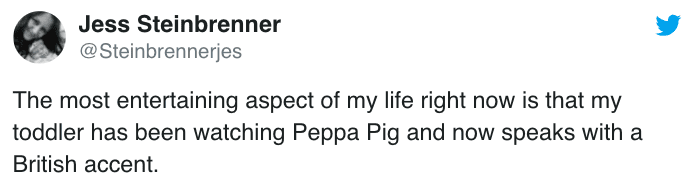
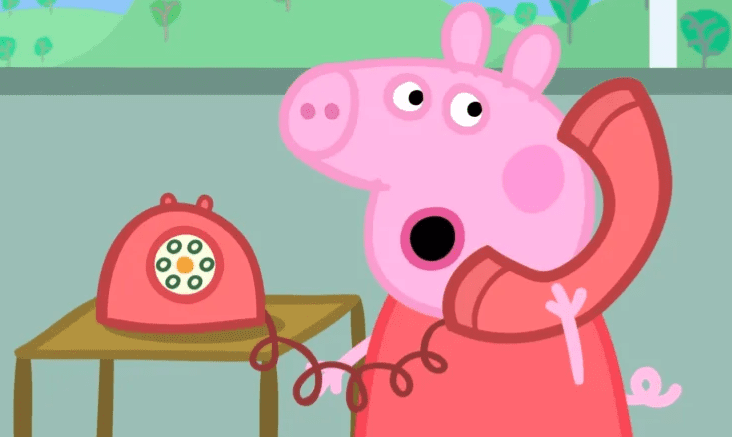
But American parents have noticed lately that there’s been one strange consequence of their kids’ watching lots and lots of Peppa Pig.

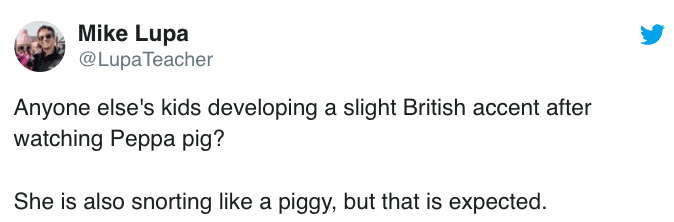
Photo Credit: Twitter

As strange as it sounds, parents in the U.S. are noticing that their little ones are developing British accents from watching Peppa Pig.

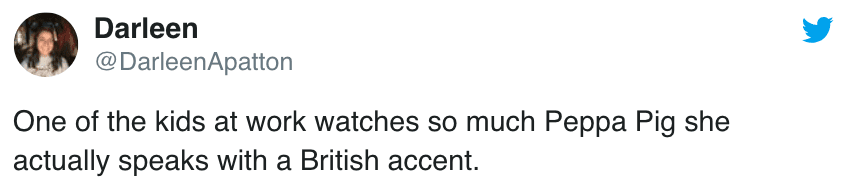
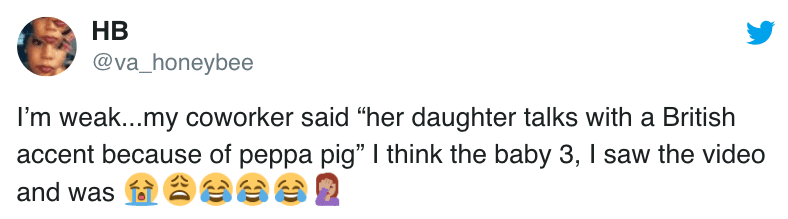
And this guy isn’t alone. Look at all these other folks who are also experiencing the same phenomenon.

Photo Credit: Twitter

Roberto Rey Agudo, language program director of the department of Spanish and Portuguese at Dartmouth College, says the British accents are weirdly prevalent among kids in the U.S. “in part because Peppa Pig has been such a phenomenon with the 2 to 5-year-old crowd and it’s considered cute, whereas I don’t know what other shows have that kind of currency right now.”

I wonder why this didn’t happen with Mr. Belvedere when I was a kid…

The post American Kids Are Starting to Sound British After Watching Too Much ‘Peppa Pig’ appeared first on UberFacts.

15 Posts That Prove Just How Weird English Can Be

It might be hard to believe if you’ve grown up with it all your life, but English is actually a pretty tough language to learn. You see, English has rules, bu it’s also got about 10 different exceptions to each of these rules, and you’d best believe you need to remember all of them. Plus, English at this point has borrowed words and structure from so many other languages that it’s hard to enforce a standard set of rules anyway. The result is a true mish-mash that makes zero sense, and these posts prove it.

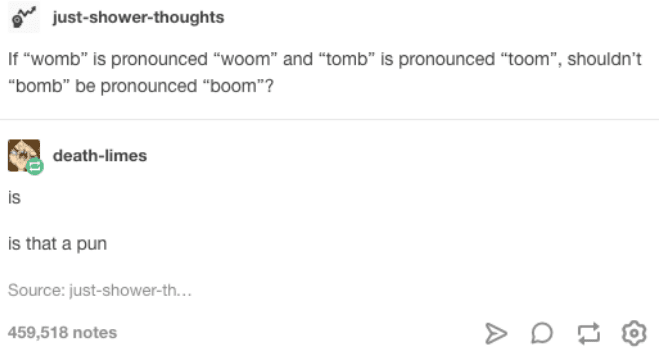
15. Very punny

Photo credit: Tumblr

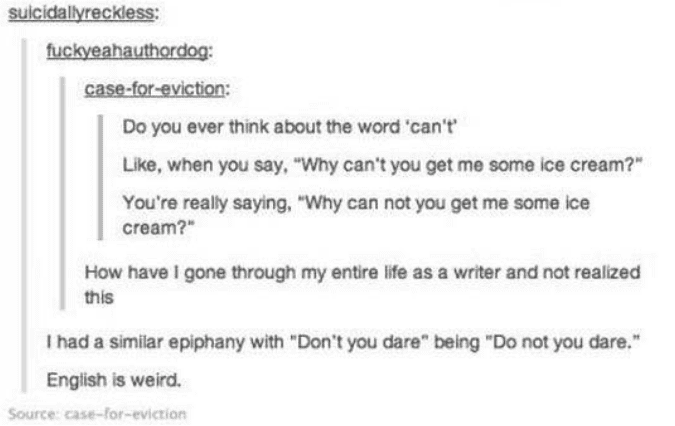
14. Do not you dare

Photo credit: Tumblr

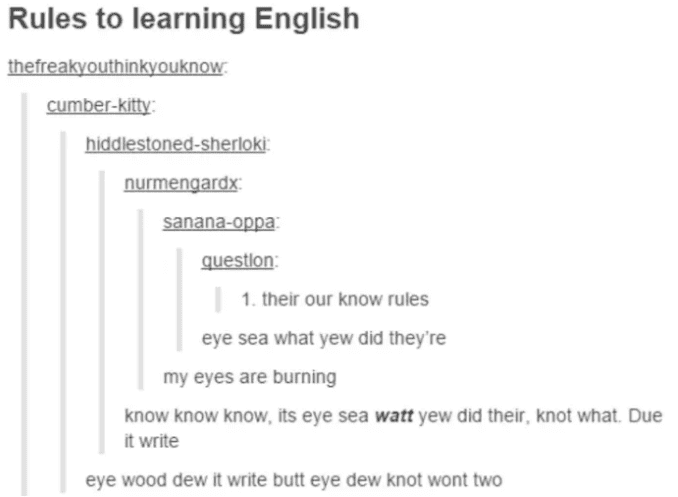
13. It burns

Photo credit: Tumblr

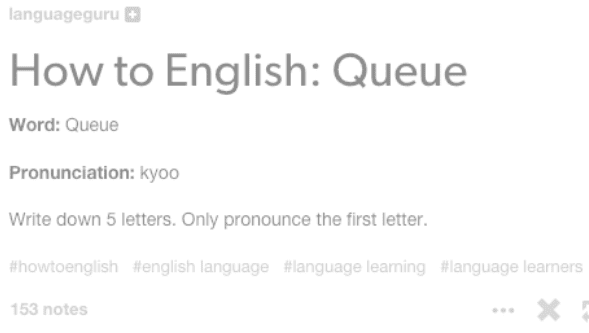
12. Q

Photo credit: Tumblr

11. What have you done?

Photo credit: Tumblr

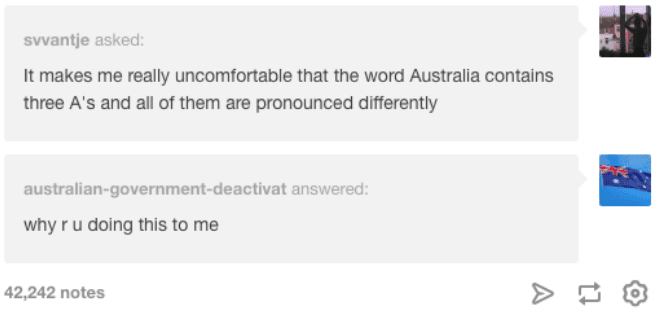
10. I’m looking at you, Australia

Photo credit: Tumblr

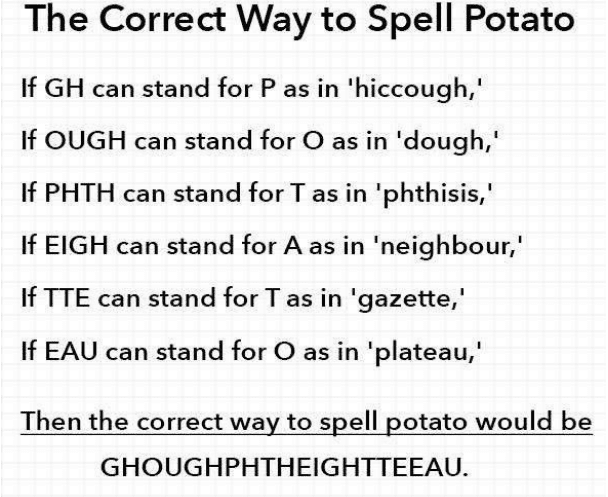
9. Potato

Photo Credit: Twitter

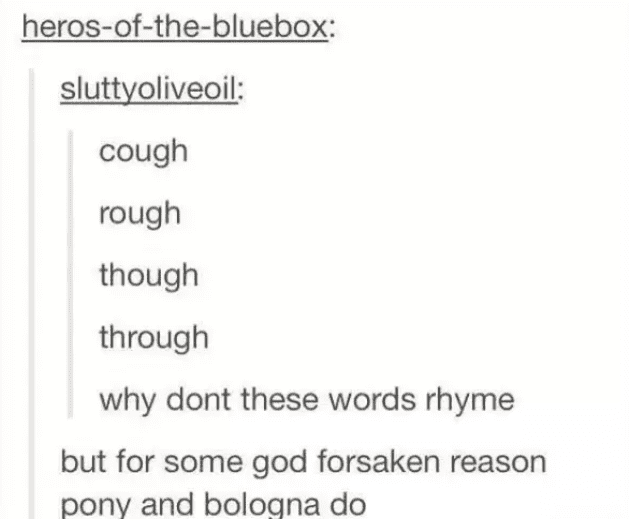
8. Why?!?

Photo credit: Tumblr

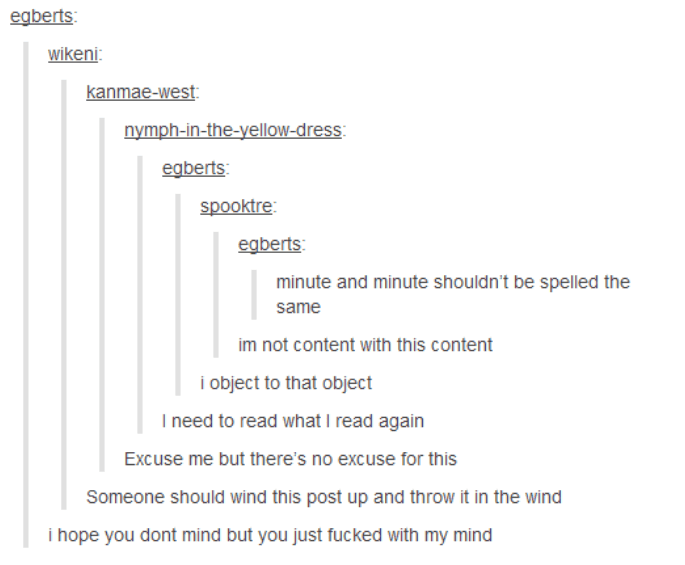
7. I object!

Photo credit: Tumblr

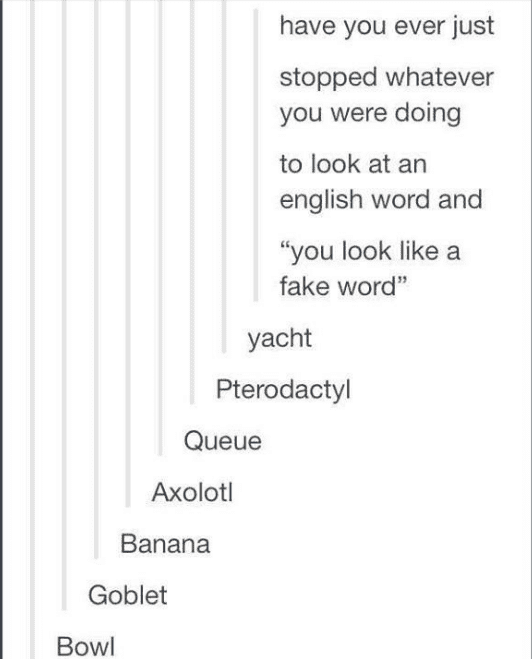
6. These can’t be real

Photo credit: Tumblr

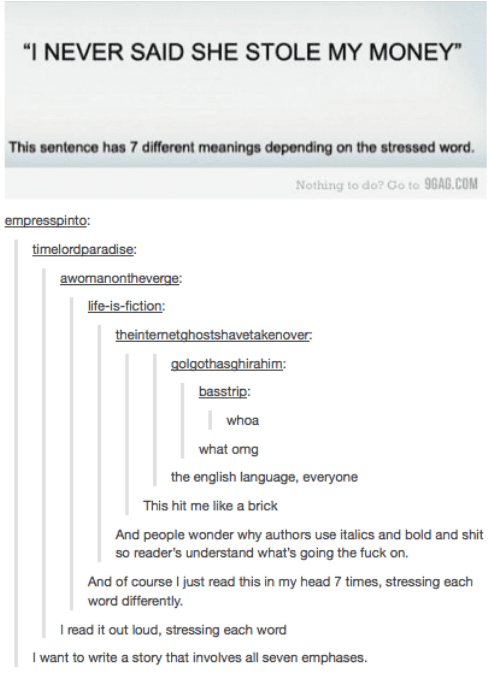
5. Seven meanings

Photo credit: Tumblr

4. So confusing

Photo credit: Tumblr

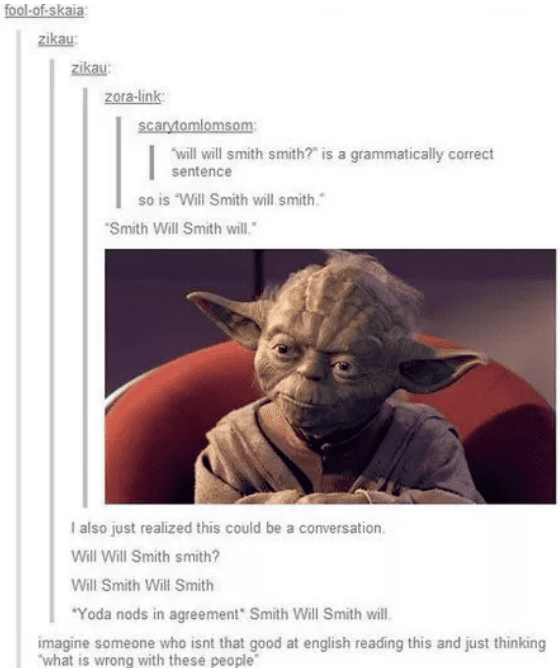
3. Will Smith

Photo credit: Tumblr

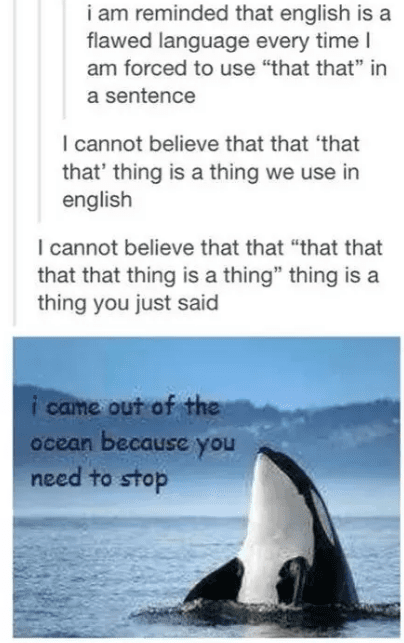
2. That that

Photo credit: Tumblr

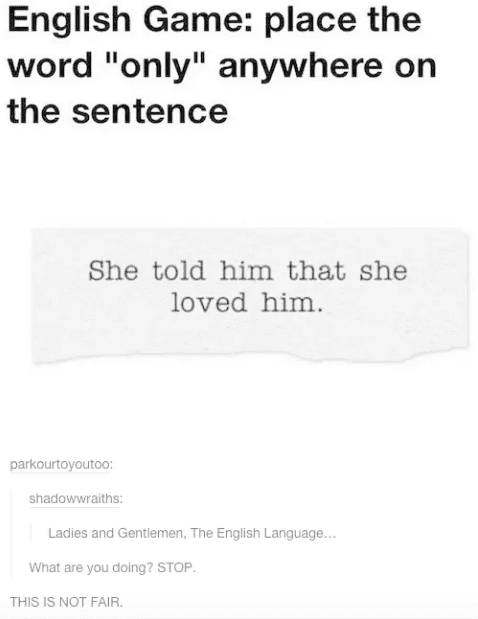
1. Just stop

Photo credit: Tumblr

Who doesn’t love language jokes, right?

The post 15 Posts That Prove Just How Weird English Can Be appeared first on UberFacts.
Older forms of English…

Older forms of English kept Latin’s gender specific suffixes -tor and -trix, -tor is for men and -trix is for women. So a male pilot is a aviator and a female pilot is a aviatrix. A male fighter is a gladiator and a female fighter is a gladiatrix. 00

Here’s Why We Call a Leg Cramp a Charley Horse

If you’re someone who gets charley horses, those tight balls of muscle that cramp in your leg, then you know how painful they can be. But what’s with the name charley horse, anyways? There’s got to be a reason behind such a strange name…

While the term’s etymology isn’t completely clear, experts believe it originated on the baseball field sometime in the 1880s.

Photo Credit: Wikipedia

There is an 1887 article in the Democrat and Chronicle that states the phrase to be well-known to baseball players but not to the average person, and the Oakland Daily Evening Tribune reported that “nearly every sporting journal gives a different version as to how the term “charley horse” originated in baseball circles.”

They believed that the likeliest origin centered around John Wesley “Jack” Glasscock, a shortstop who had strained a tendon in his thigh and gone home to his farm to heal. There, he spent time with his father and a lame old horse called “Charley horse.” Upon seeing the similarities between the two, his father supposedly said, “Why, John, my boy, what is the matter; you go just like the old Charley horse?”

Others argue the phrase has nothing to do at all with an actual horse, but the fact that an injured player limping resembles a rocking horse or child riding aside a wooden horse.

Photo Credit: Wikipedia

The New Dickson Baseball Dictionary also recounts other theories, such as players from the Orioles (or possibly Cubs) going to the races and betting on a horse named Charlie who pulled up lame in the final stretch, only to have a similar injury happen to a player the following day.

Another suggestion is whether it could possibly relate to an old workhorse that pulled a roller across the infield. According to author Tim Considine, “old workhorses kept on the grounds of ballparks were called Charley. The movements of the injured stiff-legged ballplayers were likened to the labored plodding of these old horses, and the injury itself eventually became known as a ‘charley’ or ‘charley horse.’”

Photo Credit: Pixabay

Though no one knows for sure exactly where the turn of phrase comes from, it’s a pretty safe bet that you can thank a vintage ballplayer the next time you feel silly hopping around on one leg moaning about horses in the middle of the night.

Bonus points if you’re pregnant.

The post Here’s Why We Call a Leg Cramp a Charley Horse appeared first on UberFacts.
Since the 1300’s, the pronoun…

Since the 1300’s, the pronoun “thou” was actually considered more informal and even derogatory than the pronoun “you.” This is also why its usage began declining in the 17th century; it was considered “impolite.” 00

How Did the English Language End up with Their/They’re/There?

It’s one of the most common mistakes in the English language, and it drives a lot of people up the wall. If you’ve ever read a rant by someone on Facebook or Twitter, chances are you’ve seen them misuse their/they’re/there. But how did it end up that way?

Photo Credit: Pixabay

It all started with Old English. The word for “there” was spelled þǽr (thǽr). The Old English word for “their” was hiera, so no one was having any trouble telling those two apart. When Scandinavians started coming to the British Isles around the year 1000, the locals started incorporating their words into English. One example is their word for “their”, þaire (thaire). Now there were two words that were similar, but had different spellings and pronunciations.
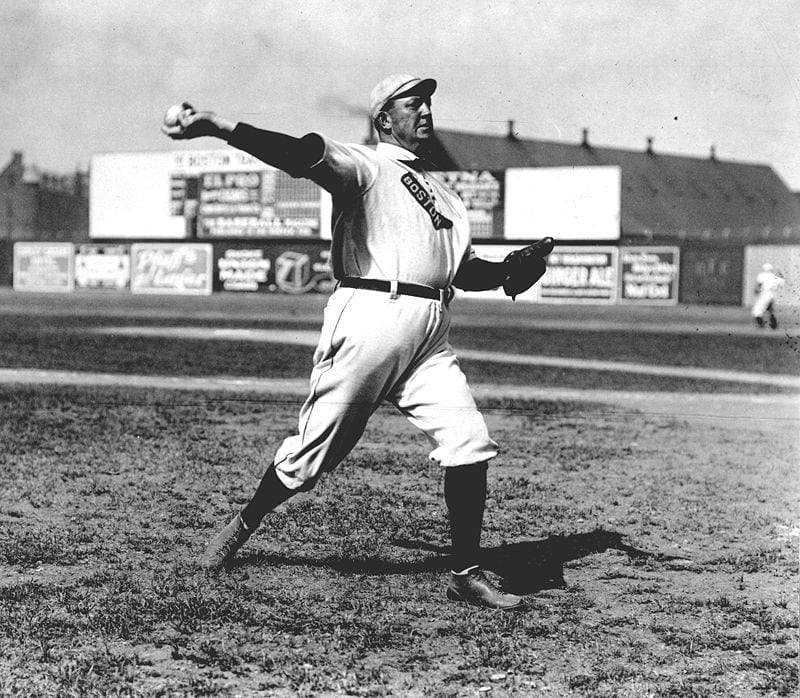
Photo Credit: Public Domain

Over the next several centuries, the English language was standardized somewhat through more development and the invention of the printing press, which led to higher literacy levels.

Photo Credit: Public Domain

“There” changed spellings many times, including thar, thaire, ther, yar, theer, thiar, and thore. “Their” was alternately spelled as thayir, thayre, yaire, and theer. Over hundreds of years of changed spellings, we ended up with two words spelled differently with the same pronunciation. And then there was “they’re” (confused yet?). Contractions weren’t written like this until the late 16th century, and “they’re” naturally became the short spelling for “they are.” So English speakers ended up with three words that all sound the same but have different meanings.

Thanks a lot, ancestors.

The post How Did the English Language End up with Their/They’re/There? appeared first on UberFacts.