
South Dakota reportedly paid an advertising firm $449,000 to develop its new anti-meth campaign. The firm came up with the slogan, “Meth. We’re on it.” The public reaction, so far, hasn’t been kind.
Instagram Gets Fooled by a Fake “Influencer”… Again
Right now, we live in a very strange world. People are famous and wealthy for doing almost nothing except knowing how, when, and where to take a photo and post it to social media. Very odd…
A construction worker named Omar asked his daughter what an “influencer” is, and after she explained the (pretty ridiculous) reality behind this phenomenon, Omar said “Pssh, I could do that!”
And he did: He started his own Instagram account with carefully curated photos of his everyday life.
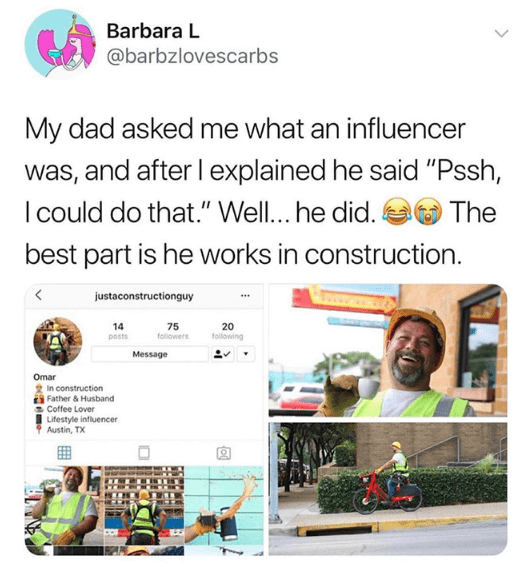
Photo Credit: Twitter,barbzlovescarbs
Omar posted his first photo on May 3, 2019, and his numbers have gone through the roof. As of this writing, Omar has 435,000 Instagram followers. I’d call that a success, wouldn’t you?
Take a look at Omar’s pics and maybe pick up some tips on how you can become an influencer yourself.
PS: Read all the way until the end for an important update on this viral, trending story. It turns out that all is not as it seems…
1. On the job


2. A delicious cup of coffee
 coffee.
3. Pinkies up


4. Blowtorch

5. The splash
 #InfluencerProblems
6. More coffee

7. Stogie time
8. Here I am

Update: it turns out that Omar and his Instagram persona are just a marketing ploy by an ad agency to sell coffee.
Cuvée Coffee in Austin, Texas, to be exact. If you go back and look through “Omar’s” photos, there are quite a few coffee pics in there and they’re all tagged the same location.
Duped again!
Mike McKim, the owner of Cuvée Coffee, said, “The whole idea was what we always thought as an influencer, and what we used as an influencer in the past, they don’t always fit our brand. We need a different type of influencer: a hard-worker, blue-collar guy.” So McKim worked with a marketing company to create the Omar character and the ad campaign.
I wish Omar was real, but this is still a pretty clever marketing ploy, I must admit.
The post Instagram Gets Fooled by a Fake “Influencer”… Again appeared first on UberFacts.
Back in 2002, computer game maker…
Back in 2002, computer game maker Acclaim Entertainment announced that it planned to advertise its newest game, ShadowMan2, by paying families for the right to place small billboards on gravestones. The amount paid would be proportional to how visible and well-placed the gravestone was. The company suggested that its scheme might “particularly interest poorer families.” […]
In 1993, an American company proposed to build a giant advertising…
In 1993, the American company Space Marketing Inc. proposed to build a giant advertising billboard in outer space that would appear roughly the same size and brightness as the moon. The project didn’t meet funding and inspired a bill to ban all advertisement in outer space.
In 1967 Canadian Club whisky launched their…
In 1967 Canadian Club whiskey launched their “Hide A Case” ad campaign. Cases of CC were hidden in exotic locations such as Mount Kilimanjaro, Angel Falls, Mount St. Helens, and the Swiss Alps. A small number of cases, such as one hidden above the Arctic Circle have never been found.
A New York ad agency tried marketing laundry detergent to Arab consumers through the use…
A New York ad agency tried marketing laundry detergent to Arab consumers through the use of sequential pictures showing laundry being cleaned. However, the advertisers didn’t realize Arabic was read from right to left and their ad actually depicted the detergent soiling the clothing after wash.
In that Quebec, Sweden and Norway it is illegal to advertise to children. This to…
In that Quebec, Sweden and Norway it is illegal to advertise to children. This to keep companies from encouraging children to beg their parents for stuff.